
A booking can look reassuringly simple: choose a place, confirm the dates and look forward to the trip. In March 2020, that familiar sequence broke apart.
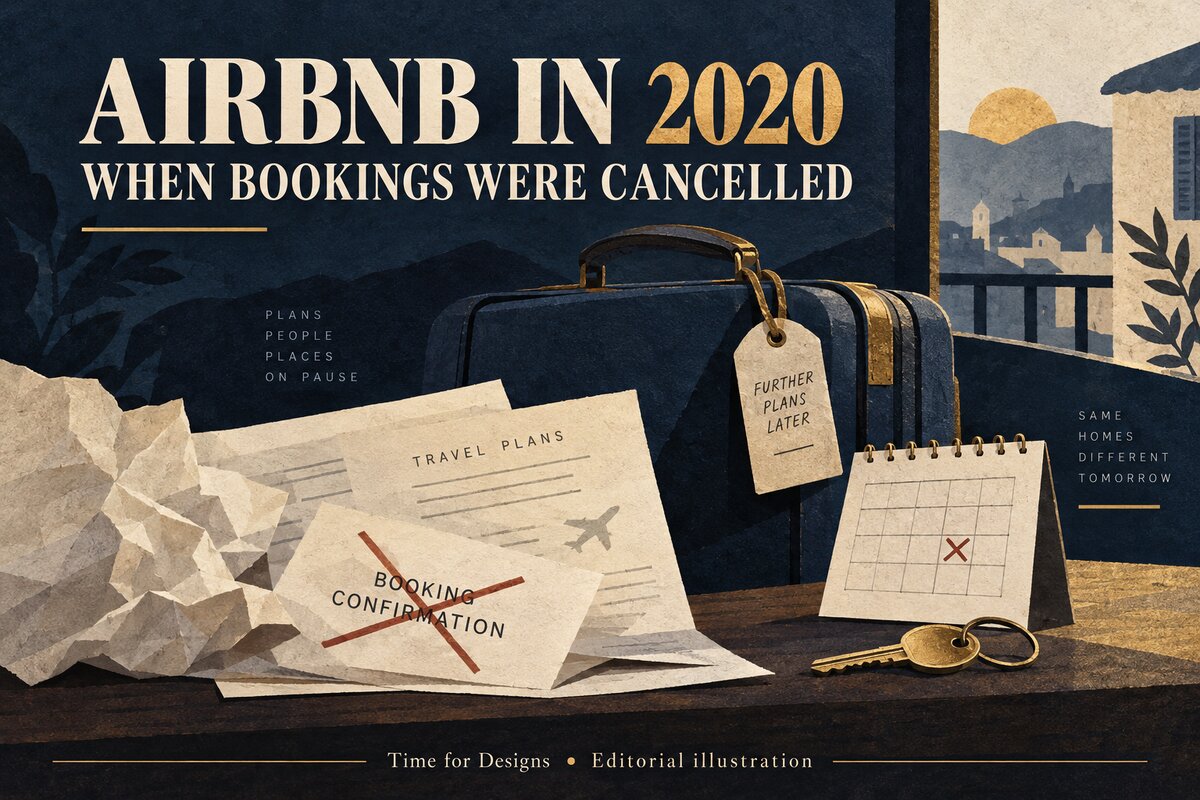 Original AI-generated editorial illustration by Time for Designs, not Airbnb campaign artwork or a real booking record.
For Airbnb, a cancelled stay involved more than one disappointed customer. There was a guest who wanted money back, a host who had expected income and a platform whose decisions affected both. A message that reassured one side could create a new problem for the other.
That makes Airbnb’s pandemic experience a more useful branding story than a list of businesses that supposedly “thrived”. The documented record contains apology, financial support, job losses, a narrower business focus and a changed invitation to travellers. It also contains results that were better than an early forecast but still substantially below the previous year.
This is not a story about a clever campaign solving a crisis. It is about a business discovering that the meaning of its promise depended on what happened when the promised experience could not take place.
A marketplace had two different versions of the same cancellation
On 17 March 2020, Airbnb’s founders addressed hosts in a public message. They explained that the company had introduced a global policy allowing guests to cancel eligible reservations for a full refund, including Airbnb fees. The message acknowledged hardship for hosts and said the decision was intended to avoid pressure on guests to travel in unsafe circumstances. That was the company’s stated reasoning; it is not a health recommendation from this article. The dated message to hosts establishes what Airbnb said at that stage.
The word “eligible” matters. This was not a promise that every reservation, whenever made and for any future date, could be cancelled on identical terms. Reading a crisis announcement as an unlimited guarantee would create a different claim from the one being documented.
Even within its stated scope, the choice exposed a difficult relationship. A guest could view a refund as the reasonable correction to a trip that could no longer proceed. A host could view the same cancellation as the removal of expected income under a booking agreement.
Those are different positions in the same transaction, not proof that either side had one universal response. The public message cannot tell us what every guest or host experienced. It does show why a single reassuring sentence was unlikely to explain the whole situation.
Airbnb’s brand existed between these groups. It needed places people could offer and guests willing to book them. Communicating only to one side would not make the other side disappear.
The apology concerned how the decision was communicated
A later letter made the communication issue explicit. In the UK newsroom version, dated 31 March 2020, Brian Chesky apologised for communicating the refund decision to guests without consulting hosts. He described hosts as partners and acknowledged that the company could have acted more like one. The letter also announced a US$250 million support commitment. For qualifying cancellations with check-in between 14 March and 31 May, Airbnb said it would pay hosts 25% of what they would normally receive under their cancellation policy. Payments were announced to begin in April. The letter sets out the apology and proposed support.
The important detail is not just the size of the fund. It is the basis of the percentage. A quarter of the amount a host would normally receive under a cancellation policy is not necessarily a quarter of the entire booking price.
The distinction is easy to lose in a headline. Yet it is precisely the information an affected person would need to understand the offer. A large total commitment can sound generous or inadequate in the abstract; the individual calculation depends on the stated terms.
There is another boundary to preserve. This letter establishes what the company announced. It does not independently establish that every eligible host received the expected payment, or that the support restored everyone’s confidence.
That restraint makes the story clearer rather than weaker. We can identify the action and its terms without turning a company statement into a complete account of every outcome.
A promise became an operational question
“We are partners” is a relationship claim. In an ordinary period, it may sit comfortably beside welcoming photographs and encouraging copy. During disruption, people can ask what that relationship requires in practice.
Who is consulted? Who receives the explanation first? Who carries the cost when a confirmed arrangement changes? What can the affected person reasonably expect next?
Those questions are our interpretation of the episode, not evidence that one communication decision alone determined Airbnb’s fortunes. They explain why the apology is more interesting than a polished expression of sympathy.
Its subject was a process: the business had communicated a consequential decision without first consulting the group it described as partners. That places the issue inside the way the service worked, not merely inside the wording of a campaign.
A revised paragraph can make a policy easier to understand. It cannot, by itself, change who bears its consequences. Trust depends partly on the relationship between the language and the action underneath it.
By May, the company was making itself smaller
On 5 May 2020, Chesky announced that nearly 1,900 of Airbnb’s 7,500 employees would leave, approximately 25% of the workforce. His message said the company forecast revenue for the year at less than half its 2019 level. It also described a more focused business: efforts in Transportation and Airbnb Studios would be paused, while investment in Hotels and Lux would be scaled back. These were decisions and expectations stated at the time, not a retrospective description of the eventual annual result. The May message records the announcement.
A later account of recovery can make this period look like a confident turning point. The contemporary document is more unsettled. The company was telling employees that it could not continue everything it had been doing.
Job losses should not become a decorative detail in an uplifting business story. They were a major consequence of the crisis. Naming the reported scale is appropriate; inventing individual experiences or declaring the decision painless would not be.
The narrowing of activity also complicates the usual language of “pivoting”. A pivot can sound like adding a new idea while the old organisation remains intact. Here, the public announcement included stopping or reducing activities as well as changing direction.
That is a more demanding kind of focus. It requires choosing what the business will not continue, rather than merely finding a new message for everything it already does.
The invitation changed from distant possibilities to nearby stays
In June, a different public message appeared. Airbnb’s Australian and New Zealand newsroom announced its Go Near initiative on 11 June 2020. It described planned app and homepage changes that would feature local trip ideas, nearby getaways and last-minute stays, alongside an email and social campaign. The company connected the initiative to patterns it reported in bookings and commissioned research in those markets. The regional announcement explains the proposed customer experience.
The geographical scope is important. Australian and New Zealand findings should not be silently turned into measurements of Irish customers or the whole world. Nor does a statement about booking patterns establish that the campaign caused those patterns.
What the announcement does establish is a concrete change in presentation. Nearby options were to become easier to discover within the product, not simply mentioned in an advertisement somewhere else.
That creates a useful connection between marketing and website design. If the message introduces a particular kind of stay, the destination should help the visitor find that kind of stay. Otherwise, the business has created an invitation and left the customer to solve the next step alone.
Our interpretation is that Go Near made a changed customer question visible: not only “Where would I love to go?” but “What options are closer to home?” The announcement does not prove how much extra business that presentation generated. It shows the question the company chose to organise around.
A shorter journey was not the same thing as a recovered business
It is tempting to take an encouraging campaign name and use it as the turning point that explains everything afterwards. That would make this story neater than its evidence allows.
An interface change, a shift in travel patterns, cost reductions, financing and the wider conditions affecting travel are different parts of the account. Without evidence separating their effects, we cannot assign the eventual result to one headline or homepage.
This is where many brand case studies become misleading. They move directly from “the company did this” to “the company later improved”, treating the order of events as proof of the cause.
The more useful history keeps the sequence but does not manufacture the missing experiment. We can document what changed. We can document reported results. We cannot claim that everything between them has been explained.
That leaves room for the real design lesson: a message should connect to something a customer can actually find and use. The lesson does not require an invented percentage uplift to be worthwhile.
The rules were still being revised later in the year
On 24 September 2020, Airbnb announced further cancellation-policy changes after consultation with hosts and guests. It said the revised approach would apply to reservations beginning on or after 20 January 2021, excluding Luxe reservations, which had a separate policy. It would not change the treatment of COVID-19-affected reservations booked on or before 14 March 2020. The announcement also discussed planned travel-insurance options. The September record shows that the policy conversation continued.
These are historical dates and announcements, not a guide to Airbnb’s current cancellation or insurance arrangements. A reader making a booking now must not use an old article as current terms.
For the story, the significant point is that the problem did not end with one apology or one fund. The company continued adjusting how cancellations would be handled and communicated.
That makes the episode less like a campaign with a clean finish and more like a service being rebuilt while circumstances remained uncertain. The terms were part of the experience, even when they were less visually attractive than the travel imagery.
The year-end result was better than the forecast, not better than the previous year
Airbnb’s fourth-quarter and full-year 2020 shareholder letter reported approximately US$3.4 billion in annual revenue, down 30% from approximately US$4.8 billion in 2019. That was better than the earlier expectation that revenue could fall below half the previous year’s level. The same document reported a US$4.6 billion annual GAAP net loss and explained that major non-cash charges associated with its initial public offering and warrants affected the result. The shareholder letter filed with the SEC contains both the recovery framing and the financial qualifications.
These distinctions prevent two opposite simplifications. The company did not achieve higher annual revenue than in 2019. Equally, the reported net loss should not be described as though it consisted entirely of cash lost through cancelled travel.
The figures are historical company results, not investment guidance. Their purpose here is to keep the narrative honest.
“Better than feared” and “better than before” answer different questions. A business can show resilience against an earlier expectation while still having a difficult year. An account that calls it an uncomplicated pandemic winner would conceal that difference.
The branding lesson is inside the booking
At Time for Designs, our interpretation of this episode is that branding becomes most revealing when the normal transaction breaks down.
A familiar identity can help a person recognise a business. An appealing page can encourage them to consider its service. But when dates change or delivery becomes impossible, the practical information starts carrying more of the relationship.
What happened? Which arrangements are affected? What action is available? What has been promised, and what remains uncertain?
Airbnb’s story is unusually large, but those questions are not exclusive to a global marketplace. They can arise whenever a business accepts work that depends on dates, availability or somebody else’s part of the service.
This is not a recommendation for a particular refund policy. Different arrangements require their own assessment. The communication principle is narrower: explain the real options clearly, keep the terms attached to the promise and avoid presenting an announcement as proof of its eventual outcome.
The photographs and headline still matter. They should lead into an experience the business can explain and fulfil, rather than offer reassurance that its operating decisions cannot support.
Why “pandemic winner” is the less interesting description
The most revealing parts of this history are the tensions: a refund that reassured guests while affecting hosts; an apology about consultation; support defined by a specific calculation; a smaller organisation; nearby stays brought into the interface; and an annual result that improved on a forecast without exceeding the earlier year.
Calling Airbnb a winner or loser would not explain those tensions. It would replace the story with a verdict.
The better question is what the company changed when its ordinary promise could not be delivered as expected. The public records show that the answer involved policy, money, people, product presentation and communication together.
A brand did not escape the transaction. It had to operate inside it.
Sources and scope
This account uses Airbnb’s dated messages, regional campaign announcement, policy update and SEC-filed shareholder letter. Company intentions, forecasts and explanations are attributed; they are not independent evidence that every affected person was satisfied. The practical interpretation is Time for Designs’ own. Historical financial figures are in US dollars. This is not health, travel, insurance, legal or investment advice, and it does not describe current booking terms.