
A company can sell someone a motorcycle. Organising what happens after the purchase is a different undertaking.
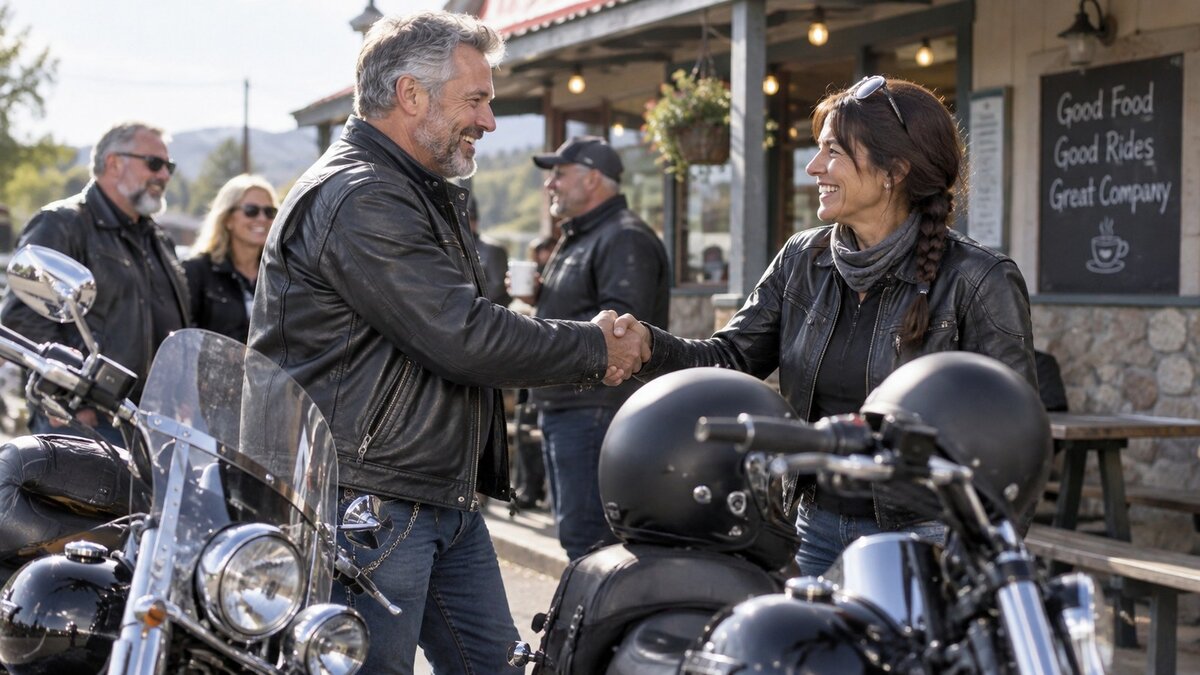 Original AI-generated editorial illustration by Time for Designs. The riders, roads and map are conceptual, not photographs of a H.O.G. event or evidence of guaranteed loyalty.
That is the useful question behind Harley-Davidson’s owners group. The familiar version of the story describes a brand so powerful that customers become a devoted community. It sounds impressive, but skips the practical work: how do people find one another, decide what to do and take part?
The documented beginnings of the Harley Owners Group, usually shortened to H.O.G., offer a more interesting answer. The organisation was not born as a perfectly finished theory of belonging. Practical services came first; local participation became more important as the programme developed.
For anyone interested in branding, that distinction changes the lesson. A shared mark can make a group recognisable. It cannot, by itself, provide a reason to join in. The story is about the structure behind the symbol—not proof that a badge creates permanent loyalty.
The early idea was more practical than the legend
In Harley-Davidson’s published account of H.O.G.’s beginnings, founder Steve Piehl recalls receiving the assignment in September 1982. The initial concept focused on services connecting owners to the company. Early benefits included breakdown recovery and a theft-reward programme. A membership pack contained a pin, patch, card and Touring Handbook, which listed dealerships to help riders plan journeys.
Piehl says the social aspect received less attention initially. Dealers subsequently asked to organise local groups, and he recalls the chapter approach being introduced by late 1983. This is a participant’s retrospective published by the brand, not an independent evaluation of the programme’s results.
The details make the story tangible. A handbook answers a particular question: where can I find a dealership during a journey? A local group answers another: who can I ride with nearby?
Neither requires us to invent an emotional response for every owner. The organisation offered things someone could inspect and use.
A reason to own is not automatically a reason to participate
People can buy the same product without wanting the same relationship with its manufacturer. One buyer may prefer to use it privately. Another may enjoy organised activities. A third may want practical information but little social involvement.
This is a useful distinction for interpreting any brand community. Ownership describes a transaction or possession. Participation describes an action. Neither tells us everything about how someone feels.
A group therefore needs to answer a different question from the product advertisement. The advertisement explains why the item might suit the buyer. The group needs to explain what the person can do after joining.
Our reading is that H.O.G.’s practical arrangements matter as much as its badge. The design challenge is not only to make membership attractive. It is to make the next step clear.
Where is the group? What happens there? How would a newcomer take part? A recognisable emblem may help someone find the invitation, but those answers make the invitation usable.
The dealership became a local connection
Harley-Davidson’s official chapter information describes dealership-sponsored groups and activities including rides, rallies, trips and charitable events. Its FAQ says local chapter membership is optional and that a person can belong to more than one chapter. It also directs prospective participants to contact a chapter about trying a meeting or event.
These are descriptions of the programme’s structure, not a promise that every chapter provides an identical experience. They nevertheless reveal something important: participation has a local destination and a route into it.
That is different from telling a customer that they are already part of a community merely because they bought a product. An organised activity gives the idea somewhere to happen.
The location also makes the relationship easier to picture. A global brand can be abstract. A nearby group, a contact person and an event are specific.
For a smaller business or organisation, the transferable question is not whether it can reproduce Harley-Davidson’s network. It is whether its own invitation leads to a real, manageable activity rather than an impressive description with no next step.
Organisation is the less glamorous part of branding
Branding is often discussed through the things that can be photographed: the logo, clothing, signs and merchandise. Those things can matter. They are not the whole experience.
A hypothetical group could have excellent shirts and a beautifully designed event page while leaving basic questions unanswered. Where should a new participant arrive? Is registration required? Who can explain the activity? What happens if arrangements change?
This is an illustrative example, not a claim about H.O.G. or a Time for Designs customer. It shows why visible coordination and useful organisation should not be confused.
The design should carry the information people need. The organisation should be able to deliver what that information promises. If one is missing, the other has to work harder without necessarily solving the problem.
Our practical interpretation is that an invitation is a small service in its own right. It helps someone move from interest to an informed decision about taking part.
The badge identifies a relationship; it does not explain it completely
The early membership pack included wearable identifiers. That offers a natural connection between the H.O.G. story and the wider subject of branded clothing.
A mark on a garment can identify a group. It cannot tell an observer the wearer’s entire history, level of involvement or future intentions.
Marketing stories often use a visible logo to claim something about how people feel. But a wearer may be an active member, an occasional visitor, a collector or simply someone who likes the item.
Without further evidence, we cannot choose the explanation for them.
For an organisation preparing group clothing, the more useful design question is what the garment needs to communicate. Is it identifying an event, a team, an organiser or a general association? Does the wording help others recognise the role?
There is no need to promise that clothing manufactures belonging. It can perform a clear communication job while the group’s activities establish their own value.
The programme did not remain frozen in its founding period
On 20 June 2023, Harley-Davidson announced H-D Membership, describing it as building on H.O.G.’s forty-year history. The announcement included riders and non-riders, digital profiles and groups, ride planning and rewards. It said the launch would begin in the United States before further regional rollout.
Those are dated announcement details, not a current Irish benefits guide or evidence that every planned feature achieved its intended effect. They show the company expanding how it presented participation beyond ownership of a motorcycle.
The interesting branding question is how a long-established identity can support a broader invitation. A programme known through owners has to explain what a wider audience can do without making the older relationship incomprehensible.
Adding a digital layer does not remove that communication task. An application still needs to help a person understand the choices in front of them.
A company can describe its community in a press release. The participant experiences the particular activity, information or interaction they encounter.
Keep the historical stages separate
It is tempting to retell a long-running programme as though every later feature was present in the original plan. That makes the history tidier and the strategy look more inevitable.
The sources here support a more useful sequence: practical owner services, a developing local chapter structure and, much later, a broader membership announcement involving digital tools.
That sequence leaves room for adaptation. It does not require the founders to have predicted every later form of participation.
For businesses, the lesson is not that plans are unnecessary. It is that a useful plan can change when the people using it reveal another need.
A customer activity should not have to fit an elaborate origin story to be worth improving. The organisation can recognise what is happening, clarify the purpose and decide whether it can support the activity properly.
Community and commercial loyalty need different evidence
A membership count, an attended event and a repeat purchase are different observations.
Someone can enjoy a group without buying another motorcycle. Someone can buy again without attending a group event. A person can remain a member while participating rarely. None of those possibilities establishes a universal explanation of customer behaviour.
This article therefore does not assign a sales increase to H.O.G., calculate its return or claim that participation guarantees retention. The sources used here describe history, structure and announced intentions. They do not isolate the programme’s commercial effect.
That boundary makes the story stronger rather than less useful. We can examine the mechanics of participation without pretending that every desirable business outcome follows automatically.
For an organisation assessing its own activity, define the question before collecting a flattering number. Are people able to join? Do they understand the event? Do they return to activities? Are suitable enquiries or orders genuinely attributable to the work?
Those questions may produce different answers. Keeping them separate prevents one encouraging result from standing in for all the others.
There is a cost to making an invitation real
An organisation promising ongoing participation needs someone to maintain it. Information changes, enquiries need answers and activities require suitable arrangements.
That is not a reason to avoid community activity. It is a reason to assess the commitment before advertising it.
A small organisation may be better served by one clear, well-managed occasion than by a permanent programme it cannot maintain. A business should not create expectations merely because a global brand has made a large community look attractive.
This is our practical interpretation, not an account of H.O.G.’s internal costs. No confidential economics or assumed margins are needed to recognise the difference between designing an invitation and fulfilling it.
The useful starting point is an activity people already have a reason to value, with responsibilities the organisation can actually carry.
Three questions behind a better group identity
What can the person do?
Replace a broad claim about belonging with a concrete explanation of participation. An event, useful information or an organised activity gives the invitation substance.
How will they find the next step?
A name and logo help recognition. Clear dates, locations, contact routes and expectations help someone act. Use both rather than asking the visual identity to do all the work.
What has actually been demonstrated?
Describe an observed activity as an activity. Do not convert it into guaranteed trust, lifelong commitment or profitable repeat business without the appropriate evidence.
These questions apply at a much smaller scale than a motorcycle manufacturer. A team, club or event can use them without copying Harley-Davidson’s appearance or pretending to reproduce its history.
The useful story is behind the emblem
H.O.G. makes an interesting branding case because its history is not only about a powerful image. It is about giving participation a practical form.
The company’s own account recalls an early emphasis on owner services and a developing response to local demand. Later official information describes ways to take part. The 2023 announcement shows another stage in how the invitation was presented.
Our Time for Designs reading is that the visible identity works best when there is something useful behind it. The mark helps identify the group; the arrangements explain what the group offers.
A business cannot purchase permanent customer loyalty by printing a badge. It can make an honest invitation easier to recognise and understand.
That is a more modest claim than unwavering devotion—and a more useful place to begin.
Sources and scope
This story uses Harley-Davidson’s published founder recollection, official chapter information and dated membership announcement. Company sources establish what the organisation says about its history and programme; they are not independent measurements of customer loyalty. The interpretation about design, participation and evidence is Time for Designs’ own. No motorcycle safety guidance, current membership pricing or guaranteed commercial outcome is offered.