
In April 1853, an MP described a peculiar problem with a book-trade publication. It could tell readers that new books existed, but, he said, it omitted the publishers' names to avoid an advertising duty.
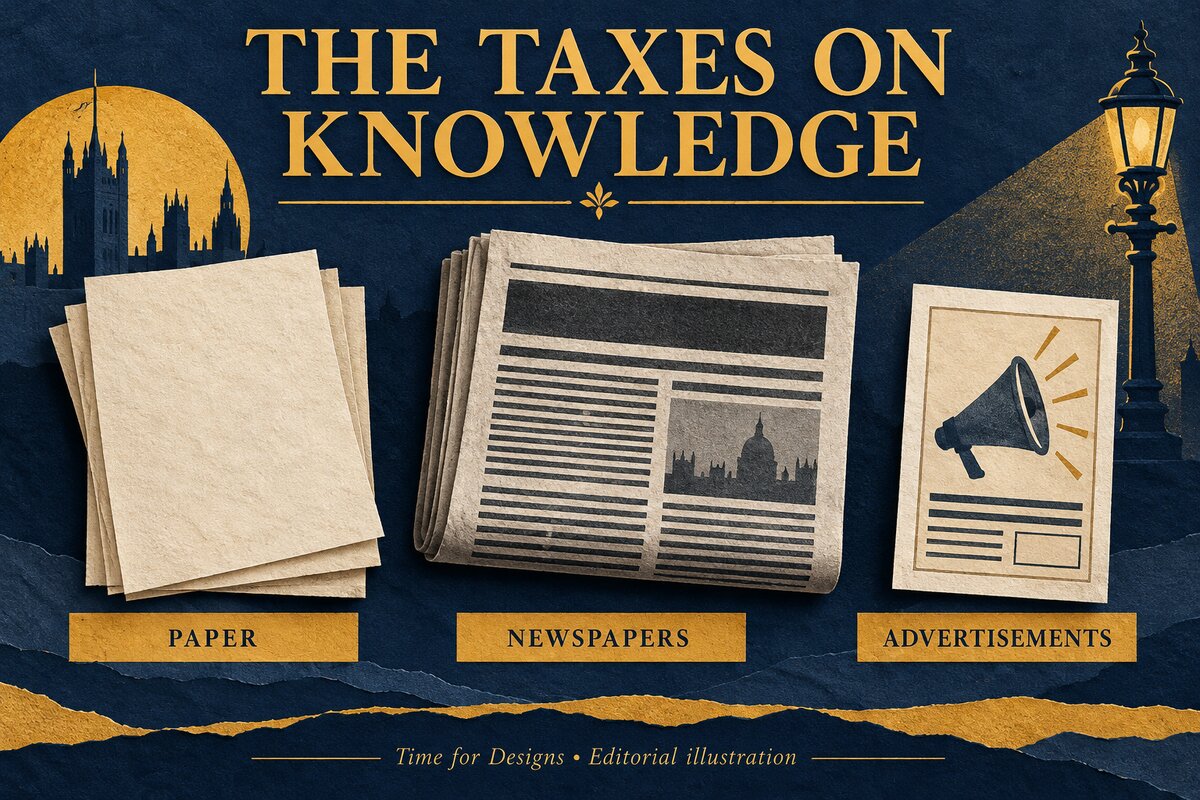 Original AI-generated editorial illustration by Time for Designs, not a historical newspaper or tax document.
The information survived. The useful route to the seller disappeared.
That example, reported in Parliament by Milner Gibson, captures the odd world of Britain's “taxes on knowledge”. Paper, newspaper publication and advertisements were subject to different duties. Reformers argued that the system obstructed learning, political information and ordinary commercial communication.
Their opponents did not all describe it that way. Some saw valuable public revenue. Others saw a payment connected with delivering newspapers through the post. Established interests, distribution arrangements and the definition of news itself became part of the argument.
The fight was not a modern trade war. It was a nineteenth-century struggle over the cost of putting information into print—and over who could afford to circulate it.
Three taxes, three points of friction
It is tempting to picture one tax on reading. That misses the structure of the dispute.
The paper duty concerned the material. The newspaper stamp concerned a particular kind of publication. The advertisement duty concerned announcements carried in print. Their effects could overlap, but repealing one did not automatically remove the others.
For a publisher, that meant the economics of a publication were connected to more than the quality of its writing. The material used, the content included and the way copies travelled could all matter.
For an advertiser, there was another question: why pay to place a message in one medium when another route might avoid the duty?
The debates make these questions concrete. MPs discussed supplements, paper, job advertisements and how to decide what counted as a newspaper. These were practical disputes, not only arguments about freedom.
Those details are the story. They reveal how a charge apparently attached to a physical object could shape what appeared on it.
The book announcement with a missing name
On 14 April 1853, Milner Gibson argued for repeal of the advertisement duty. He compared newspaper announcements with advertising through a town crier or an advertising van, and said the duty discouraged the periodical press.
He also cited the Publishers' Circular: according to his account, it omitted publishers' names from new-book announcements to escape the charge. He described even some unpaid announcements as liable to duty.
This is evidence of the case Gibson made to Parliament, not an independently audited account of every announcement or enforcement decision.
Yet his example is unusually revealing. A book's title answers “what is new?” A publisher's name helps answer “where can I obtain it?” Remove the second piece and the first becomes less useful.
For Time for Designs, that is the striking connection with communication today. Information can remain technically present while the practical next step becomes harder to find.
Gibson was not merely complaining that advertising cost money. He was arguing that the tax changed the usefulness and competitive position of a medium.
Gladstone's complication: what if the saving never reached the advertiser?
The counterargument was more interesting than a simple refusal to lower taxes.
In his Budget speech on 18 April 1853, Chancellor William Ewart Gladstone proposed reducing the advertisement duty rather than removing it entirely. He also addressed stamps on newspaper supplements.
His concern was that removing the advertisement charge alone might benefit newspaper proprietors without reaching advertisers. Additional advertising could require additional sheets; charges on supplements could still restrict the space available.
He proposed a package rather than treating the advertising charge as an isolated lever.
That makes the argument unexpectedly modern in its structure, although the taxes themselves belong to their historical setting. A lower cost at one point in a supply chain does not, by itself, establish a lower price at the end.
The printer must produce the extra space. The proprietor must decide what to charge. The advertiser must decide whether the placement is worthwhile.
Gladstone's prediction should remain a prediction. His speech does not prove that full repeal would have been pocketed by newspaper owners. But it does show why the argument was about the whole publishing arrangement, not just one number.
July 1853: sixpence or nothing?
The disagreement continued. In the 1 July 1853 advertisement-duty debate, Gibson objected to a proposed sixpenny charge. He argued that a reduction would preserve the unequal treatment of newspaper advertising and competing forms of publicity.
The recorded divisions give this part of the story a clear turning point. Keeping “sixpence” in the proposed resolution was defeated by 68 votes to 63. The amended zero-duty resolution then passed by 70 to 61.
These are committee votes, not a reason to confuse a resolution with the final enactment. The advertisement duty was abolished in 1853; by the 1855 newspaper-stamp debates, MPs referred to its abolition as an accomplished change.
Notice how narrow the votes were. The familiar three-date summary of the reforms can make their outcome seem inevitable. The proceedings show something less tidy: proposed compromises, objections to how decisions were being taken and small majorities at an important stage.
Public communication did not become cheaper because everyone agreed that it should. Reform required arguments about revenue, fairness and what different forms of advertising were allowed to do.
The next problem: what counted as news?
Removing the advertisement duty left the newspaper stamp.
In the 26 March 1855 debate, MPs discussed the difficulty of applying the existing law. One response was repeal of the compulsory stamp; another was to define more clearly what counted as a newspaper.
The debate also records an objection to dispensing with registration and declaration requirements. The objector associated those arrangements with protection against attacks on private character and with standards of publication.
That is a different concern from the price of paper. It asks who is accountable for a publication and what safeguards should accompany the circulation of news.
It also exposes a difficulty with a content-based boundary. Publications do not always fit neatly into categories. A periodical may carry literature, useful information, advertisements and accounts of current events together.
The classification question mattered because the consequences were material. The decision was not simply which shelf a publication belonged on. It could affect its obligations and cost.
We should not turn every concern expressed by an opponent into an excuse for censorship. Nor should we accept every reformer's claim as an established effect. The sources show a contest over what the law did, what it was intended to do and what should replace it.
The stamp also bought a journey
The postal connection makes the story harder—and better.
On 23 April 1855, the Chancellor explained the proposed change as removal of the compulsory stamp, not a general lowering of its rate. The debate examined transmission and retransmission through the post, including the practical difficulty of checking stamped papers.
A newspaper could be a printed product and an object moving through a distribution system. Those two functions were linked.
In the Lords debate on 24 May, defenders of the existing arrangement stressed postal privileges and revenue. One speaker argued that some proprietors valued the stamp as a return for those privileges rather than regarding it as a tax on knowledge.
That claim is an opponent's account, not proof that every proprietor wanted the tax retained.
Still, it prevents an overly simple cast of characters. A newspaper proprietor might dislike a compulsory charge yet value the distribution benefit associated with it. An arrangement burdensome to one business model could be useful to another.
The debate was therefore not just about making a copy cheaper at the point of sale. It was also about what happened after printing: where the copy could go, what its journey cost and whether established arrangements should remain available.
1855: optional for publication, retained for postal privileges
The 1855 Act, dated 15 June, made newspaper stamping non-compulsory after fourteen days, except for the purpose of free transmission by post.
That qualification matters. “The newspaper stamp was abolished” is a useful shorthand for ending the compulsory publication requirement, but it can wrongly suggest that every stamped-paper arrangement vanished immediately.
The Act also specified conditions for periodical publications using the postal privilege. Its provisions required details including a title and publication date at the top of each page, and a fold exposing the stamp.
These are wonderfully physical details in a story usually told as a political slogan. The newspaper had to present itself in a way the postal system could inspect.
Information policy reached all the way down to how a sheet was folded.
For the reader, the content was the point. For the administration handling the object, the visible stamp and identifying details also mattered. A printed piece occupied both worlds at once.
Paper remained—and repeal failed in 1860
The material duty was still there.
In 1860, Gladstone's attempt to remove it met a major obstacle. On 21 May, the Lords rejected the Paper Duty Repeal Bill at its second-reading stage. The recorded totals, including proxies, were 193 against proceeding and 104 in favour.
The debate included arguments about financial prudence and the Lords' power to reject the measure. Opponents questioned whether the country could afford to surrender the revenue.
It would be misleading to treat the rejection as proof that no one accepted the case against taxing paper. The disagreement also concerned timing, replacement revenue and parliamentary authority.
The reversal gives the story a second turning point. The first two reforms had not made the third automatic.
For publishers looking ahead, that distinction was consequential. A promised reduction in material cost and an enacted reduction are not the same thing. The law still applied until changed.
The argument returned with books at its centre
In debate on 6 May 1861, repeal supporters described evidence from publishers who said removing the duty would allow cheaper works and new publications.
The argument distinguished expensive books from lower-priced editions in which paper represented a substantial part of the cost. It also referred to school books, illustrated works and privately published religious material.
These were claims about expected benefits, voiced in Parliament. They are not a measurement of what every publisher subsequently did.
But they explain why campaigners treated the material as more than an ordinary taxable commodity. Paper was the carrier. Its price helped determine which kinds of publication could be attempted and how they could be sold.
That is the connection between a manufacturing input and a public conversation. The reader sees the finished page, but decisions about making it begin before a word reaches the reader.
A publishing dispute changed the shape of financial legislation
The next attempt changed the legislative arrangement too.
In the 13 May 1861 Commons debate, Sir James Graham defended combining paper-duty repeal with other financial measures in one bill. Opponents challenged the form and precedent of that approach.
The dispute was no longer confined to the merits of the paper tax. It concerned how Parliament should consider a connected financial programme.
Parliament's own procedural authority, Erskine May, explains that the Lords' 1860 rejection led the Commons to adopt the practice of gathering annual fiscal changes into a general or composite bill. It notes that the practice became accepted as normal by 1894.
This is a remarkable consequence for a dispute involving the material beneath printed words. The argument about paper helped change how tax measures were packaged for Parliament.
It is not necessary to pretend the constitutional questions were simple. The contemporary debate shows that they were not. The institutional history nevertheless identifies a lasting procedural connection.
October 1861: the material duty ends
The 1861 Customs and Inland Revenue Act ended the relevant paper excise duties from 1 October. Its provisions also addressed specified paper customs duties and arrangements concerning already-taxed stock.
The familiar sequence can therefore be stated carefully: advertisement duty removed in 1853; compulsory newspaper stamping ended in 1855, with postal stamping arrangements retained; paper duties repealed in 1861.
Those changes removed particular statutory burdens. They did not eliminate the cost of writing, printing, distributing or selling a publication.
Nor do the repeal dates alone tell us how much of a later growth in readership was caused by tax changes rather than production technology, distribution, literacy, editorial decisions or demand. That would require a different body of evidence.
The cost hidden beneath the words
The most memorable object in this story may be that book announcement with its publisher's name missing. The content was there, but the route from attention to action had been weakened.
The same history also contains a newspaper folded to reveal its stamp and a paper-duty bill folded into a larger financial measure. At each stage, the arrangement surrounding the words mattered.
Our reading at Time for Designs is that communication depends on more than the words. Material, allowed formats, delivery and the route to a response all affect how useful a message becomes.
Britain's taxes on knowledge made those connections unusually visible. Their repeal was not one clean moment of liberation. It was a sequence of arguments and changes, with compromises, a defeat and a return.
Understanding that sequence makes print history more interesting than a simple claim that cheaper paper changed everything. It shows people arguing over the conditions under which information could become useful, affordable and widely available—and discovering that changing those conditions could change institutions as well.