
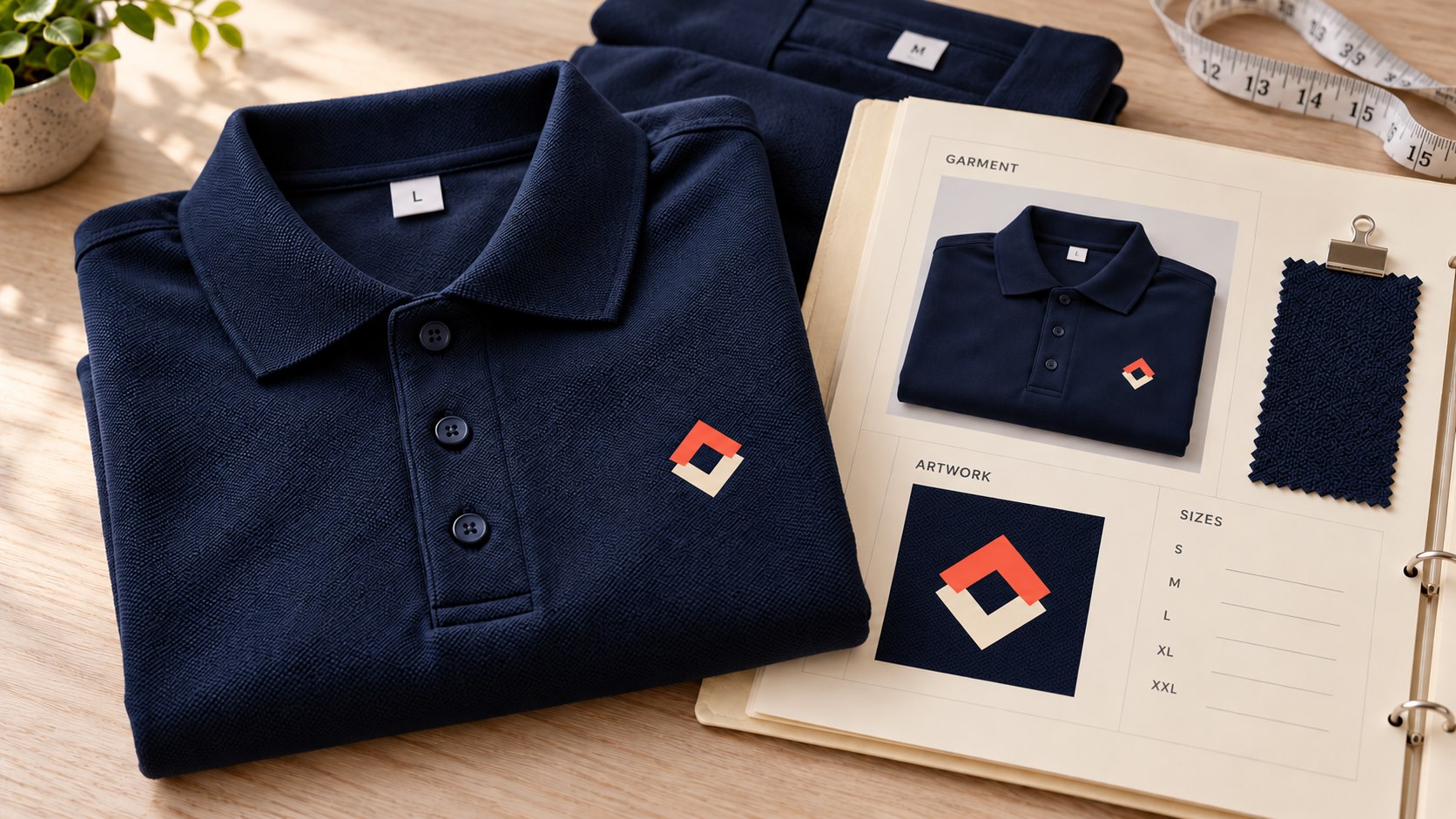
A repeat workwear order needs a record of the differences, not just a copy of the old order. Keep the last accepted specification—the agreed garment and artwork details—as a reference. Beside it, list what stays the same, what is changing and what still needs checking for the new job.
This guide starts after a team has received an order it accepted. A new organiser may take over, a garment may need replacing, or an event may need its own version. The record keeps those changes from quietly becoming “same as last time”.
Freeze the accepted reference
Keep the previous job reference, garment description and code where available, colour, fit or style, artwork version, decoration positions and accepted proof together. Label the record with the job and date it describes.
Do not replace that record with an unapproved file for the next order. It should remain possible to tell what was accepted before and what has only been proposed now.
A photograph of an accepted garment is useful context. It may not establish an exact colour or print measurement, and it does not identify the artwork file on its own. Use the documented specification and proof to explain the previous job, with the photograph as supporting reference.
Write down the change before requesting the repeat
Separate the new request into three categories:
- Requested unchanged: details you want to repeat, subject to the provider confirming that this is feasible.
- Requested change: a new quantity, garment, fit, artwork version or individual wording.
- Not yet confirmed: availability, an alternative product, price, timing or another unresolved detail.
“Requested unchanged” is an instruction to check continuity, not proof that stock or production conditions have stayed the same.
For example, an illustrative reorder might request the previous front logo and position, a new size breakdown, and a revised sponsor on the back. The organiser would identify the accepted front proof, supply the new sponsor wording and leave the back design unapproved until its revised proof is checked. This is a hypothetical example, not a customer project.
Treat a substitute garment as an open decision
If the previous item is unavailable, keep its reference in the record and list the proposed replacement separately. Ask what changes in fit, sizing information, colour, construction or suitability for the intended use.
Do not carry a size label across to a different item without checking its own guide. Establish whether the chart gives body measurements or garment dimensions. Ask for clarification if that is unclear.
The same rule applies to the decoration. A replacement garment should not be assumed compatible with the previous method merely because both items are called polos or hoodies. The provider needs to assess the actual item and artwork.
If an alternative is agreed, record that decision against the new job. It does not automatically become the permanent team garment. Say whether the choice is a one-off replacement or the intended reference for future requests.
Map the new quantity list to the right version
Use a fresh quantity list for each reorder. Identify the garment, fit or style, colour, size and artwork variant before adding the quantity. The old size list is a historical record, not the current instruction.
A standard team version and an event-organiser version may share a front logo but have different back text. Give each a clear identifier. Check that every quantity row refers to the intended variant and that the row totals match the overall quantity.
If a name is printed, check its exact spelling and the garment it belongs on. Where production needs only aggregate quantities, keep personal allocation details within the organisation instead of circulating them with the artwork.
The Irish Data Protection Commission identifies minimisation, accuracy, storage limitation and confidentiality as data-protection principles. Its guidance supports limiting the information shared and access to it; it does not prescribe one retention period for every staff clothing order. See the DPC’s principles guidance and data-security guidance.
Approve the change, not just the familiar logo
Give the approver both the accepted reference and the proposed new details. Ask them to check the specific differences, then the complete order: garment, colour, size quantities, total, artwork version, positions and individual text where relevant.
A previous invoice establishes the previous transaction. Ask for a current quotation and feasible date for the new scope. Do not treat an old price or deadline as confirmation for the repeat.
Before approving, distinguish a requested change from an agreed one. If the quotation describes an alternative garment or a revised print specification, resolve that explicitly rather than assuming the familiar job reference covers it.
When contacting Time for Designs through its clothing page, send the earlier job reference, the current quantity list and the change note together. Include the required date and identify the person who can confirm outstanding choices.
A small change record for the next organiser
The following blank format keeps the old specification and the new decision separate. It is a suggested working record, not a mandatory production form.
| Field | What to record |
|---|---|
| Accepted reference | Previous job, garment reference, artwork version and accepted proof. |
| Requested unchanged | Exact details to repeat, awaiting current feasibility confirmation. |
| Requested changes | Each new garment, quantity list, wording or artwork variant. |
| Open questions | Proposed substitutions, availability, quotation, timing and approval gaps. |
| New approval | Agreed specification, proof version, approver and date. |
| Future reference | Whether this accepted version replaces the team standard or remains a one-off. |
After the garments arrive, compare them with the agreed specification and use the provider’s process to raise any concern. Record accepted changes without erasing the previous job’s history.
Keep personal allocation information only for an appropriate purpose and limit access to it. The useful long-term artwork reference does not require every staff size or individual allocation to remain attached indefinitely.
The next organiser needs to know what the team accepted before, what changed in this order and which version to use next time. That is a clearer handover than a folder containing several files called “final”.
Sources and scope
The linked DPC principles and security guidance support the limited discussion of staff information. The comparison record is an editorial recommendation. It does not establish garment availability, a guaranteed match, a particular production method, current price or turnaround.