
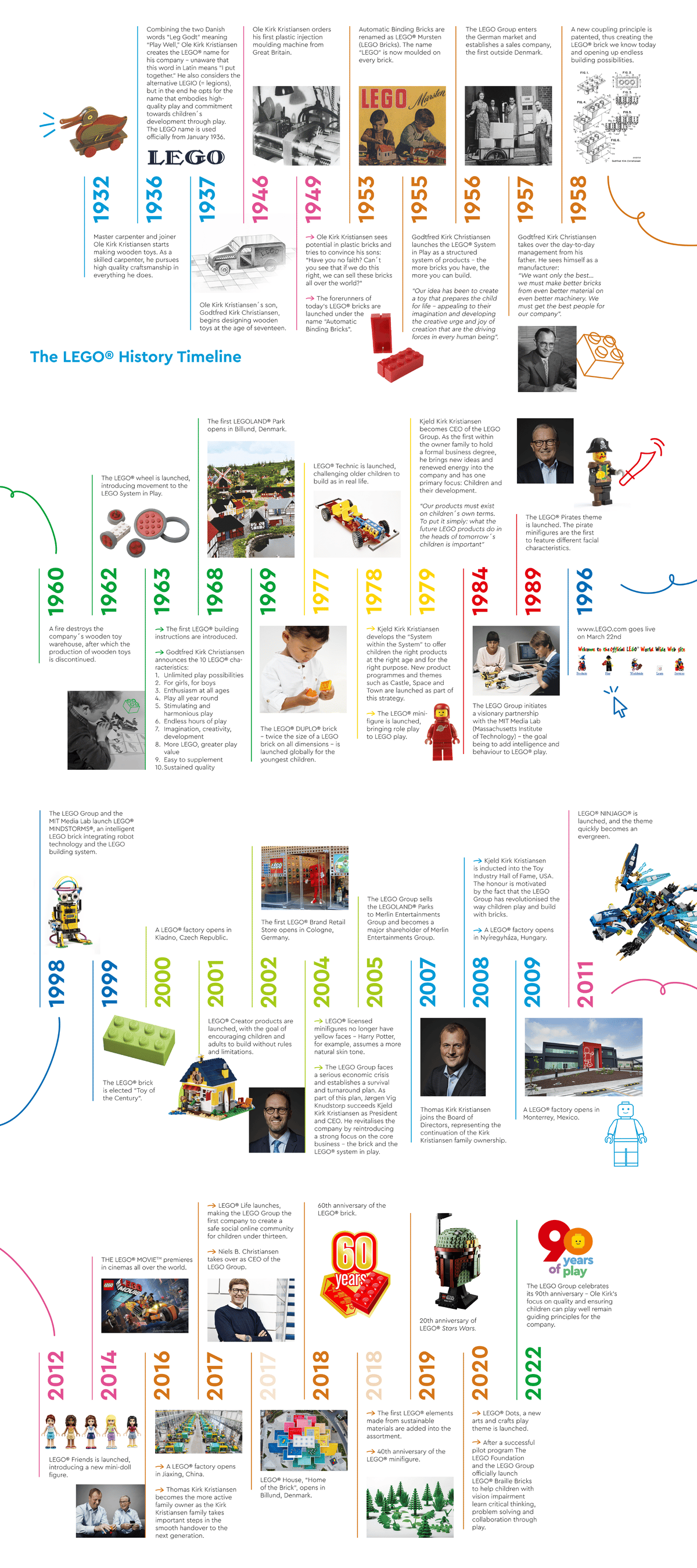
 The LEGO Group official company-history timeline; reproduced for editorial commentary.
In its 2003 annual report, LEGO said sales had fallen by 26% in a single year.
The company lost DKK 1.4 billion before tax. Sales in the United States fell by about 35%. Asian sales dropped 28%. The annual report did not hide behind the weather, fashion or a difficult Christmas.
It blamed an “unsuccessful growth strategy”.
This was the company that made one of the most successful product systems ever created: small plastic bricks designed to connect across sets, themes and generations. Yet the business surrounding that system had become difficult to connect.
LEGO had theme parks, electronic projects, retail stores, licensed entertainment products, new play concepts, manufacturing capacity and an expanding portfolio. Its products were creative. Its economics were not clear enough.
The usual comeback story says LEGO abandoned innovation and returned to the humble brick.
That is only half right.
LEGO did return its attention to the brick and the System in Play. But it did not stop making new things. It changed where innovation happened, how quickly it reached the market, which risks the company carried itself and whether new products strengthened the system that made LEGO distinctive.
The real lesson is not “stay in your lane”.
It is that innovation becomes dangerous when a company cannot see the operational cost of variety, the customer value of each addition or the connection between a new idea and the system paying for it.
The short answer
- How serious was the crisis? Very. LEGO reported a DKK 1.4 billion pre-tax loss in 2003 and a DKK 1.931 billion group net loss in 2004, although the latter included restructuring, impairments and discontinued activities.
- Did too many strange products cause everything? No. Falling movie tie-in sales accounted for more than half the 2003 sales decline. Retail inventory, market competition, cost levels and excess capacity also mattered.
- Did LEGO simply stop innovating? No. It refocused product development on its core play system, transferred some non-core projects to licensed partners, shortened development cycles and improved customer and retailer feedback.
- Did returning to classic themes help? LEGO's 2005 and 2006 reports specifically credited renewed core products including City, DUPLO, Technic and Mindstorms.
- Was the recovery only cost cutting? No. Cost reductions, asset sales and workforce changes stabilised the company, but revenue, consumer sales, margin and market share also improved.
- How fast did the numbers turn? The group moved from a DKK 1.688 billion pre-tax loss in 2004 to a DKK 702 million pre-tax profit in 2005. In 2006, pre-tax profit reached DKK 1.562 billion.
Those figures are dramatic. They do not support a one-cause fairy tale.
The invention that was more than a product
A LEGO brick is an individual object. The LEGO System is the more important invention.
A piece bought in one set can connect with pieces from another. A child can follow the instructions once, dismantle the model and build something nobody at LEGO planned. The value grows because the parts share rules.
That compatibility creates several kinds of advantage:
- old pieces retain usefulness;
- new themes can reuse familiar building behaviour;
- one purchase makes another more valuable;
- designers can create variety from common elements;
- and customers understand what the product invites them to do.
The system is both a creative promise and an operating model.
It allows enormous variety without requiring every new idea to become an entirely separate product universe. When variety starts breaking the common system, it becomes more expensive for the company and less recognisable to the customer.
LEGO's crisis was not caused because managers forgot that people liked bricks. It arose partly because the organisation had expanded faster than its ability to see which innovations reinforced the system and which ones simply added another layer of business.
Growth looked like the obvious answer
By the late 1990s and early 2000s, traditional toys faced intense pressure. Video games, electronic entertainment, shorter fashions, retailer power and private-label competition changed the market. Children appeared to be leaving conventional toys at younger ages.
Standing still did not look safe.
LEGO explored new themes, digital experiences, entertainment, branded stores and parks. Some ventures became genuine strengths. BIONICLE created a new category and joined physical toys to an expanding story world. Star Wars showed that a licensed universe could work brilliantly with the construction system.
Other efforts travelled further from the company's strongest capabilities or added complexity faster than value.
The temptation is to divide everything into “good core” and “bad innovation”. The company's own results resist that division.
Licensed movie products were a major source of weakness in 2003 because no new Star Wars or Harry Potter film arrived to support demand. The fall in those ranges accounted for more than 50% of LEGO's total sales decrease. Yet Star Wars became the company's second-biggest-selling line in 2005.
The lesson is not that licensing was wrong. It is that a hit can create concentration risk when the release calendar belongs to somebody else.
The 2002 result hid a warning in the shops
LEGO entered 2003 with too much product sitting in retail channels, particularly in the United States.
The 2002 Christmas season had not met expectations. Retailers still held substantial inventory, so their orders to LEGO slowed sharply at the beginning of the following year. That distinction matters:
- products shipped to a retailer count as company sales;
- products bought by families reveal consumer demand;
- inventory sitting between them can temporarily make both periods misleading.
A company can report a strong shipment year while its products accumulate on shelves. The next year's fall then looks sudden even though the consumer warning began months earlier.
Inventory is not only a warehouse number. It is delayed information.
LEGO's 2005 report later celebrated that retailers had reduced inventory and held a healthier mix. The turnaround included rebuilding the flow of information between the company, shops and customers—not simply making a better television advertisement.
2003: the numbers fall apart
The 2003 annual report is unusually direct.
- Net sales fell from DKK 11.426 billion to DKK 8.433 billion.
- The 26% fall removed nearly DKK 3 billion in sales.
- Play-material sales declined 29%.
- Pre-tax loss reached DKK 1.432 billion, compared with a DKK 626 million profit in 2002.
- US sales fell by approximately 35%.
- Asian markets fell 28%.
- Germany finished about 20% lower, while the UK, Netherlands and Nordic markets fell about 13%.
Competition and a stagnant traditional-toy market formed part of the background. LEGO also lost market share.
The cost base could not adjust quickly enough to the lower sales level. A company constructed for growth suddenly had to carry its structures through contraction.
This is where the phrase “nearly collapsed” needs discipline. LEGO's report showed a strong brand and substantial equity; it did not print a countdown to legal bankruptcy. Former leaders and later accounts describe a business on the brink, but the dated accounts are better evidence for the specific position: falling sales, historic losses, declining cash resilience and an urgent strategy change.
The crisis was real without adding a fictional date on which the doors would certainly have closed.
Complexity is not just the number of products
Business stories love a single astonishing statistic: LEGO had too many pieces, too many colours or too many sets.
Former CEO Jørgen Vig Knudstorp and later case research have described an assortment exceeding 10,000 distinct elements, with thousands of shapes and a large colour palette. Every addition could require moulds, forecasting, manufacturing slots, storage, replacement stock and quality control.
The exact counts vary according to whether a “component” means a shape, a colour combination or a saleable element. That makes casual comparisons risky.
The more useful point is structural.
One new piece does not create one new cost. It creates a trail:
- design and testing;
- tooling or mould capacity;
- supplier and material decisions;
- production scheduling;
- stock forecasting;
- warehouse locations;
- inclusion in sets;
- missing-part support;
- obsolescence risk; and
- a requirement to coordinate every other piece in the model.
If one unavailable element prevents a 600-piece set from being completed, its cost is larger than the plastic it contains.
Variety feels creative at the design desk. In the supply chain, variety multiplies dependencies.
The difference between visible and invisible complexity
Customers see a finished set. The company sees a network of components, forecasts and commitments.
That creates a dangerous asymmetry.
A new colour may make a model look slightly better. Internally, it can create new inventory, planning and sourcing work. A one-purpose mould may enable a memorable detail while being unusable in any other theme. A licensed product can sell strongly but carry royalties and depend on another company's entertainment schedule.
None of those decisions is automatically wrong.
They become dangerous when the organisation cannot answer:
- What does this addition cost across its complete life?
- How often will it be reused?
- What customer value would disappear without it?
- Which saleable products depend on it?
- What happens when forecast demand is wrong?
- Does it strengthen the common system or create a separate one?
Innovation without those answers is not necessarily bold. It may simply be unpriced.
The 2004 plan was more severe than “back to basics”
In its 2004 annual report, LEGO described an action plan with three themes:
- set a clear direction and fundamentally change how the company operated;
- restore competitiveness by focusing on customers, including retailer profitability; and
- reduce risk by resizing activities, costs and assets to a lower revenue base.
That third point matters.
The company had expected growth of 8–10% a year and built capacity for it. Toy revenue had instead fallen by more than 25% over several years while production efficiency improved. The result was more production capacity than the smaller business required.
LEGO cut production and operating costs by DKK 1.523 billion—20% from the 2003 level—and reduced its workforce by about 1,000 people. It impaired assets, closed facilities, prepared to sell the LEGOLAND parks and even disposed of the company aircraft.
This was not a branding workshop.
It was a financial and operational rescue that affected jobs, ownership of assets, production and the boundaries of the company.
Return to the core did not mean retreat from the future
The product strategy concentrated on the brick and the values surrounding the LEGO brand.
Classic areas including DUPLO, Make & Create, City and Technic received renewed attention. Projects outside the core—electronic games were the report's example—could move to licensed partners rather than being developed and carried entirely inside LEGO.
That distinction allowed the brand to participate without owning every capability.
LEGO video games did not disappear. The successful LEGO Star Wars game launched with an outside partner. The company retained the connection to its world while shifting development risk and specialist execution.
This is a more useful form of focus than saying no to everything unfamiliar.
The question became:
What must LEGO be uniquely excellent at, and where can somebody else add capability without weakening what makes the result LEGO?
Focus changed the architecture of innovation. It did not abolish it.
Speed was part of the redesign
The 2004 report set out to halve product-development time.
That goal can sound contradictory. If uncontrolled innovation helped create the crisis, why accelerate development?
Because the problem was not merely the number of ideas. It was the distance between an idea, market evidence and a commercial result.
Long cycles increase the chance that:
- fashion changes before launch;
- forecasts become stale;
- more cost accumulates before feedback;
- inventory commitments become harder to reverse; and
- teams continue defending a product because so much has already been invested.
Faster development, paired with sharper constraints and retailer feedback, can reduce rather than increase risk.
Discipline is not the enemy of creativity. Good constraints help creative work reach the customer before it becomes an expensive private theory.
Retailers were customers too
LEGO's action plan explicitly referred to retailer profitability.
That may seem less inspiring than rediscovering the joy of the brick, but retailers decide shelf space, inventory depth, promotions and reorders. A toy that fascinates its designer but ties up shop capital or arrives unpredictably creates a weak commercial relationship.
The company adjusted products, prices and development processes in response to retailer and consumer feedback. By 2005, it reported closer retailer dialogue, healthier inventories and a 9% increase in retail sales to consumers.
This is an important correction to the hero-CEO version of the turnaround.
The recovery did not occur only in the boardroom. It happened where forecasts met shelves, where product ranges met shop economics and where families decided whether to buy.
2004 looked worse before the recovery looked better
The group reported a DKK 1.931 billion net loss for 2004, compared with DKK 935 million the previous year.
Read alone, that suggests the rescue plan made the crisis worse.
The composition matters. The figure included restructuring costs, asset impairments and the discontinued LEGOLAND activities. In the continuing play-material business, the result before special items, finance and tax improved from a DKK 1.061 billion loss in 2003 to a DKK 103 million profit in 2004.
The company was recognising the cost of shrinking and disposing of decisions made for a larger future while the underlying toy operation began to stabilise.
This is why turnaround numbers require more than two points on a line.
A business can generate a worse statutory loss while making its continuing operation healthier. Equally, selling an asset can improve cash without proving the everyday business has recovered. Both views are necessary.
The recovery becomes visible
In its 2005 annual report, LEGO reported:
- DKK 702 million profit before tax, after a DKK 1.688 billion pre-tax loss in 2004;
- a 12% increase in revenue;
- an 8% reduction in expenses excluding royalties and bonus;
- consumer sales through retailers up an average of 9%; and
- healthier retailer inventory.
Classic themes returned to the biggest-seller list. DUPLO grew strongly after its reintroduction. Star Wars was again a major success, this time showing that a licensed idea could thrive when fitted to the system and supported by the right market moment.
In the 2006 annual report, the progress accelerated:
- revenue increased 11% to DKK 7.823 billion;
- pre-tax profit reached DKK 1.562 billion;
- operating margin before special items rose to 19.5%, from 6.5% in 2005;
- profit for the year reached DKK 1.430 billion; and
- global market share increased.
The report credited classic relaunched lines, improved product mix, more effective pricing and discounts, cancellation of less profitable lines, cost reductions and reduced portfolio complexity.
The turnaround was not one brick. It was a rebuilt system.
What the popular story gets wrong
| Popular claim | What the evidence supports |
|---|---|
| LEGO nearly failed because it stopped making bricks. | Too simple. Core drift mattered, but the company still sold construction products. Sales concentration, retail inventory, market weakness, cost levels and operational complexity also mattered. |
| Licensed products caused the crisis. | Incomplete. Movie tie-ins drove more than half the 2003 sales decline, but Star Wars became a leading product again in 2005. The risk was dependence and execution, not licensing itself. |
| One new CEO saved the company. | Misleading. Jørgen Vig Knudstorp led the transformation, but the action plan began under Kjeld Kirk Kristiansen and required employees, owners, retailers, partners and difficult asset decisions. |
| LEGO stopped innovating and returned to old sets. | False. It shortened development, relaunched core lines, used partnerships and continued creating products—but inside clearer strategic and economic boundaries. |
| Cutting the number of elements caused the whole recovery. | Unproven as a single cause. Reduced complexity helped margins and operations, alongside revenue growth, asset sales, cost reductions, pricing, inventory repair and customer focus. |
| The 2004 loss proves the plan initially failed. | Incorrect without context. Restructuring and impairments enlarged the statutory loss while the continuing play-material operation improved before special items. |
| “Back to the brick” meant refusing every adjacent opportunity. | False. LEGO remained in games, entertainment, licensing and retail, but changed what it owned directly and how those activities connected to the core system. |
The table is the article's central citation asset: it replaces a motivational turnaround fable with a documented, multi-part recovery.
Did innovation cause the crisis?
It is tempting to answer yes because “too much innovation” makes a clean warning.
Innovation is not one activity.
LEGO's portfolio contained at least four different kinds:
- System innovation: new ways to build with compatible elements.
- Theme innovation: new stories and settings constructed with the system.
- Channel innovation: shops, parks, games and entertainment that changed where people met the brand.
- Business-model innovation: licences, partnerships and owned capabilities that changed how value and risk were shared.
Some initiatives could be successful in one category and dangerous in another. A licensed theme could be a brilliant customer proposition but expose the company to film-release timing. A unique element could improve one model while weakening manufacturing reuse. A theme park could create a remarkable brand experience while tying up capital and management attention.
Calling all of this “innovation” hides the decisions that matter.
The 2003 report did not say creativity had become undesirable. It said the growth strategy had been unsuccessful. The 2004 plan did not ban development. It tried to halve development time and align products with the brand's core idea.
That is a useful distinction for any company reviewing a crowded range:
- Is the idea attractive to customers?
- Does it produce an acceptable commercial result?
- Does the business need to own every part of delivering it?
- Does it make the rest of the range stronger or harder to operate?
An initiative can pass the first question and fail the others.
Five changes worked together
The annual reports reveal five connected repairs rather than a single miracle.
1. The company planned for the revenue it had
LEGO stopped operating as though 8–10% annual growth was guaranteed. Capacity, costs and assets were resized around a more conservative future.
That sounds obvious after sales fall. It is difficult in practice because every facility, team and project carries a story about the growth it will eventually enable.
2. The product range had to reinforce the system
City, DUPLO, Technic and other familiar lines were not revived merely because they were nostalgic. They used capabilities, connections and customer understanding LEGO already possessed.
The core gave designers a test: does this idea become more valuable because it is LEGO, and does it make the LEGO system more valuable in return?
3. Retail sell-through mattered more than shipments alone
Healthier shop inventory reduced the gap between products leaving LEGO and products reaching families. Closer retailer dialogue improved the company's ability to see demand before another Christmas exposed it.
4. Partners carried risks outside LEGO's deepest expertise
Games and other activities did not need to disappear simply because owning their full production process was expensive. Licensing and collaboration let LEGO contribute the brand and play system while specialists supplied different capabilities.
5. Complexity became a financial question
Reducing portfolio complexity was not a demand for visually boring sets. It forced the cost and reuse of elements, lines and processes into the same conversation as creativity.
Together, these changes explain why copying only one tactic is unlikely to copy the recovery.
Selling an asset without repairing customer demand is not a turnaround. Cutting product variety without knowing what customers value can make an offer weaker. Returning to old products without shortening decisions can simply preserve an old problem. A system works because the pieces support one another.
What a smaller business should not copy
Famous turnarounds can encourage theatrical action: slash the range, rename everything “core”, outsource quickly and wait for clarity.
LEGO's record suggests more care.
Do not remove products solely because they sell less than the bestseller. A lower-volume option may share materials, generate repeat business or complete a useful range at very little extra cost.
Do not outsource simply to move a cost off the page. A partner still needs specifications, quality checks, deadlines, transport and customer support. The right question is whether the partner can perform the activity more reliably and economically while protecting the customer experience.
Do not define the core as whatever the owner likes producing. The core exists where distinctive capability, customer value and workable economics overlap.
Do not cut marketing and call the saving a strategy. LEGO's reports describe changes to products, pricing, retailer relationships, inventory, assets and execution—not a disappearance from the market.
And do not wait for an annual loss to reveal complexity. A basic product register can show:
- selling frequency;
- gross contribution after direct work and outsourcing;
- materials and equipment required;
- setup and rework time;
- repeat-order potential;
- whether the product creates useful cross-sales; and
- which items or processes only exist to support it.
The purpose is not to make every decision from a spreadsheet. It is to stop invisible operational commitments disguising themselves as harmless creative variety.
The core is a design rule, not a museum
“Return to the core” can be terrible advice when it means returning to the past.
LEGO's useful core was not a particular 1970s set or a ban on screens. It was a principle: a creative building system in which compatible elements let people construct, dismantle and invent.
That principle could support:
- traditional City sets;
- programmable Mindstorms models;
- licensed Star Wars worlds;
- story-driven BIONICLE;
- video games made with partners; and
- later films and digital communities.
The core did not specify the surface form. It decided whether the form still behaved like LEGO.
Businesses often confuse their core with their oldest product. A better definition asks:
- What customer value remains distinctive across products?
- Which capability would be difficult for a competitor to reproduce?
- What common system makes separate offers more valuable together?
- Which additions deepen that advantage rather than merely borrowing the name?
That definition can guide innovation without freezing it.
A complexity test for a smaller business
Complexity rarely arrives labelled as waste. It arrives as a helpful exception.
One more material. One bespoke size. One supplier. One finishing option. One software subscription. One product that only one employee understands.
Before adding it, ask:
- Does it strengthen the main customer promise? If not, why should this business own it?
- What is its complete operational trail? Include quoting, purchasing, setup, stock, production, quality, rework, delivery and support.
- Can existing materials or processes produce the same customer benefit? Reuse is an economic advantage.
- How often will the capability be used? A rare option may need a partner rather than an internal process.
- What happens when demand is wrong? Identify stranded stock, unused equipment and staff time.
- Can the customer understand the choice? Variety that creates uncertainty can reduce conversion.
- Can it be stopped cleanly? Exit costs belong in the launch decision.
The objective is not the fewest possible products. It is the smallest amount of complexity required to create worthwhile customer choice and margin.
LEGO did not become less imaginative
The most encouraging part of the recovery is that discipline did not flatten the company.
LEGO remained playful, visual and inventive. It built new stories and partnerships. It relaunched Mindstorms, grew licensed themes and eventually participated in films that turned product rules into popular entertainment.
The difference was that creativity operated within an intelligible business system.
The company knew more about retailer inventory. It paid closer attention to product profitability. It reduced less useful variety. It separated capabilities it needed to own from capabilities a partner could provide. It put customer recognition and the compatible brick system back at the centre.
That is not a retreat from innovation.
It is the difference between producing ideas and building a company capable of benefiting from them.
The comeback in one sentence
LEGO nearly collapsed after growth, variety and capacity outran commercial control; it recovered by making every major decision reconnect with the system that customers valued and the economics required to deliver it.
That sentence is less magical than “go back to basics”.
It is also more transferable.
A business does not need to stop experimenting. It needs to know which experiments reinforce its strongest system, what each one truly costs, where outside partners are better and what evidence will cause it to continue or stop.
LEGO's bricks were never the problem.
The problem was everything the business had built without enough visibility into how the pieces connected.
Sources and evidence
- The LEGO Group Annual Report 2003 — the 26% sales decline, DKK 1.432 billion pre-tax loss and the company’s description of its unsuccessful growth strategy.
- The LEGO Group Annual Report 2004 — the DKK 1.931 billion net loss, restructuring, workforce and asset changes, LEGOLAND disposal plan and renewed core-product focus.
- The LEGO Group Annual Report 2005 — the return to pre-tax profit, 12% revenue increase and healthier retailer inventory.
- The LEGO Group Annual Report 2006 — DKK 1.562 billion pre-tax profit, margin improvement and reduced portfolio complexity.
- The LEGO Group company profile and history — the company timeline and the development of the System in Play.
The financial figures retain the units and reporting scopes used in LEGO’s own annual reports. Pre-tax, net and operating measures are not treated as interchangeable.
Related reading
For a product-level example of operationally coherent change damaging customer recognition, see Tropicana’s packaging redesign.
For a smaller business, the practical challenge is often turning products, choices and enquiries into a journey customers can understand. Our website design service is individually assessed and quoted. Call 062 61524, WhatsApp 085 858 1906 or visit 98 Friar Street, Cashel.