
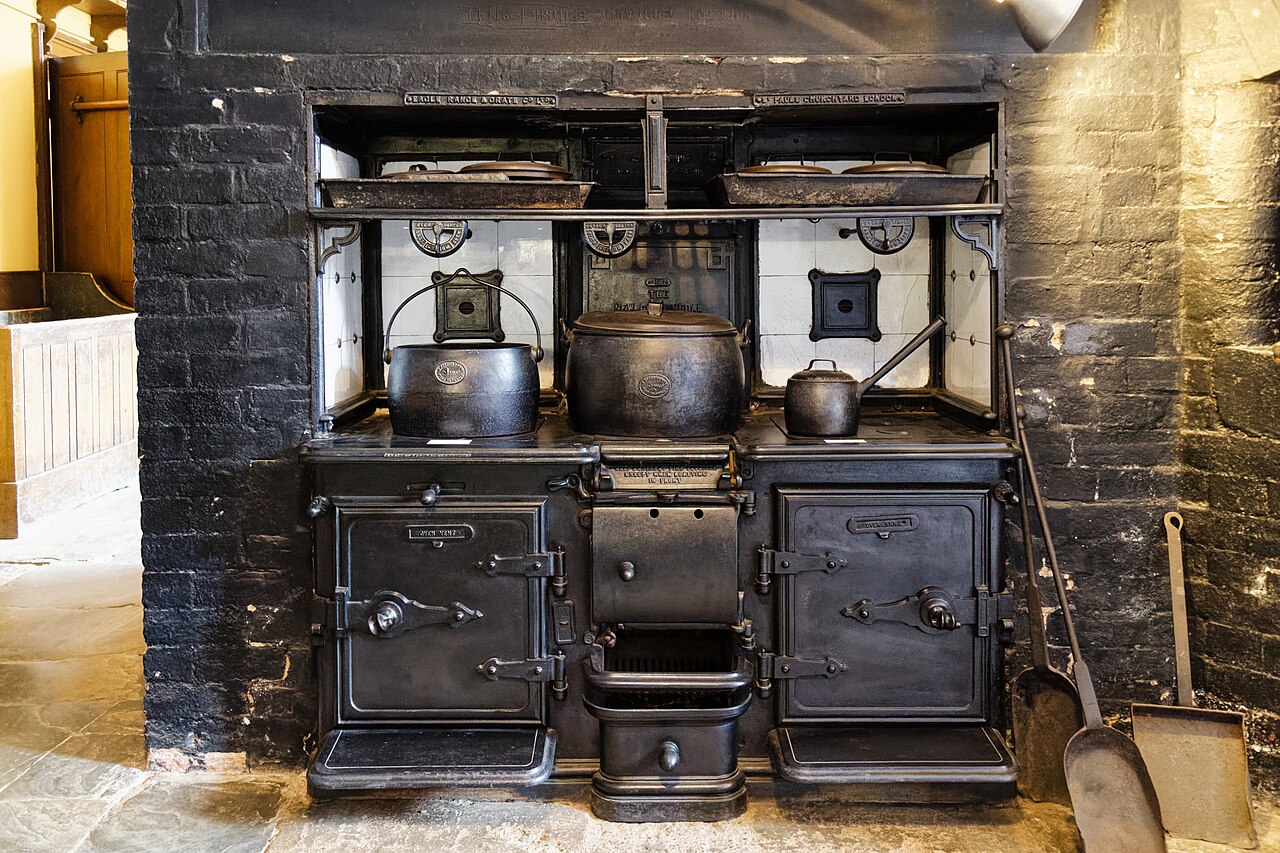

Gavin, the owner of Time for Designs, recently found himself telling a man about the coal cooker his house once had. It kept a kettle warm, an oven ready, supplied hot water and kept the house warm. When the electricity went out, he remembers the power cut as an inconvenience.
What stayed with him was how much one object could do.
There is a particular reassurance in that memory: the household had something substantial to fall back on. The cooker belonged to the working life of the house, rather than to one narrowly defined task. It made Gavin wonder whether, in buying more convenience, we have surrendered some of our ability to look after the things we depend on.
That question reaches beyond a preference for old appliances. It is about what ownership feels like. Does buying a machine give us a useful tool we can maintain for years, or the beginning of a replacement cycle whose terms somebody else controls?
The old range is a powerful object through which to ask. It also makes an awkward witness. Its warmth is easy to remember. The work that sustained it, and what went up the chimney, must remain in the picture too.
One fire, several parts of the day
In Gavin's recollection, cooking, warmth and hot water were connected. The kettle was already near the heat. The oven was ready. These were not separate requests sent to separate machines.
That arrangement has an appeal a list of specifications struggles to describe. An appliance can become part of the background confidence of a home: a thing whose usefulness extends beyond the moment somebody deliberately switches it on.
But shared heat also joins decisions together. Heat welcome in a cold kitchen may be unwanted when the room is already warm. Wanting an oven and wanting space heating are not always the same demand. A system that does several things together can be wonderfully useful when those needs coincide, and less convenient when they diverge.
The move towards separate controls therefore bought something real. It made it easier to ask for one service without asking for all the others. Convenience can mean less work, more predictable results and more freedom over when a task happens.
None of that cancels the pleasure of a kettle sitting ready. It explains why a household might willingly exchange some of that continuity for control.
Whose self-reliance?
There is another person standing just outside many affectionate descriptions of the old kitchen: whoever kept it working.
The National Museum of Ireland's account of the changing rural kitchen describes electricity reducing hard manual labour for women. Thermostats on electric cookers made cooking temperatures controllable. Washing machines and dryers were particularly welcomed in large families. Its wider Kitchen Power exhibition follows the difference between promises of modern domestic life and women's actual experience of it.
That history complicates the word self-reliance. A home can seem admirably independent from outside while demanding a great deal from somebody inside. The ability to keep a household going may represent knowledge and pride; it may also involve work from which that person would gladly be released.
We should not assign that work to Gavin's family without knowing their circumstances. The broader point is that domestic technology has to be judged from the position of the person using it, maintaining it and doing the work around it.
The old household was never independent of everything. Coal came from beyond the house. A durable cooker still belonged to a world of fuel supplies, manufacturing and skilled trades. What could feel different was the relationship: keeping a familiar object going, rather than having to replace an unfamiliar one.
The desirable part of self-reliance is agency. It is having the knowledge, help and practical options to deal with a problem. It need not mean doing every difficult job yourself.
As a household becomes able to afford more, buying back time can be a perfectly reasonable ambition. Replacing a troublesome appliance may feel easier than arranging a repair. The uncomfortable possibility is that a home can become better equipped while its owners have fewer practical options when something stops working. Greater comfort and greater independence do not necessarily arrive together.
The all-in-one machine has not disappeared
The neatest version of this story would have one old cooker replaced by a collection of modern boxes, with nobody making anything comparable any more. It would also be wrong.
The current AGA Rayburn range includes the oil-fired Heatranger, which combines cooking, central heating and hot water. Its manufacturer describes heating controlled independently from cooking. This is evidence of an available design, rather than independent proof of its economy or longevity. It is not an identification of Gavin's cooker.
Nor does integration belong exclusively to a traditional range. SEAI explains how heat pumps take heat from outside the building and raise its temperature using electricity. Water-based systems can supply both space heating and domestic hot water. They do not cook the dinner, but they do bring more than one household service into a system.
Even the apparent opposition between cast iron and electronics breaks down on inspection. The all-electric AGA eR7 described by its Australian distributor combines cast-iron ovens with digital control and independently switched ovens and hotplates. The old material and the new controls occupy the same appliance.
The useful dividing line is therefore harder to draw than old versus new. A machine's fuel, controls, functions and repair arrangements are separate design choices. A heavy exterior tells us little about how long its controls will be supported. A circuit board does not, by itself, tell us that a product is disposable.
Lasting is not the same as being repairable
A range still working after decades is tangible evidence that this particular object has endured. It cannot tell us the average life of all the cookers made alongside it. The failed, discarded and uneconomical examples are less likely to be there when we look back.
That is the trap in comparing an exceptional survivor with an ordinary replacement appliance. We have selected the old machine partly because it survived.
The modern evidence is more varied than a universal story of decline. The European Environment Agency's briefing on product lifespans says data remain limited. In the household-appliance survey it discusses, the average lifespan for large appliances increased from 11.6 years in 2019 to 12.5 years in 2023. Those figures describe that category and survey period, not a contest between historic ranges and modern heating systems.
Yet the concern about repair has substance. The same briefing identifies repair cost, product complexity and spare-parts access as barriers. A machine may be technically repairable while its owner faces a price or a wait that makes replacement the practical choice.
A Joint Research Centre study published in 2019 examined about 11,000 diagnoses of faulty washing machines and dishwashers from an independent European repair centre. Electronics were among the faults associated with lower repair rates. So were certain mechanical components, including circulation pumps and, in washing machines, bearings, drums and tubs. This is evidence about the appliances arriving at that repair centre, not every appliance sold.
It nevertheless gets closer to the uncomfortable question. The issue is not merely whether a component can fail. Components always can. It is whether an otherwise useful machine has a realistic route back into service when one does.
Reliability asks how often something goes wrong. Repairability asks what happens next. Owners need both.
The cost outside the price tag
When replacement becomes easier than repair, a purchase starts to look less like taking possession of a lasting tool and more like paying for an interval of use.
The frustration is understandable. Someone may still want the same oven, the same familiar controls and the same place in the kitchen. The failure has not created a desire for a new product; it has created a bill.
That experience does not establish that every manufacturer deliberately engineers failure. An argument about motives needs evidence about a specific decision. The owner's problem exists regardless: a part, a diagnosis or an affordable repair may be missing when it matters.
Repair is also becoming a public design question. The EU's right-to-repair rules include manufacturer repair obligations for products covered by relevant EU repairability requirements and access to spare parts at reasonable prices. Their scope is defined; they are not a promise that every object can be repaired cheaply or indefinitely.
The principle matters even where a particular remedy does not apply. Support after purchase belongs in the meaning of a product. Spare parts, understandable fault information and somebody able to do the work help determine how much practical control an owner retains.
Consumerism is often discussed as wanting too much. There is a quieter version: having to buy again when you were content with what you had.
A long life cannot settle the environmental question
The temptation is to make durability the final verdict. If a cooker lasts long enough, surely the resources used to make it have been justified?
There is a valuable truth inside that argument. The European Commission's explanation of embodied energy makes clear that a product's energy story includes extraction, manufacture and other stages as well as use. Repeated manufacture matters. Keeping useful products in service can avoid demand for replacements.
But a coal cooker is also a machine that burns fuel while it works. Its original manufacture is not its only environmental cost. SEAI identifies coal among the fossil fuels that release carbon dioxide when burned. The EPA's State of the Environment report explains that burning solid fuels releases harmful air pollutants, including fine particles, affecting indoor and outdoor air quality.
The ability to use heat for several purposes does not erase those emissions. Equally, a new appliance's lower energy demand does not erase the materials and energy used to make it.
A fair comparison would have to examine the actual systems providing the same cooking, hot-water and heating services over time, including their fuel use, manufacture, maintenance and replacements. Counting one old object against several new ones cannot settle it. Neither can a reassuring label or the weight of a cast-iron door.
Without that comparison, declaring Gavin's old cooker environmentally superior would turn an affectionate memory into a claim it cannot prove.
Keeping the useful part of the memory
The power-cut detail is perhaps the strongest part of Gavin's recollection. The feeling is of a house that could carry on.
It remains a memory of his particular arrangement. It is not proof of how another cooker, boiler or hot-water installation behaves without electricity. Those details depend on the equipment and system. But the underlying desire needs no exaggeration: people want some confidence that a disruption will not take away everything at once.
The same desire appears when an owner asks for an ordinary replacement part, a clear explanation of a fault or a repair that does not cost almost as much as starting again. These are requests for a continuing relationship with a useful object.
We can value what modern appliances have given us: less labour, greater control and different ways of meeting a home's needs. We can also expect those benefits to arrive with the means to keep the equipment working.
The most useful inheritance from the old cooker may be that expectation. Something bought for a home should be allowed to become familiar. We should be able to understand enough about it, find help for it and keep it useful without being pushed back to the beginning.
Gavin remembers a kettle that stayed warm. Behind that small comfort is a larger ambition: a home equipped with things its owners can continue to rely on.
Sources and perspective
The opening is Gavin's reported personal recollection; no make, model or date has been established. The National Museum of Ireland supplies the domestic-history context. EPA and SEAI sources address pollution and energy; the EEA and Joint Research Centre describe the limits and findings of appliance-lifetime and repair evidence. Current manufacturer descriptions establish that integrated ranges and digitally controlled cast-iron cookers still exist. They do not establish comparative lifetime, running costs or environmental superiority. The discussion of ownership and agency is editorial interpretation.