
A price tag can squeeze a small story into two numbers. This is what it cost. This is what it costs now. The line through the first number supplies the happy ending: you got there at the right time.
Yet the first number deserves as much attention as the second. A shop can charge less than it charged yesterday without the latest price being the right starting point for an advertised discount.
That distinction has reached an Irish courtroom. The interesting part is not a spectacular bargain or a secret trick. It is the apparently ordinary question of which earlier price belongs on the sign.
A price announcement becomes a court record
The CCPC's case record for DID Electrical Appliances Limited describes an investigation into online price-reduction announcements during the 2023–24 winter sales period, including Black Friday 2023.
It records a guilty plea in Dublin District Court on 10 March 2025 for failing to indicate the correct prior price in a price-reduction announcement. The later outcome matters too: the record says the court applied the Probation of Offenders Act in lieu of conviction on 26 May, after ordering a €1,000 charity donation and payment of the CCPC's costs.
That is more precise than describing the outcome simply as a fine. It also keeps the story within the evidence: a documented historical case about the price information displayed, not an accusation about every offer the retailer makes today.
The public record does not reproduce a particular product's complete price history. There is no need to invent one to understand what the case reveals. A sale announcement has something to substantiate beyond the amount charged at checkout.
Yesterday is not always the starting point
For covered goods, CCPC guidance on announced price reductions requires the prior price to be the lowest applied during at least the preceding 30 days. The reduction must be based on that price. The framework concerns specified goods announcements; services and some promotional arrangements are treated differently.
The important word is lowest. A brief rise does not automatically supply a fresh starting point for the discount.
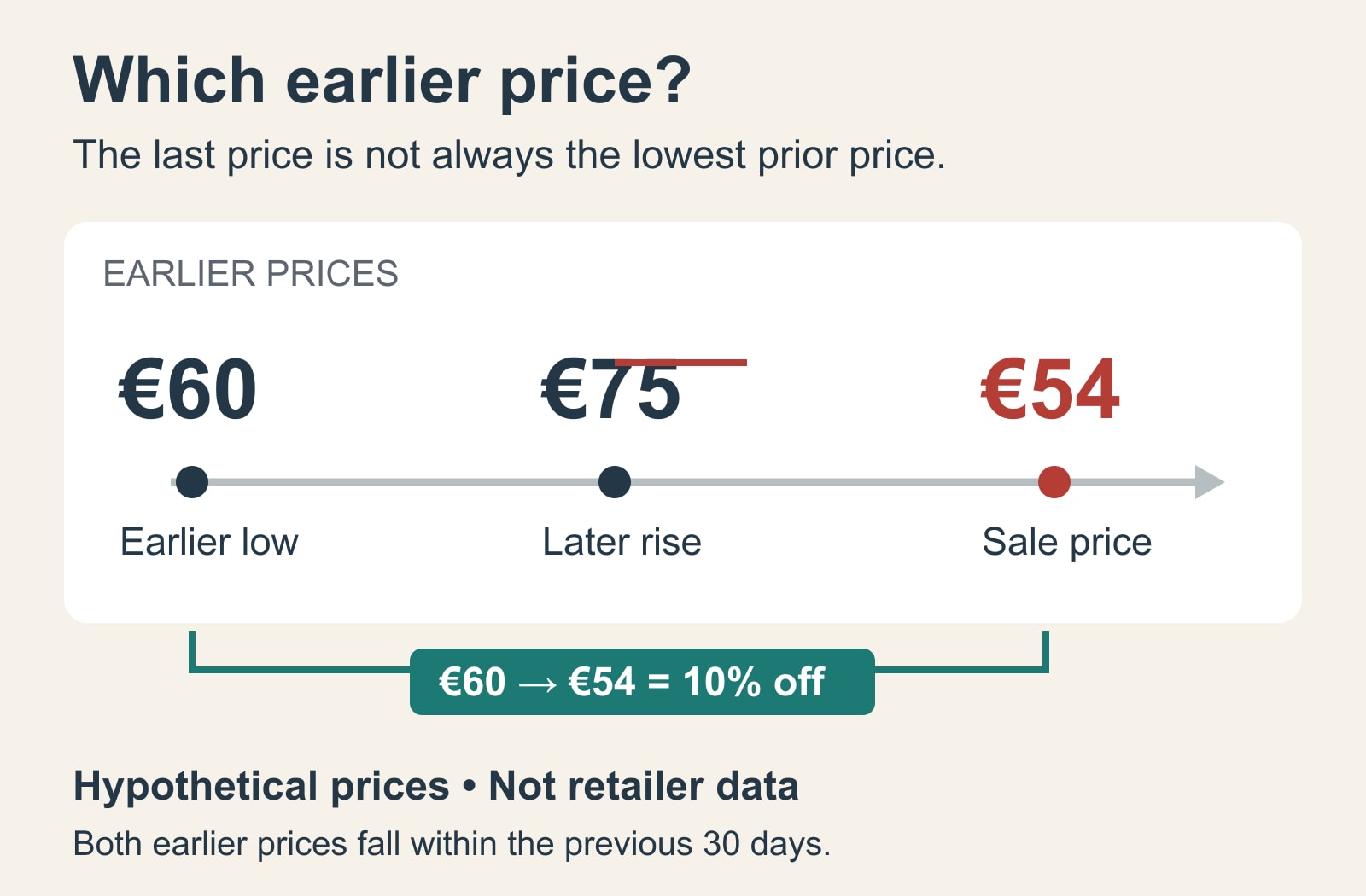
Consider a wholly imaginary item sold for €60, raised to €75 and then reduced to €54, with both earlier prices falling within the relevant period. The move from €75 to €54 is 28%. From the €60 starting point, it is 10%.
Those calculations can both be arithmetically correct while answering different questions. Under the rule just described, the relevant comparison in this hypothetical is the €60 prior price. The figures are illustrative, not evidence from the DID case or a monitored shop.
This is why a large percentage cannot explain itself. The price it starts from is part of the claim.
A price history can be accurate and still leave questions
Even a correctly identified prior price tells a limited story. It concerns that seller's relevant price history. It does not establish that no other shop sells the item for less, that the price has never been lower, or that buying it is the best use of a household's money.
These questions belong beside one another, rather than being collapsed into “good deal” or “bad deal”. Was the discount described properly? Is the present offer competitive? Does this particular item suit the need?
An urgent replacement may be worth buying without an impressive reduction. A heavily discounted product may have the wrong size, capacity or features. Someone who needs an item immediately and someone who can wait may reasonably choose differently.
There is no virtue in making a necessary purchase more difficult to prove that an advert has not influenced you. The useful distinction is between the offer's history and its usefulness now.
Why a sale calendar cannot wipe the slate clean
Promotional names make separate occasions feel fresh. Black Friday ends; another event begins. But a new heading does not make earlier prices disappear.
The CCPC distinguishes separate campaigns from successive reductions within one uninterrupted campaign. Separate campaigns must take earlier reductions within the relevant period into account. An uninterrupted campaign with successive reductions can retain the prior price from before its first reduction.
For a reader, the interesting consequence is that a calendar of offers and a history of prices are different things. An event name tells you when the seller wants attention. It does not, by itself, tell you which comparison the price can support.
A screenshot captures a claim, not the whole past
This problem is still attracting scrutiny. In results published on 26 March 2026, the European Commission reported that 30% of 314 online traders checked during a coordinated Black Friday and Cyber Monday sweep referenced discounts incorrectly. That is a finding about the traders screened, not a measure of every Irish retailer or a prediction about the next sale.
A shopper, meanwhile, usually sees the current page. A saved screenshot can preserve what was claimed and when. It cannot supply every price that existed before it was taken.
That is a reason to keep a question open, rather than jump to an accusation. Which exact item and variant is this? What does the reference price represent? If the comparison is unclear, an explanation from the seller is more useful than guessing from the crossed-out number alone.
The same care should apply when retelling enforcement stories. A regulator's allegation, a guilty plea and the eventual court outcome are related events, not interchangeable labels. The case deserves its history too.
The number that remains
Once the colour, percentage and crossed-out price have done their work, one number remains: the amount the household will pay.
A genuine discount can make a needed purchase more affordable. Its value does not depend on treating the buyer as easily fooled or the seller as automatically suspect. It depends on a clear comparison and an item that is useful at the price being asked.
The crossed-out number is not decoration. It is a statement about the past. Reading it that way gives the present price a fairer hearing.
Sources and scope
This story uses the CCPC's detailed DID case record and pricing guidance, plus the European Commission's dated screening results. The numerical example is hypothetical. The discussion explains the published framework and household comparison questions; it is not an assessment of a current retailer's compliance or individual legal advice. Sources checked 23 October 2026.