
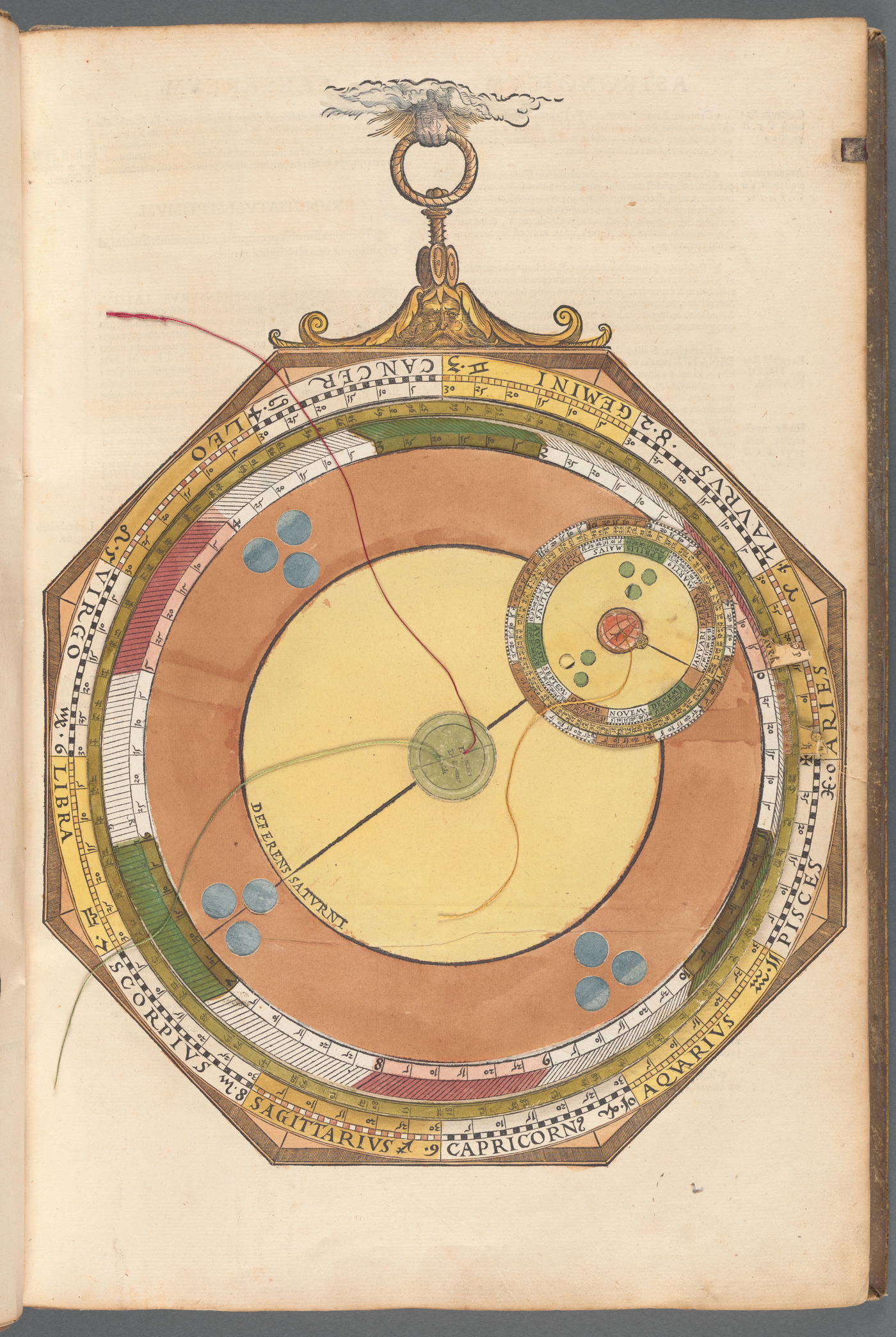
A small wheel sits off-centre inside a much larger one. Threads run across coloured rings. Around the edge, names and numbers crowd a border that looks almost too elaborate to touch.
Yet touching the page was part of the idea. The circles were working parts of Astronomicum Caesareum, Peter Apian’s astronomy book published in Ingolstadt in 1540. The History of Science Museum in Oxford describes it as an instrument in book form.
The photograph shows a page preserved by The New York Public Library. Its coloured circles and loose threads make the distinction visible. This was a book with something to operate, as well as something to read.
The page could change without being rewritten
The moving discs are called volvelles. A disc turns against another surface, changing which marks line up. Stack several parts and their relationships can change independently. The University of Chicago Library’s explanation of Apian’s paper instruments describes layered circles and weighted threads used to work out positions for particular times.
Think of the difference between a printed clock face and a clock face with hands you can move. The numbers stay put, but their relationship with a pointer changes. That comparison explains the basic interaction; Apian’s planetary instruments involved more than setting a single pair of hands.
Oxford’s account describes small circles whose centres move along larger circles. The smaller circles are known as epicycles; the larger ones as deferents. Turn the paper parts and you change the arrangement of that geometry.
Those terms can sound forbidding. The important point is simple: movement that would be awkward to follow in a paragraph becomes something the reader can arrange on the page.
The printed scales, settings and instructions give that movement a purpose. These instruments were intended to calculate where planets would appear in the sky for a given time. They were not pictures that happened to spin. Nor did they move themselves: the reader supplied the action.
An ornate object with a practical job
The page’s decoration can make it look like a display of wealth before it looks like a tool. Gold-coloured ornament surrounds the rings. The small off-centre assembly has its own markings, while threads cross the larger disc.
Apian’s publishing arrangement helps explain why the object deserves attention as a made thing. According to the Deutsches Museum’s account of the book, he ran a printing shop with his brother Georg. The museum says the woodcuts were hand-coloured in Apian’s workshop.
Printing the information was therefore only part of the finished object. A working wheel also depended on a physical relationship between its layers. A beautifully reproduced scale would not do the same job if its moving part could not turn against it.
That is what makes the page more interesting than an early illustration of a machine. The paper itself participates in the calculation. The reader changes a relationship rather than merely looking at a picture of one.
A sophisticated instrument, a different universe
There is a catch in calling it a model of the planets. Apian’s book worked within the Ptolemaic system, with Earth at the centre. Its circles represented a way of accounting for movements seen in the sky, rather than the Sun-centred arrangement familiar today.
The Library of Congress’s exhibition on the book places that view beside a striking date. In 1543, three years after Apian’s publication, Copernicus published his challenge to an Earth-centred cosmos.
That makes an irresistible before-and-after story: an elaborate paper universe, followed almost immediately by a book that challenged its foundation. But the dates do not tell us that every reader abandoned Apian’s instruments overnight.
The Chicago library identifies an inscription recording Tycho Brahe’s gift of its copy to a student forty years after publication. That is the history of Chicago’s copy, not the New York volume pictured here. A gift does not establish how often its recipient used the wheels. It does show why “nobody wanted it after 1543” would be too neat an ending.
The distinction matters to the object itself. A mechanism can be ingenious and useful within a theory without making that theory a true account of the universe.
Moving books were not only toys
Today, moving paper inside a book may bring a children’s pop-up to mind. The earlier uses were often serious. In the Library of Congress’s history of movable books, a rare-book specialist describes instructional works on science and medicine, including rotating discs and flaps that revealed anatomy.
Chicago also places Apian’s calculations in both astronomical and astrological contexts, including the preparation of horoscopes. Those were historical uses of the instruments; their presence does not validate astrological predictions.
Moving parts also add a weakness. They can be damaged or lost, and the Library of Congress notes the resulting difficulties for survival in good condition. What survives is more than a printed image: it can preserve an arrangement that somebody was meant to manipulate.
Look again at the small circle inside the larger one. It is tempting to treat the page as an intricate pattern, or to admire it only because it is old. The more surprising achievement is that the pattern had a job.
The page did not have to remain in one state. Its reader could change it, and read a different relationship from the same printed marks.
Sources
The linked museum and library records document the book, its mechanisms and its historical uses. Princeton University Library’s extended catalogue also records the May 1540 colophon and a later 1541 leaf. Descriptions of surviving copies vary; this article does not assume that every copy has identical parts. The clock-face comparison is explanatory. We have not handled or operated the original instruments.