
Some laminated items can be trimmed after finishing, but removing surplus film is different from cutting through an edge-sealed construction. Before making a sheet fit a holder, establish where the paper ends and which part of the finished edge you would remove.
The word “laminated” does not describe every detail of the construction or promise that a newly cut edge will behave like the original one.
There may be two boundaries to consider
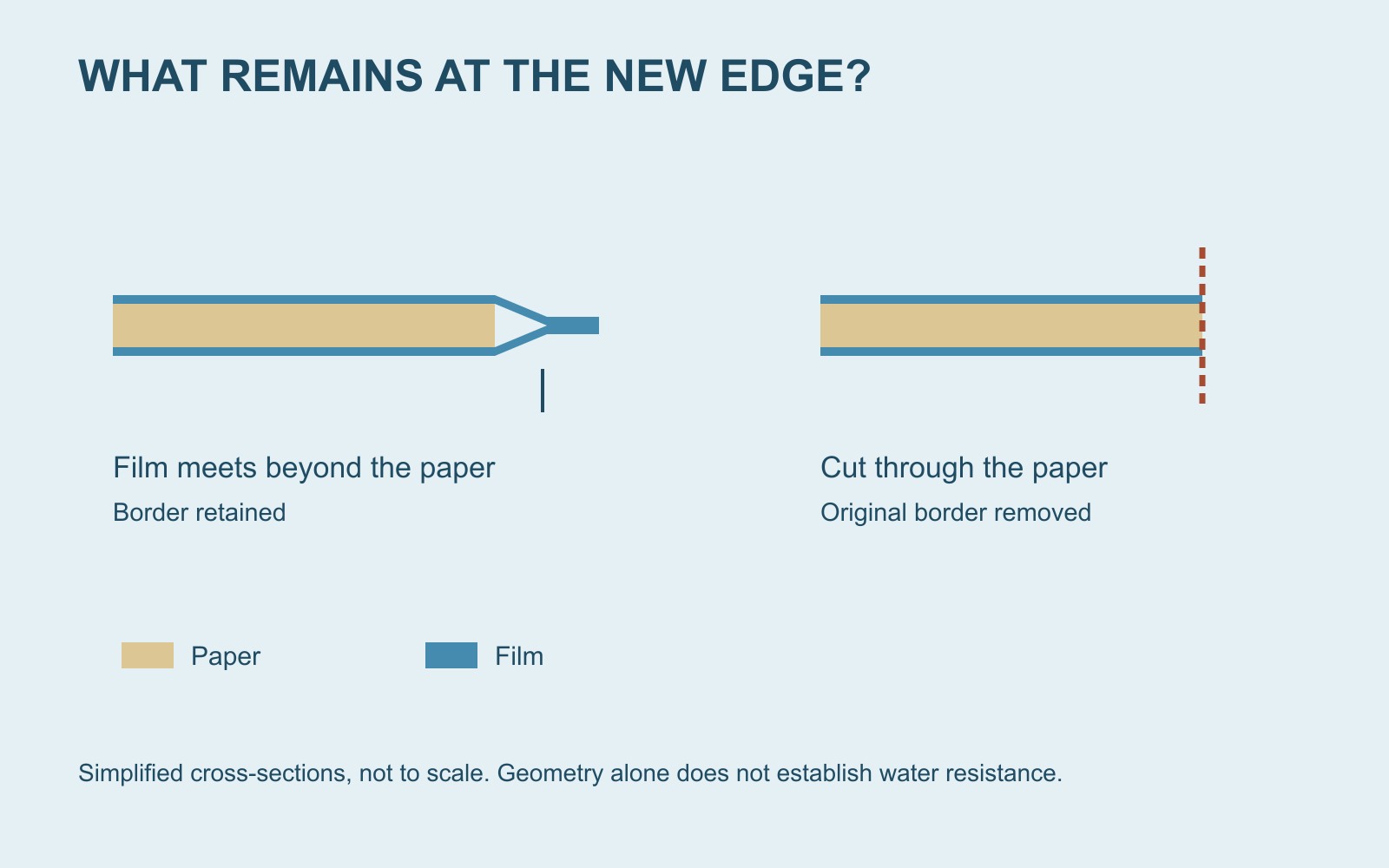
Picture a paper reference card enclosed between two films. The paper stops before the outer edge, leaving a clear border where the films meet beyond it. In that construction, the paper edge and the finished plastic edge are different boundaries.
Trimming some excess clear film while retaining the specified border is a different change from cutting into the paper. A cut through the paper removes the original film-to-film border at that new edge. That describes the geometry; it does not, by itself, predict the complete item’s durability.
Dennis Maps describes its encapsulated maps as sheets between two films sealed at the edges, with a retained border. It is a useful example of this construction, rather than a definition that every product called laminated must follow.
Follow instructions for the actual finish
For its pouch workflow, Fellowes advises trimming excess material after lamination and cooling. That is manufacturer guidance for the described process. It is not permission to cut an unknown finished item wherever convenient.
Other constructions can be intended for cutting to shape. Spectrum’s description of its own encapsulation service says a sealed edge is not necessary for durability in that process. This is why “cut edge” should not automatically be translated into “failed product”. Equally, durability is not a substitute for a confirmed requirement about water exposure.
Decide the holder size before the next order
Imagine a café menu that fits its display before finishing but becomes too large once its surrounding border is included. Cutting away the border may solve the immediate fit while changing the construction originally supplied.
For the next version, give the producer the usable space inside the holder and explain how the item will be handled. Ask whether the quoted finished size includes any surrounding film. The paper size alone may not be the final outside size.
If an existing sheet needs changing, identify the finish and ask whether trimming, holes or rounded corners are suitable. Do not assume an edge seal establishes every cleaning, outdoor or immersion claim.
A clear brief describes the final outside dimensions, the intended edge treatment and the real use. That is more reliable than ordering a familiar paper size and deciding what to cut away afterwards.
Sources: Fellowes’s pouch guidance and two producers’ descriptions of their own constructions. This guide does not claim that Time for Designs supplies either named system or a particular lamination service.