
A landscape leaflet can be printed on paper with grain running in either direction. Landscape describes the artwork's orientation. Grain describes something in the sheet itself. Confusing the two can leave an important finishing question unanswered.
When a printer asks about grain long or grain short, the useful response is to identify the paper and intended fold together, rather than turn the design sideways and assume the material has changed.
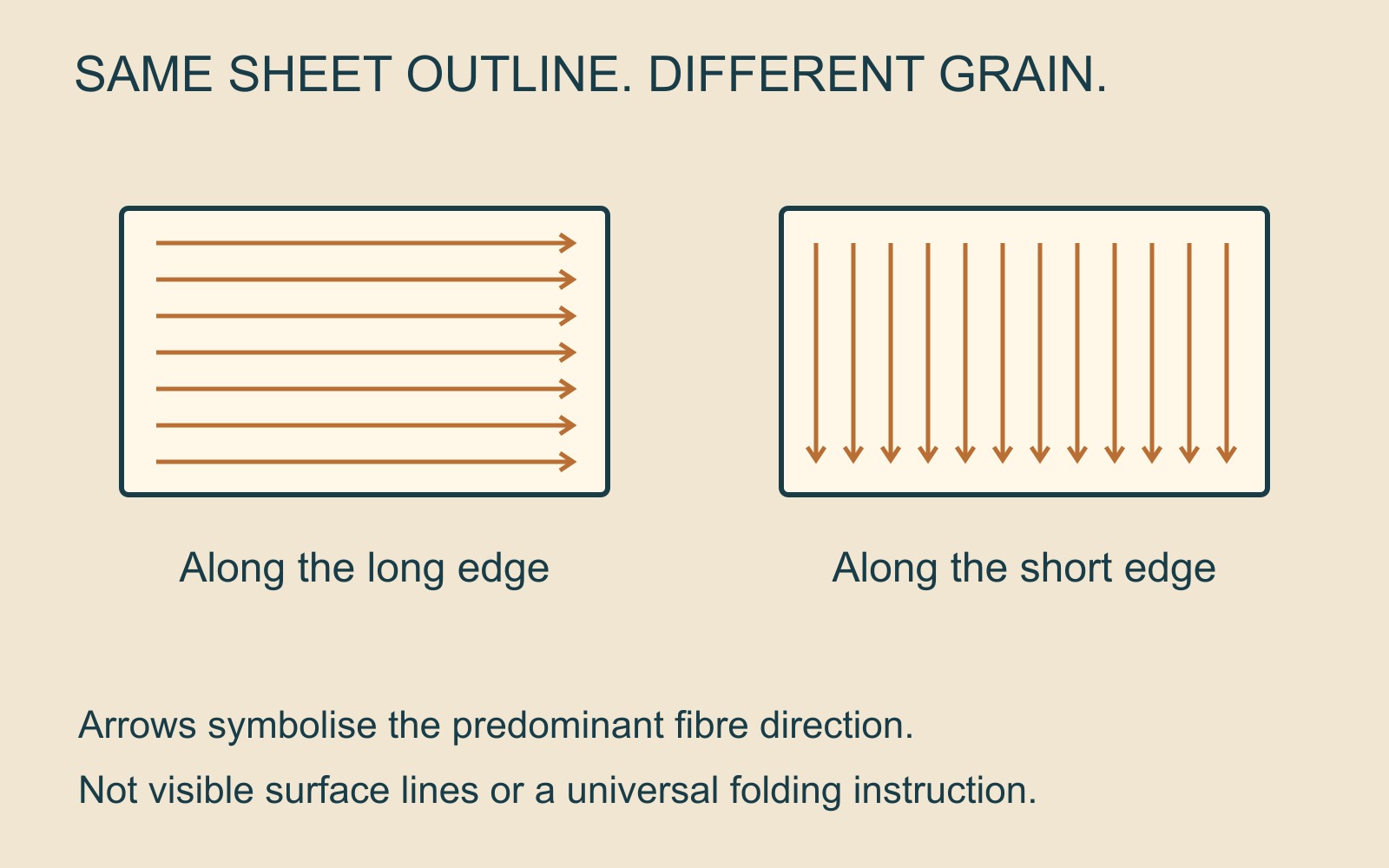
Long and short refer to the sheet's edges
Mohawk's Paper Basics explains that most fibres align with the direction of travel during machine papermaking. A cut sheet is grain long when that direction follows its long side, and grain short when it follows its short side.
Imagine two identical rectangular sheets lying horizontally. The first has its grain running left to right along the long edge. The second has its grain running top to bottom along the short edge. Their outlines and landscape orientation are identical; their grain directions differ.
The arrows in our illustration represent that distinction. They are not visible lines you should expect to find on ordinary paper, and they do not mean every fibre lies in a perfectly straight row.
Ask how the fold relates to the grain
A fold line can run parallel to the grain or across it. Naming only the flat size and finished size does not establish that relationship. The stock and the way the job is arranged on the sheet matter too.
Nor is “always fold with the grain” a complete rule for every paper and every defect. Sappi's Fold Endurance technical guide distinguishes splitting in lightweight papers from cracking in heavier papers. It describes different grain-direction behaviour for those situations, alongside the effects of scoring, coatings, moisture and production conditions.
That is a reason to agree the finishing specification with the printer. It is not a recipe for adjusting equipment, or proof that every cracked fold was caused by the wrong grain.
Rotating artwork does not change the fibres
Turning the design in a layout changes how the printed content relates to the sheet. It does not rearrange the fibres already in the paper. If somebody proposes a different orientation, ask which relationship is changing: the reading direction, the fold line, the sheet arrangement or the chosen stock.
Keep the intended front cover and opening sequence clear while discussing that change. A physically convenient arrangement still needs to deliver the right reading order.
Make the enquiry about the finished piece
For a folded business-printing enquiry, send the flat and finished sizes, fold style, quantity and artwork. Identify the stock if already chosen and explain how the piece will be handled.
Ask for the agreed material and finishing requirements before treating the layout as ready. Grain long and grain short help describe the sheet; they do not replace a specification for the complete folded object.
Sources: Mohawk's Paper Basics and Sappi's Fold Endurance guide, linked above. Diagrams are symbolic; no stocked paper, physical trial or universal folding rule is claimed.