
A shipping container keeps the cargo together. The people and places around it do not get the same protection from change.
That is the less comfortable half of the familiar story. A loaded box can pass between road, rail and sea without its contents being handled at every transfer. For a waterfront worker, the handling being removed was also work: skilled, difficult work on which a household depended. For a port, making room for the new system could mean remaking the shore.

The container did not simply make the old journey faster. It changed who performed parts of it, where they happened and what had to be negotiated before the machinery could do its job.
What the box replaced
To understand the change, begin inside a conventional ship rather than beside a modern crane. Break-bulk cargo arrived as separate packages: sacks, bales, crates and other units that had to be assembled into loads and fitted into a hold.
The Smithsonian's waterfront exhibition describes gangs of longshoremen working out how to stow those different cargoes. Their knowledge included how to fill awkward spaces and keep successive loads moving. A cargo hook extended a worker's reach; a sling gathered goods for a lift. This was a coordinated physical craft, not an empty interval waiting for an inventor to notice it.
Now compare the two arrangements. In break-bulk handling, the units inside the transport system repeatedly become the workers' immediate concern. In container handling, the loaded enclosure can become the unit being moved. The contents still need packing and eventual unpacking, but those operations need not occur at every change of vehicle.
That is why intermodal transport matters. The term describes a journey using different modes, such as a lorry, a train and a ship. It does not mean that the vehicles become interchangeable. It means that the cargo unit can move between them.
NOAA's account of the modern shipping container puts standardised wartime boxes before the best-known commercial voyage. Earlier boxes existed; the challenge was a dependable transport system around them.
The voyage that made the next transfer part of the story
On 26 April 1956, the converted tanker Ideal-X sailed from Newark towards Houston carrying 58 aluminium containers. The South Street Seaport Museum's history of containerisation identifies trucking entrepreneur Malcom McLean and engineer Keith Tantlinger in the development of the modern system.
Its account includes an easily missed detail: trucks were waiting at the destination to carry the boxes onwards. The demonstration did not finish when the vessel reached Texas. A box that could be lifted off the ship needed a way to leave the waterfront.
The same history describes earlier combined-transport boxes. The significant claim is therefore not that McLean invented putting things in a box. It is that a loaded enclosure could be organised around a complete commercial journey, with its next carrier ready to receive it.
Consider the difference between those journeys without inventing a particular customer's consignment. In one, packages leave a vehicle, are made into handling loads, go into a ship and are handled again on arrival. In the other, the packed box changes carriers while the packages remain inside. Those are different sequences of work, not merely two speeds of crane.
The reduced handling was the attraction. The work displaced from the transfer points was the conflict.
A rule about handling was also a rule about jobs
One of the clearest records of this change is a contract, not a photograph of a container.
The Mechanization and Modernization Agreement dated 18 October 1960, reproduced by ILWU Local 19, addressed sling loads, repeated handling, gang sizes and manning. It allowed changes in methods and labour-saving equipment while retaining provisions concerning safety, welfare and onerous work.
Its detailed treatment of where cargo first rested on the dock shows how much was at stake in what might sound like a minor movement. An additional transfer could require another group of workers. Eliminating it altered both the flow of the cargo and the amount of labour required.
The agreement distinguishes an onerous workload on an individual from increased output achieved through equipment or organisation. That distinction mattered: a machine could increase the amount moved without a simple corresponding increase in each person's physical effort. It could also reduce the number of people needed.
The question was no longer just whether a box could be lifted. It was how the benefit from lifting more with fewer hands would be shared.
The ILWU's own history of the agreement explains its bargain as protections and benefits for the existing workforce in exchange for allowing new machinery and removing restrictive work practices. Voluntary early retirement was intended to reduce the workforce without laying off the current registered workers. This is the union's institutional account of the arrangement, not a claim that every worker experienced it alike.
A retirement benefit can protect somebody leaving an occupation. It does not answer every question facing somebody who expects to spend another twenty years in it.
One worker's memory complicates the progress story
Longshoreman Dan Imbagliazzo's recollection of the 1971 waterfront strike supplies that younger-worker perspective. Writing thirty years later, he remembered entering the occupation in the 1960s and facing the strike while his wife was expecting their first child.
His account describes an earlier double-handling operation: cargo was taken from a driver's board, put on a warehouse floor and made into another load for the ship. Removing that sequence removed paid handling. He also recalls the anxiety of workers who still needed jobs, rather than retirement benefits.
These are a participant's memories, with an explicit point of view. They are valuable because they show why a technical improvement could feel very different according to a worker's age and place in the workforce.
No invented dockside conversation is needed. The conflict is already present in the record: the same reduction in handling could be an efficiency gain to an employer and a disappearing future to a worker.
By 1971, disagreement also concerned the allocation of the jobs that remained. The union history describes the dispute over steady equipment operators, attached regularly to one employer, rather than obtaining assignments through the hiring hall. The strike lasted 134 days, interrupted by a return to work, and ended in February 1972. It produced a new agreement, but did not make the controversy about steady employment disappear.
A better crane was therefore part of a dispute about access, security and the organisation of working life. The box cannot tell that story on its own.
Oakland needed somewhere for the boxes to wait
The change was equally physical on land. A container port needs more than a waterfront edge. It needs space for boxes between movements and connections that let them enter or leave without blocking the next operation.
Oakland had flat land and road and rail links that its rival across the bay could not match as readily. The Smithsonian's account describes San Francisco losing its former regional primacy as Oakland adapted. The change did not merely replace a vessel at the same berth; it shifted the geography of port activity.
The Port of Oakland's 1970 board records make the development concrete. Its account of the Seventh Street terminal describes a terminal still under development, with a planned extent of 140 acres on newly developed land. It sets out deep-water access, rail and highway connections, container freight stations and berths being brought into use in stages.
Matson began operating at its new terminal in September 1968, according to that record. Japanese shipping lines and a public terminal followed in other parts of the development. The shore was being divided and equipped around actual operators, not simply cleared for a theoretical box.
The same report lists containerised cargo tonnage of 375,000 in 1965 and 1,529,000 in 1968. Its next figure, for 1969, is expressly an estimate. Keeping that distinction matters: an estimate must not be silently reported as a confirmed total.
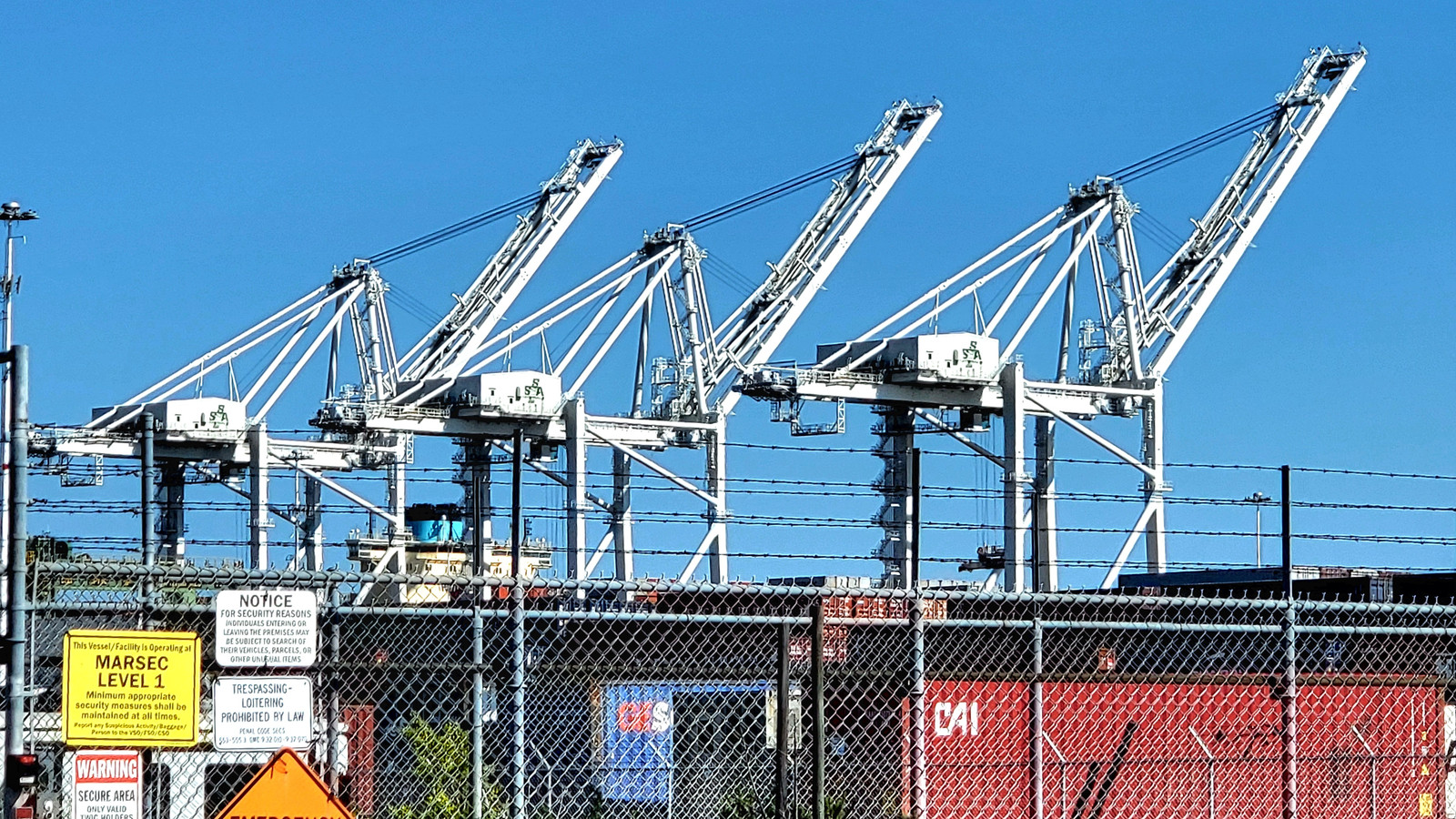
Look again at today's cranes and stacks. The open areas are working parts of the port. A box waiting for its next movement occupies land; a line of boxes requires decisions about access and order. Speed at the ship's side is useful only if the rest of the route can absorb it.
A standard shape still needed a safety system
Compatibility also had to mean more than a box apparently fitting a space. The corners connect the container to handling, securing and stacking equipment.
The International Maritime Organization's account of the Convention for Safe Containers explains the later framework for testing, approval and maintenance. Adopted in 1972 and in force from 1977, it supported recognition of approvals between participating states.
A shared outline answers a dimensional question. A recognised safety approval addresses a different question about the unit being handled. The container's usefulness depended on both physical equipment and arrangements that other participants could accept.
That is a more demanding achievement than the familiar picture of a simple metal box suggests.
What stayed inside, and what changed outside
Containerisation belongs to the history of expanding international trade, but it is not a complete explanation for every shift in manufacturing or employment. Nor does the evidence support a single verdict in which every waterfront worker either won or lost.
The sources show different kinds of change: fewer repeated movements of individual goods; agreements over machinery and jobs; a worker's concern about earning a living; and a port acquiring the space and connections needed to take business from another shore.
These are not side stories attached to the invention. They are part of how it became a transport system.
A container kept its cargo together through the journey. Making that possible rearranged much of the world immediately outside it.
Sources
The museum and NOAA accounts establish the transport history. The 1960 agreement, the ILWU's institutional history and Imbagliazzo's later recollection offer different views of the labour transition. Oakland's contemporary report records terminal development and distinguishes reported tonnage from estimates. The IMO source explains the subsequent safety framework. The comparisons between these records are editorial analysis; no original port observation or shipping-cost experiment is claimed.