The cash machine made a remarkable promise: money from the bank without a conversation across the counter. At Barclays in Enfield in 1967, however, the customer still needed something arranged with the bank beforehand. The machine accepted a paper voucher. The counter had moved out of one part of the withdrawal, but it had not disappeared from the whole arrangement.

The voucher came before the visit to the wall
On 27 June 1967, actor Reg Varney helped launch the Barclays dispenser at 20 The Town, Enfield. Historic England's account of the listed bank describes a cheque-like paper voucher, a signature and a PIN, with a fixed £10 withdrawal.
The important detail is where that voucher came from. Wells Fargo's corporate history of early cash dispensers explains that Barclays customers obtained the paper vouchers from tellers in advance. This was a prepared withdrawal, rather than the familiar experience of arriving with a reusable bank card and selecting an amount.
That changes how the innovation looks. A machine in an outside wall could make cash available at a different moment from the arrangement that authorised it. The customer could separate preparation from collection. Yet someone arriving without the required voucher did not have the same route to the money.
It is tempting to compress the history into one dramatic handover: human banking gives way to automatic banking. The paper makes that picture less tidy and more interesting. The service was a chain of actions, and the machine changed a particular link in it.
The bank building was part of the experiment
The Enfield location was not incidental. Historic England's account of the branch selection identifies a mix of customers, good pavement access, high windows and proximity to Barclays' head office among the reasons for choosing the branch. The machine needed a usable relationship with the street as well as a place inside a bank's operations.
The paper voucher also carried more information than a blank token. Historic England describes punched dots corresponding to the customer's four-digit PIN, with signature and PIN both required for authentication. The apparently simple exchange at the wall depended on an agreed way to identify the person making it.
Those details give the opening a more concrete setting than an isolated invention date. A particular branch offered a place to try a particular withdrawal arrangement. Access, identification and cash collection had to work together.
A different early machine kept the card
The paper voucher was not the only early arrangement. The Bank of England Museum's account of a Williams & Glyn withdrawal card describes the bank's Chubb MD2 system. Its machine retained the card. Staff updated the ledger overnight, and the card was posted back to the customer.
That was a different system from the Barclays voucher dispenser. The museum describes a usual fixed withdrawal of £20 for this card arrangement; it should not be folded into the Enfield machine's £10 story.
The returned card is a small but revealing object. Today, keeping a card would ordinarily suggest an interruption. In the arrangement described by the museum, retention and return were part of the planned service. The machine's action and the work after the withdrawal belonged together.
The museum also discusses a welcome letter telling customers to wait for the number-entry signal before entering their PIN. Understanding the sequence mattered. Possessing the right object did not, by itself, explain when each action should happen.
Several cards were supplied to each account holder, according to the museum. That detail makes sense alongside retention and postal return: a single card waiting to come back was not the entire supply. It is another reminder that the object belonged to an organised routine beyond the machine.
Demonstrating a withdrawal was part of introducing it
Wells Fargo's history of introducing cash machines describes banks stationing staff at machines to demonstrate their use and explain cards and PINs. Its account also recalls friendly names for machines, including First National Bank of Atlanta's “Tillie the All-Time Teller”. These are examples in a bank's historical account, not proof that a name caused people to adopt the service.
They do show that introducing a machine could include introducing the actions expected of its user. An unfamiliar sequence needed explanation even when the desired outcome—getting cash—was familiar.
The same history describes Wells Fargo's July 1970 tests of a Self Serv Teller activated by a special magnetic-striped card or credit card, dispensing $25 or $50. Those dollar amounts belong to the American tests, not the Enfield installation. Their relevance is the different arrangement: another bank was testing a different means of activation and selection.
There was more than one design problem under the name “cash machine”. How a customer obtained the means to use it, how the transaction was authenticated and what happened to the card were choices with consequences for the whole service.
The invention was a routine as well as a machine
These examples reveal three separate questions. What must the customer bring? What happens at the machine? What must the bank do afterwards?
In Enfield, the answer to the first included a voucher obtained in advance. In the Williams & Glyn example, the answer to the third included returning a retained card. Neither arrangement should be mistaken for every early cash machine. Their value is that they expose work hidden by the simple phrase “automatic withdrawal”.
The distinction also helps explain why a photograph of a dispenser cannot tell the whole story. It shows the point at which money emerges. It cannot show all the prior authorisation, customer instructions or subsequent handling that made that moment possible.
This is an interpretation of the documented arrangements, not evidence of how every customer felt about them. The surviving objects and instructions support a history of a changing routine. They do not establish that convenience alone caused adoption, or that every early installation worked in the same way.
A familiar object can hide an unfamiliar beginning
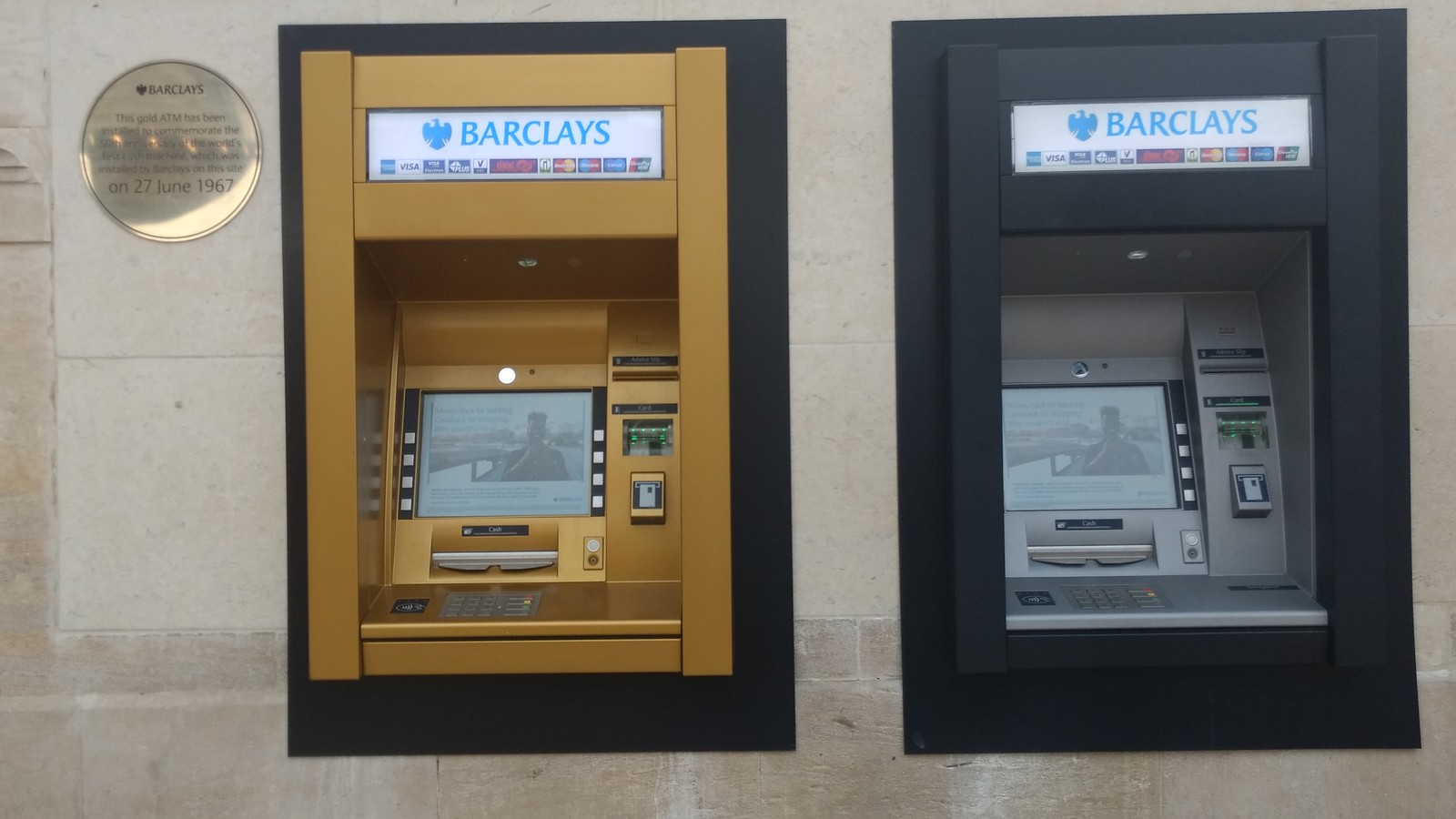
The original Enfield dispenser has long since been removed, as Historic England records. The gold-coloured machine in the photograph is a later commemoration, photographed in 2017. It marks the place without reproducing the original mechanism.
That distinction is worth keeping when looking back at an object that has become ordinary. A modern-looking machine beside a plaque can make its beginning seem closer to today's experience than it was.
The most revealing part of the Enfield story may therefore be the least machine-like: a piece of paper obtained from a teller. Cash had reached the wall. The entire banking relationship had not moved there with it.
Sources and scope
The linked Historic England record, Wells Fargo corporate history and Bank of England Museum account describe different parts of early cash withdrawal. This story distinguishes their systems rather than treating them as one design. It does not make a universal first-invention claim, specify the denominations dispensed at Enfield or claim measured customer reactions.