
Closing a cereal box and closing the bag inside it are two different tasks. A cardboard flap can make the package look finished while leaving the inner bag folded, rolled or held with a clip.
The new Cheerios with Ziploc PantrySeal addresses that second task. General Mills announced the packaging option on 27 October, for Cheerios and Honey Nut Cheerios in the United States. The resealable bag remains inside the box. Its top opens only partway across, forming a pouring opening that can be closed again.
It is a small-looking change with several layers beneath it: how cereal leaves a bag, how the package fits a familiar routine, and what must happen before a closure can become part of a large manufacturing operation.
There is also an important historical wrinkle. Resealable cereal bags did not begin with this launch. Understanding the earlier version makes the current one more interesting, because it reveals exactly what has changed—and what has not.
The box and the bag have different jobs
The actual launch photograph on General Mills’ announcement shows familiar yellow cartons with a prominent blue PantrySeal band near the top. The package still introduces itself as Cheerios. The new closure is an additional feature the exterior has to explain.
That is quite different from abandoning the carton and selling the cereal in a standalone pouch. In this design, the outer package remains the recognisable surface while the inner one gains another function.
Our reading is that the two layers can divide the work. The carton supplies a broad face for identification and information, as well as a shape someone can place on a shelf. The bag contains the cereal. A resealable opening adds something to the bag without requiring the exterior to become a storage container in its own right.
That distinction helps explain why simply tucking in the cardboard tab is not the same operation as sealing the contents. One closes the outer structure. The other concerns the route into the inner package.
It also changes what the blue band means. This is not merely another colour introduced to refresh the box’s appearance. It points to a feature that a person is meant to use after opening the pack. Whether that feature is convenient has to be judged through the opening, pouring and closing sequence, not just through the shelf photograph.
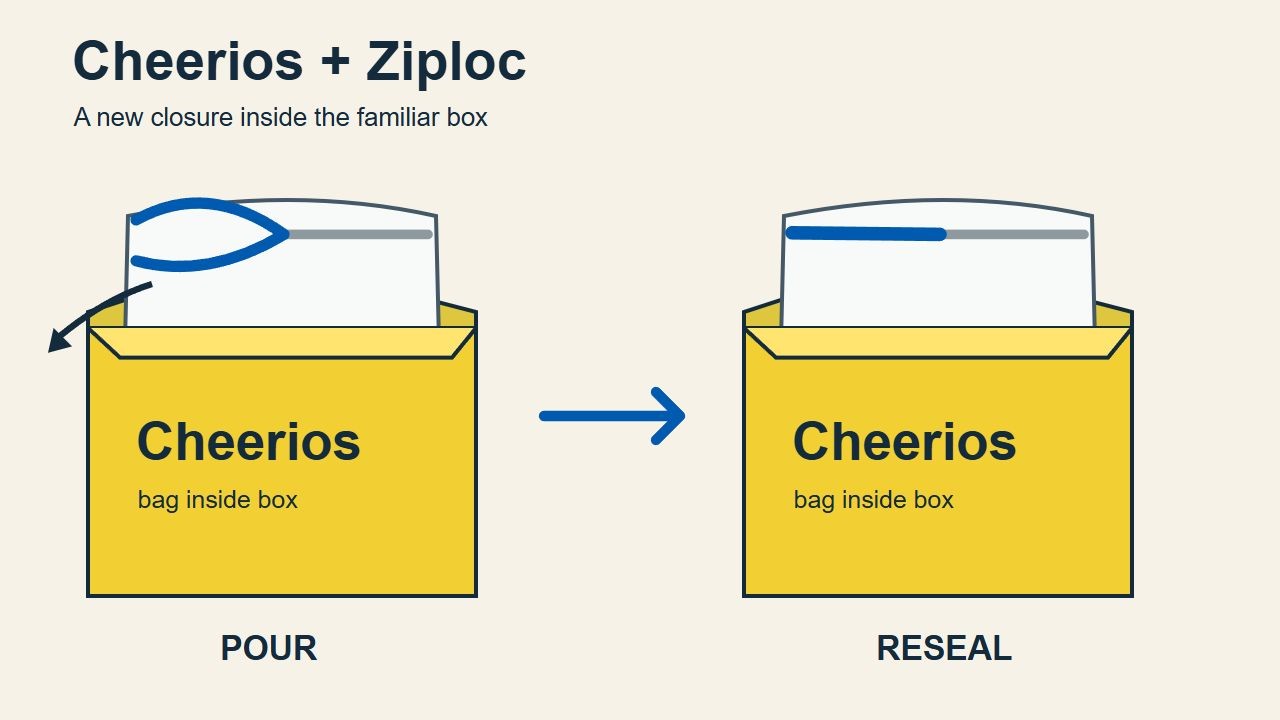
The schematic above isolates that sequence. It is an explanatory drawing, not a reproduction of the retail pack or an engineering diagram of its exact construction.
Why the opening does not run all the way across
Food Dive’s launch report describes the Ziploc closure as extending across about half the bag. General Mills calls the resulting partial opening a pour spout.
That is the most useful detail to notice. A zip added across an entire bag would answer the question of how to close it again. A shorter opening also changes the available route out of it.
The idea brings dispensing and storage into the same feature. Open the designated section to pour, then close that section before returning the pack to the shelf. The remaining top does not need to become a second opening for the concept to work.
This is a description of the intended design, not a result from our own kitchen test. The launch sources do not establish how much less cereal a household will spill, how long an opened box will retain its texture, or how easily every user will operate the closure.
Those limits matter because the shape makes an appealing promise. It gives the cereal somewhere specific to leave the bag. Whether the real pack makes that movement easier depends on its material, the opening in use and the person holding it. A drawing can explain the arrangement; it cannot perform that test.
Still, the arrangement is more specific than the instruction to keep cereal fresh. It gives the user a repeatable operation built into the packaging, instead of leaving the method of closing it entirely to them.
An earlier cereal pouch already used a shorter zipper
The combination of a partial zipper and a pouring opening has a documented history in cereal packaging.
In a 2010 Cereal Foods World article hosted by Zip-Pak, Elizabeth Sheaffer describes Malt-O-Meal’s resealable cereal pouches. The article says their zipper ran across two-thirds of the top, creating a built-in pouring opening when unzipped.
Sheaffer was Zip-Pak’s North American marketing manager. This is a supplier’s account of its work, not an independent comparative product test. Zip-Pak and the Ziploc brand in the Cheerios partnership are different names; the document does not establish a connection between their technologies.
The earlier example is useful without such a connection. It shows that a closure could already be designed to do two jobs: limit the opening for pouring and close the bag again afterwards. That principle was being discussed in a cereal-industry publication sixteen years before this announcement.
It also shows a different relationship between bag and box. The Malt-O-Meal example concerns a pouch, rather than a new closure inside the familiar Cheerios carton. The formats should not disappear into a single claim that cereal has finally become resealable.
General Mills describes its new product as the first resealable bag inside a traditional cereal box. We have not established an exhaustive history that independently verifies that priority claim. The narrower, observable development is enough: Cheerios is adding a branded resealable inner bag while retaining the carton.
The 2010 account therefore does not prove that nothing is new. It makes the novelty more precise. A long-established packaging idea can become a new option in a particular product and format, without becoming a newly invented principle.
A familiar idea still has to become a manufacturable pack
Recognising an idea is only one part of introducing it to an existing product. The packaging must also reach the point where it can be made repeatedly.
In Fast Company’s 29 October interview, Emilie Knox, General Mills’ vice president and business unit director for Cheerios, describes the need to develop a solution that worked reliably at scale while remaining intuitive to use.
The company says nearly one box of Cheerios is produced every second. That is a company statement about Cheerios’ production scale, not a measured speed for a particular new packaging line. Fast Company also reports that the new bags are made at the Buffalo facility and that General Mills wanted to avoid disrupting existing production.
Those comments explain the problem the company says it worked on. They do not disclose the machinery changes, development timetable, extra unit cost or manufacturing compromises. Nor do they establish why the change arrived in 2026 rather than earlier.
The useful tension is between two views of the same object. From the pantry, a closure is something that should open and shut without much thought. From production, it must become a repeatable part of the package. A concept can be simple to understand while still needing development before it works in that setting.
The earlier pouch example and the new interview belong together here. One establishes that the general idea has a history. The other describes the company’s task of applying its own solution at Cheerios scale. Neither makes the other irrelevant.
Two brands meet inside an everyday routine
This partnership also gives the familiar names different roles. Cheerios identifies the cereal; Ziploc identifies the resealing feature. The customer is being asked to understand the collaboration through what the package does.
That makes it different from a flavour inspired by another brand, or a collectible design on the outside of a box. The intended benefit occurs during repeated use: opening, pouring, closing and putting the carton away.
The exterior has to communicate that distinction before the person reaches the bag. In the launch photograph, the blue band makes the partnership visible above the established cereal branding. Once the pack is opened, the feature is expected to make sense physically.
Our interpretation is that this creates a more demanding relationship between appearance and function. A badge can tell someone a feature is there. It cannot substitute for that feature being usable. The strongest evidence will eventually come from how the package behaves through ordinary repeated handling, not from how many people recognise the two names.
For now, the announcement and trade coverage establish the intended operation. They do not establish repeat purchase, customer preference or a commercial result from the partnership. The fact that a common task has an understandable proposed solution is a reason to examine the design, rather than proof that its market outcome is settled.
An additional option, with questions still open
The initial release is a United States launch through Walmart.com, with wider US retail distribution planned for the following months. General Mills presents it as an additional packaging choice for the two cereals, not an immediate replacement for every existing box. There is no Irish launch promise in the announcement.
That scope matters to a reader who has just seen a headline about Cheerios changing its packaging. Finding a conventional bag in a different market would not, by itself, contradict the stated launch.
There are also questions the published material does not answer. The announcement offers no quantified comparison of freshness duration. It does not provide enough material or lifecycle information to judge the new pack’s overall environmental impact. A closure intended to reduce waste cannot, on that description alone, establish the total balance between packaging and discarded food.
The 2010 supplier article discusses environmental and commercial benefits of other packaging formats. Those claims cannot simply be carried over to this product. Different materials, products and conditions need their own evidence.
The most interesting part of the Cheerios change is therefore quite concrete. It preserves a familiar exterior while giving the inner bag a designated way to open and close. The shorter opening is part of that idea, rather than an incomplete version of a full-width zipper.
A cereal box can remain recognisable while the routine inside it changes. Whether this particular option fulfils its promise is still a question for the pack in use. What the launch already offers is a clear case of packaging design reaching beyond the printed face and into the next bowl.
Sources and scope
General Mills’ linked announcement and pack photograph establish the product description and stated launch scope. Food Dive and Fast Company provide recent trade and design reporting, including Knox’s attributed comments. The linked 2010 Cereal Foods World article documents an earlier pour-spout pouch and identifies its supplier author. Design comparisons are Time for Designs’ interpretation; no hands-on testing, independent freshness result, historical priority finding or sales outcome is claimed. Checked on 30 October 2026.