
A free trial seems to put a decision in the future. Try the tool first. Find out whether it does the job. Decide afterwards whether it is worth paying for.
But the tool and the arrangement for paying for it are two different things. You may be choosing the second before you have finished testing the first.
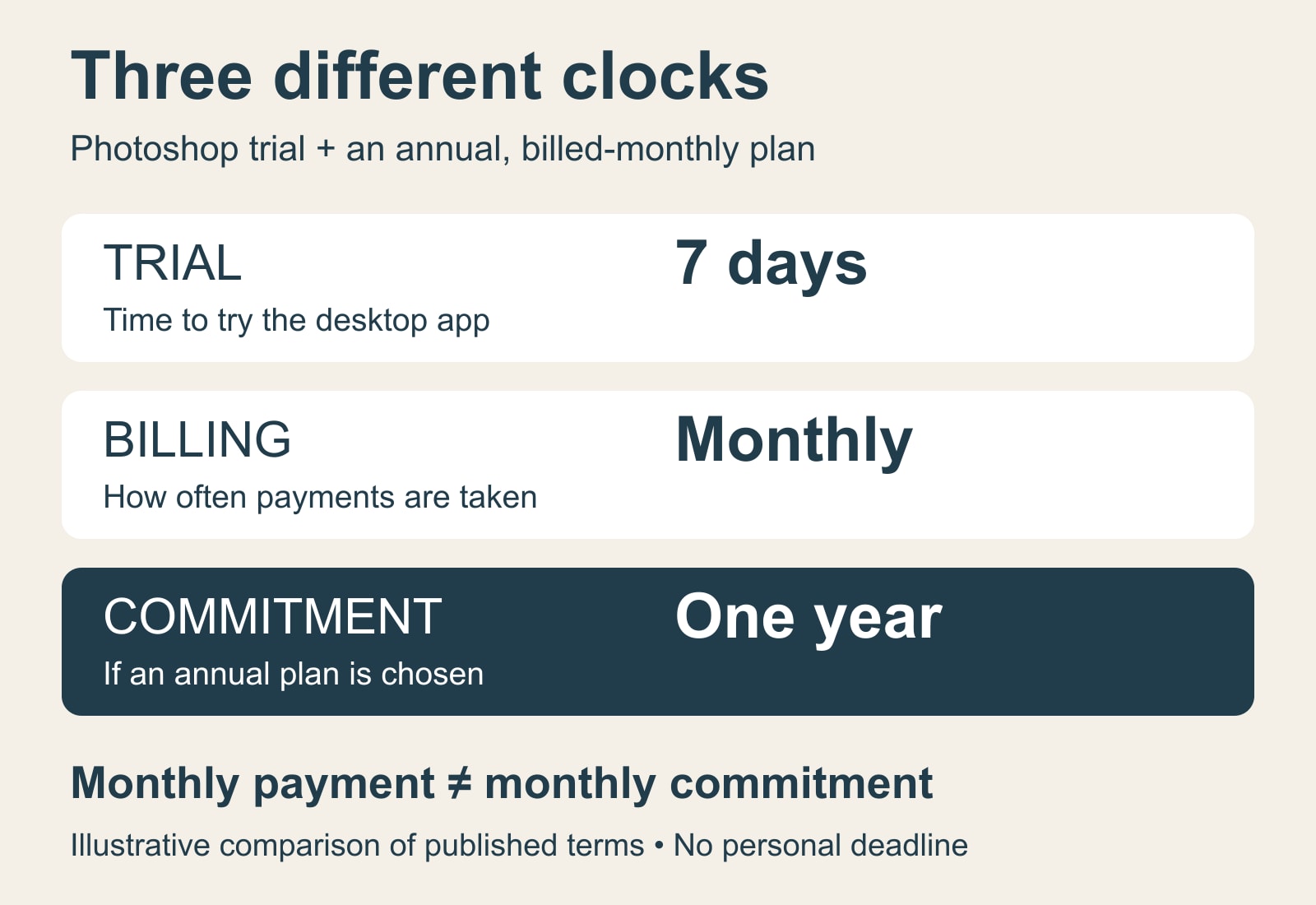
Adobe's public Photoshop desktop trial page offers seven days and explains that the trial converts automatically to a paid Creative Cloud subscription unless cancelled. It also tells people to choose a plan and billing option when starting.
That is where an apparently simple week can acquire a much longer future. A trial period, a billing interval and a commitment period do not necessarily run on the same clock.
The month on the bill and the year in the plan
The distinction is explicit in Adobe's Ireland-localised explanation of subscription terms, updated on 15 October 2026. It separates an annual plan billed monthly, an annual plan paid upfront, and a monthly plan with no annual commitment.
The first and the third can both produce monthly payments. They are different arrangements.
One spreads an annual commitment across instalments. The other has no annual commitment. The rhythm at which money leaves an account cannot, by itself, tell the customer which one they have chosen.
This is an unusually important job for a few words beside a price. “Annual” describes the commitment; “billed monthly” describes payment. Removing either part changes the reader's understanding.
For somebody who expects to need the software throughout the year, an annual arrangement may fit the intended use. Someone completing one short project is asking a different question. An affordable-looking payment does not settle whether the duration suits that need.
The useful comparison is therefore not simply which monthly figure looks smaller. It is what each figure buys—and for how long the person is agreeing to buy it.
The trial tests the tool, not the whole year
A week can reveal something about an app. Perhaps a necessary feature is there, perhaps the workflow suits, perhaps the computer handles it comfortably. Those are sensible things to learn before depending on software.
It cannot reveal every future change in someone's needs.
A family project can end. A course can finish. Work that seemed regular can become occasional. None of that makes the original trial meaningless. It explains why a successful trial and a suitable long-term commitment are separate judgements.
The difference also runs the other way. Someone may intend to keep using a tool despite not mastering it during the trial. An unfamiliar interface does not automatically make a year unsuitable, just as enjoying the first week does not automatically make a year sensible.
The offer asks the person to make two decisions with different evidence. Can this product do what I need? Does this continuing arrangement fit the way I expect to use it?
The first can become clearer through trying. The second needs the terms before trying begins.
“Cancel” does not answer the money question on its own
Adobe's Ireland-localised terms page gives the distinction a financial consequence. For a direct annual plan billed monthly, it says a cancellation charge of 50% of the remaining contract obligation may apply after the stated 14-day period. It describes different outcomes for annual prepaid and monthly plans without an annual commitment.
That is Adobe's published policy, not a calculation of anybody's bill or a judgement that a particular charge is lawful. The exact plan, timing, purchase channel and applicable rights matter. A trial's seven days should not simply be added to a separate refund period to invent a personal deadline.
The important discovery is more basic: being able to cancel and being able to leave without a further financial consequence are different claims.
A cancellation button describes an action available to the customer. The contract describes what that action means at that point. A person who knows only the first has not yet understood the second.
This is not unique to software as a way of thinking. An instalment describes how a payment is divided. A term describes the period agreed. Familiar monthly amounts can make unlike commitments look alike if the duration drops out of view.
For a household, that distinction concerns flexibility as much as price. The ability to stop buying something can have value when future needs are uncertain. Someone with a stable requirement may reasonably make another choice. There is no single arrangement that the word “monthly” makes suitable for everyone.
The end of a trial is not the only ending
There are several events that can be casually described as a subscription ending.
The trial can end and paid access begin. A billing period can finish while a commitment continues. A person can complete cancellation while retaining access for a period already paid for. A contract can reach its renewal point.
Treating those as the same event makes the whole arrangement harder to follow.
A renewal date asks whether another period will begin. An access end date asks when the person can no longer use the paid service. A payment date identifies when a charge is taken. These dates may be related without being interchangeable.
The distinction is useful before anyone reaches a cancellation page. It turns “What happens next?” into a concrete question about the next event, rather than a vague reassurance that the subscription is manageable.
It also explains why a price alone cannot describe the purchase. The calendar is part of what is being chosen.
A cancellation request still needs an ending
Adobe's published cancellation guide continues beyond selecting the cancellation option. It includes reviewing the details and confirming cancellation, then checking a confirmation email or the account page. It also distinguishes subscriptions bought directly from Adobe from those bought through another provider.
That is a description of the company's documented process, not a test of a customer's account or a claim that every screen is identical.
Its wider interest is the difference between setting out to do something and knowing it has been done. Finding a cancellation option, starting the process and receiving confirmation are different states.
This matters because the reader's memory and the service's record need to agree. “I went to cancel” describes an intention and perhaps several actions. A dated confirmation records an outcome that can be referred to later.
It should not take hostility towards a service to want that clarity. A person can value a product, use it successfully and still need a dependable way to finish the relationship.
The work can remain when the paid tools do not
There is another future to consider: the things created during the subscription.
Adobe's Ireland-localised account-access explanation distinguishes paid app access, continuing account benefits, cloud storage and locally saved files. It says locally saved work remains accessible on the device, while paid services and storage have their own conditions after cancellation.
Possessing a file, keeping it stored and retaining the same paid tools for editing it are different capabilities. None should be silently substituted for the others.
This gives a trial another useful purpose. Beyond exploring an attractive feature, someone can investigate what the finished work consists of and which tools they expect to need later. A project can be finished today and still require a small revision next year.
That does not establish that one subscription is unsuitable or that every file needs continued paid access. It explains why the output belongs in the decision. The relationship is not only with an app; it may also involve work the person wants to keep using after the subscription changes.
Automatic does not automatically mean improper
In Ireland, the CCPC explains that subscription auto-renewals are generally legal when clearly disclosed. It emphasises understandable terms, visible costs and clear cancellation conditions.
The useful standard is therefore more precise than disliking all recurring payments. A continuing service can be convenient. Someone who needs it regularly may prefer continuity to repeatedly arranging access.
The question is whether the continuing arrangement is understood at the moment it is chosen, including how it ends. That cannot be answered by declaring every free trial generous or every automatic renewal a trap.
Where there is a dispute, the European Consumer Centre Ireland advises checking the signup documentation and raising it with the business. A general article cannot decide an individual's refund entitlement from the word “trial”.
The decision that was already there
The phrase “try before you buy” is attractive because it offers experience before commitment. With an automatically converting subscription, the arrangement requires a more careful reading: try the product within an agreement whose later stages have already been described.
That can still be a useful offer. The trial can prevent a purchase that would not suit. The subscription can provide continuing access that somebody wants.
But the week of testing does not replace the decision about duration, payment, exit and future access. Those belong to the offer from the beginning.
The trial ends on a date. Understanding what happens next starts before it begins.
Sources and scope
This story follows Adobe's public Photoshop trial description and its published subscription, cancellation and access explanations, alongside Irish consumer guidance. The Photoshop trial page redirected from the Irish route to the global page; no Irish price, eligibility or personal deadline is asserted. Plan terms and purchase channels differ. No account was created or cancelled, no checkout test was performed, and no finding of wrongdoing is made. Sources inspected 30 October 2026.