
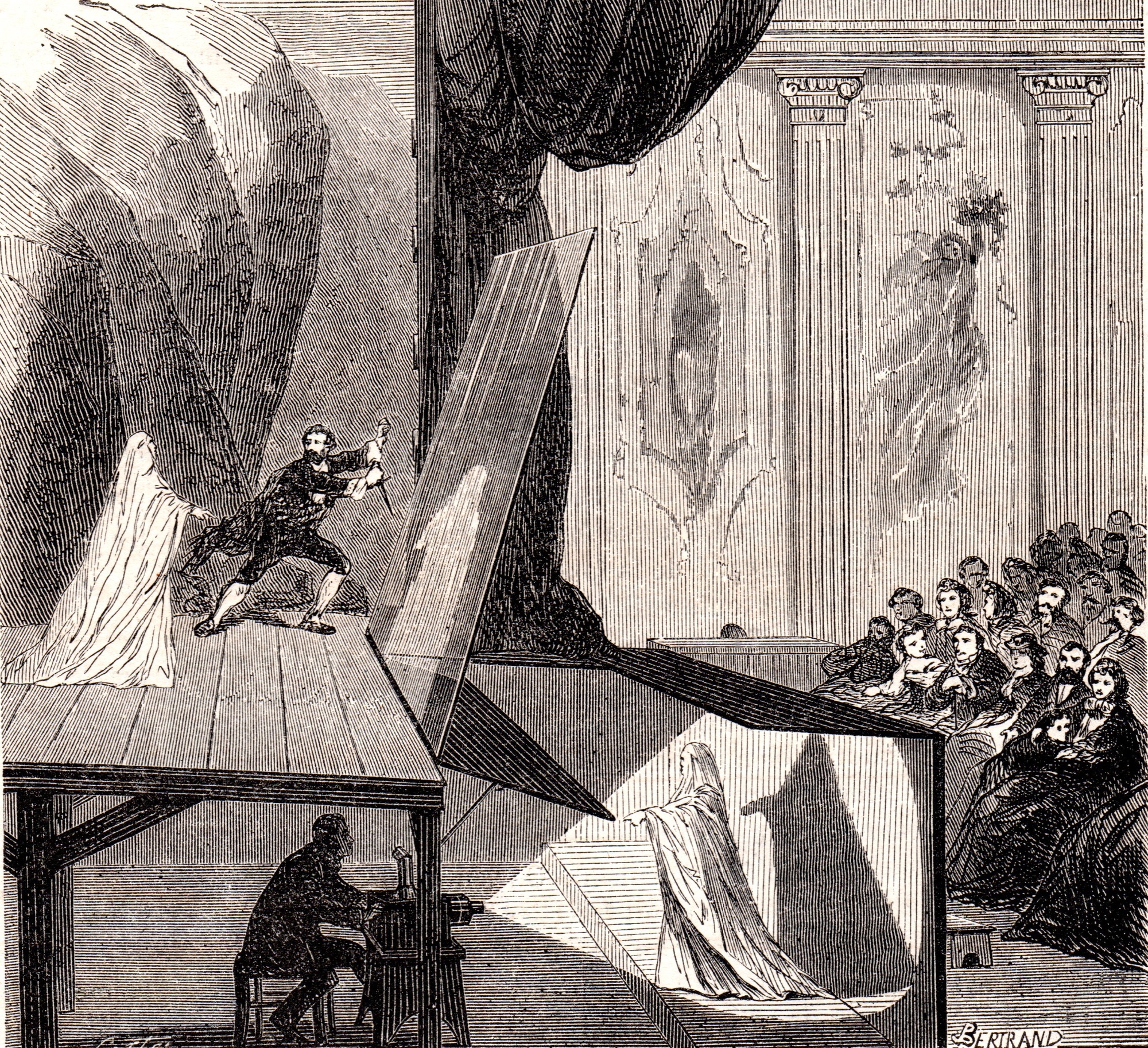
The engraving gives away something the audience was meant to miss. Above the stage floor, a pale figure reaches towards a man. Below it, another draped figure leans back under a bright light. Between the audience and the scene stands a great sloping pane of glass.
Published in Le Monde Illustré on 21 January 1865, the picture exposes the machinery of Pepper’s Ghost. It is an explanatory engraving, not a photograph of a performance. Its cutaway lets us inspect the two spaces that spectators were supposed to experience as one.

The glass is the famous part. The less familiar parts are just as revealing: the performer’s posture, the light that follows a movement, and the marks needed by an actor who cannot see the ghost.
A window with two jobs
Clear glass can let us see through it while also showing a reflection. Idaho State University’s explanation of the effect describes how those two views can appear together. The arrangement and lighting make an object on one side seem to share a place with something seen through the glass.
Pepper’s Ghost enlarged that relationship into a stage scene. Spectators looked through the pane at the visible stage. Light from a hidden performer reached them by reflection. The performer’s image therefore seemed to occupy the scene beyond the glass.
The 1863 specification reproduced in Pepper’s book describes a second, lower stage concealed from direct view. This was where the phantom’s human source stood. The ordinary stage remained available for a living actor to share the apparent space with the apparition.
That distinction explains why the hidden room mattered. The illusion did not require the performer to become invisible. It required the audience to lose their direct view of that performer, while retaining a reflected one.
The disappearance was a lighting cue
The apparatus could make its ghost appear without moving a new body onto the visible stage. It could also remove the image while the performer remained below.
The specification called for the hidden stage to be much more strongly lit than the visible stage or the house. Withdraw that light, and the reflected figure disappeared. Restore it, and the apparition returned. The ordinary scene could remain visible throughout.
The fuller description of the lighting controls allowed both sudden and gradual changes. A board or an opaque shade could mask the light. A fade was therefore part of the design, rather than an effect that depended on the performer running away.
Movement brought another demand. The hidden performer had to stay lit while moving. The document proposed moving the lights with the performer, or lighting the whole space through which they would pass. A convincing entrance was only the beginning; the apparatus had to keep supplying the image through the action.
Why the hidden performer leaned back
In the engraving, the lower figure is not standing like the apparent figure above. That odd posture belongs to the mechanism.
The specification’s description of the hidden stage placed a dark support behind the performer. They leaned against it, close to parallel with the glass, so that the reflected image would appear upright on the visible stage.
The support and lower stage were covered in black velvet or another dark material. Their purpose was to disappear from the reflected scene, leaving the illuminated person to carry the effect. A clearly reflected platform would have brought unwanted furniture into the ghost’s world.
Seen this way, the lower stage was more than a hiding place. It was a scene arranged for reflection. Its posture, background and light were chosen for the picture that the audience would receive elsewhere.
The cutaway makes that separation unusually clear. The performer occupies one physical position. The audience encounters an image in another.
The actor could not see the partner
One of the most useful instructions concerns the person on the ordinary stage. According to the specification’s performance directions, those actors did not themselves see the spectral images. Marks or other indications were needed to show them where the audience would see the apparition.
This changes how we read the confrontation in the engraving. The visible actor’s gesture could not simply follow a ghost that appeared in front of their own eyes. It had to meet an image located for the spectators.
There were two separate tasks: put the reflected figure in the right place, and put the visible actor’s response in relation to it. The stage marks connected those tasks. They gave a physical reference to something that existed, for the audience, as a reflection.
The illusion thus depended on more than successful optics. A person could see the correct image and still watch an unconvincing encounter if the other performer faced the wrong place. That is a consequence of the arrangement described in the patent, rather than a claim about any particular failed show.
A ghost designed for particular seats
The glass also had to work for people sitting at different heights. Its angle was not treated as a number to apply blindly.
The adjustment procedure placed observers in the pit and gallery. They told the person adjusting the pane when the image looked right. The fuller text describes checks from different parts of the house.
It also admits a boundary. Extreme positions that could not see the relevant part of the stage through the glass were excluded. A large audience did not mean that every possible viewpoint would produce the same illusion.
Scenery had another job: conceal the glass frame. The document even describes raising the pane into position during a scene under subdued light. An actor could first cross the space it would later occupy, reducing the audience’s reason to suspect a barrier there.
These details explain why a pane alone was not a portable ghost. The seating, stage opening, concealed space and scenery all formed part of the effect. The audience’s view had to be planned alongside the apparatus.
Two names behind the apparition
Pepper helped bring the illusion before audiences at London’s Royal Polytechnic around Christmas 1862. The Corning Museum of Glass’s account also credits Henry Dircks’s earlier work and Pepper’s adaptation for theatres. The familiar name compresses a development involving both men.
Pepper’s own 1890 book is a participant’s retrospective, with a strong interest in his contribution. It should not settle every question of credit by itself. But the patent text he reproduced names both Henry Dircks and John Henry Pepper. It is dated 5 February 1863; the fuller specification was filed on 31 October that year.
The document’s closing claim is especially revealing. It does not claim each part separately. It claims their combined arrangement: inclined glass, two stages and controlled, stronger light on the hidden one.
That combination is what the old engraving lets us examine. A reflection supplies the apparition, but concealed scenery keeps the apparatus out of sight. A light cue makes the figure fade. A stage mark tells another performer where to respond. The ghost occupies a place in the audience’s view because a much larger arrangement has been built around it.
Sources and image
The mechanical details come from the 1863 specification reproduced on pages 5–12 of John Henry Pepper’s The True History of the Ghost (1890). This is the reproduced text, not a separately inspected original patent file. Idaho State University explains the reflection principle; Corning’s museum account supplies independent historical context. The image is Bertrand’s explanatory engraving in Le Monde Illustré, no. 406, 21 January 1865, p. 48, available as a public-domain reproduction on Wikimedia Commons.