
The man sits in a patterned chair, holding a compass over cards on a table. A small loom stands beside him. Light seems to pass through the curtain at the window. The face and coat are built from delicate changes of tone.
It is an elaborate setting for a portrait. It is also a portrait with a second subject: the process that made it.
The Metropolitan Museum of Art identifies this 1839 picture of Joseph-Marie Jacquard as woven silk. Its shading belongs to the fabric’s pattern. Looking at it as a print misses the unusual achievement: a loom was made to produce this detailed image as it wove.
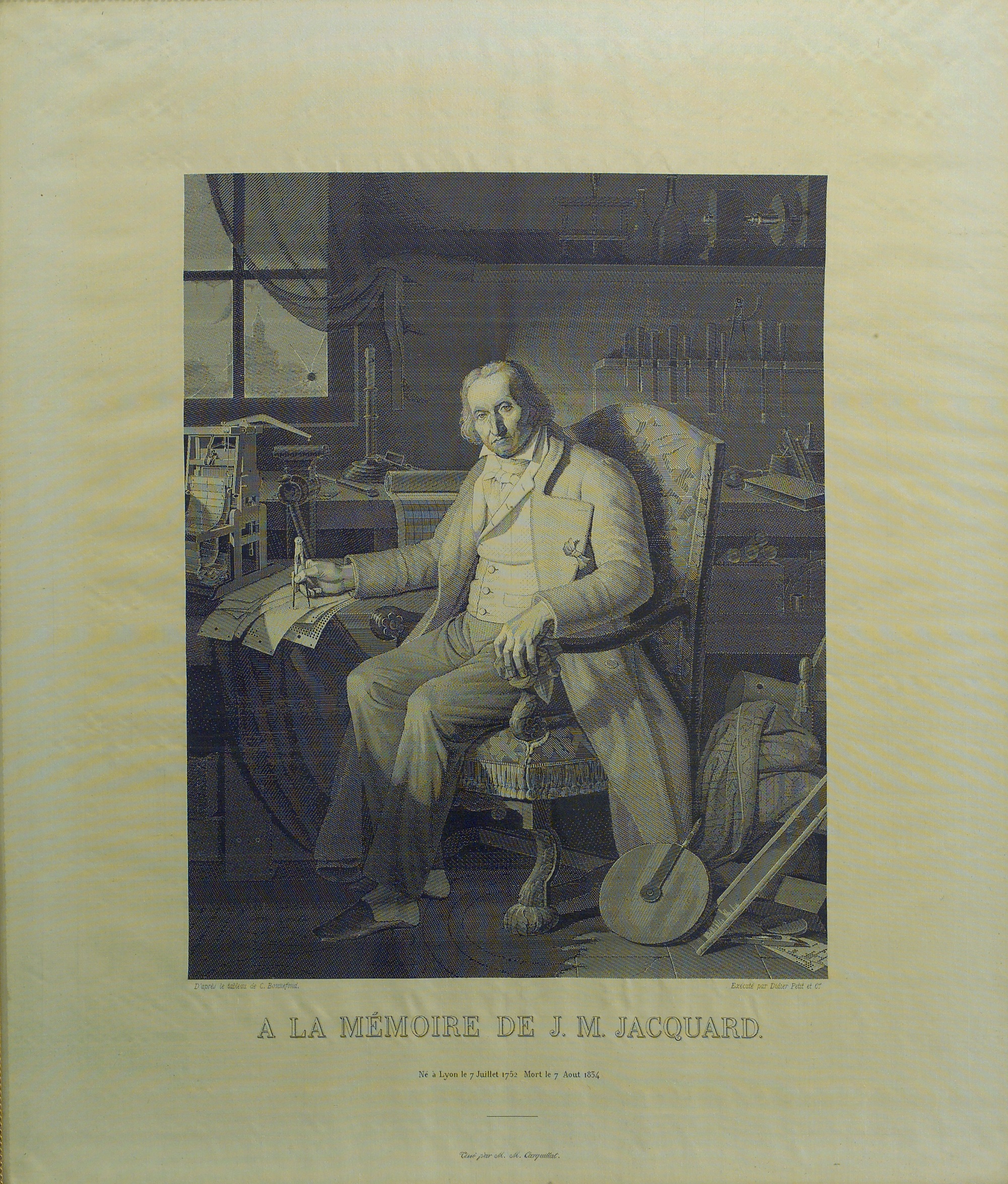

A portrait with several makers
Jacquard is the person being commemorated, rather than the weaver of his own likeness. He died in 1834, five years before the silk portrait’s date.
The Met traces the composition to a painting by Claude Bonnefond, commissioned by the city of Lyon in 1831. The manufacturer Didier, Petit et Cie ordered the woven version from Michel-Marie Carquillat, who specialised in such work.
Those names describe different parts of the achievement. Bonnefond supplied the painted composition. The manufacturer commissioned its translation into silk. Carquillat’s work brought a highly detailed picture into a medium with its own physical demands.
The choice of subject gives the result a particular force. Jacquard’s mechanism controlled patterns on a loom. Here, that system was used to depict Jacquard among the tools and cards associated with weaving. The picture honours him through its subject and through its construction.
How a card becomes a choice about thread
The card did not contain a small photograph waiting to be enlarged. It carried instructions for a mechanical selection.
The Science Museum Group’s hand-operated Jacquard loom gives a clear example. Made around 1910 for teaching weaving, it is a later machine, not Carquillat’s 1839 apparatus. Its linked cards form a loop at the top of the loom.
Each card meets a set of pins. A pin can pass through a hole; an uncut part of the card stops it. That arrangement controls which warp threads are lifted. The warp consists of the lengthwise threads held on the loom; the weft passes across them.
The cards move on as the weft passes through. A sequence of choices therefore becomes a sequence of interlaced threads. The weaver operates the mechanism with a foot lever on this teaching loom.
That is the bridge between holes and a visible image. The instructions affect which threads are raised for the next pass, and the cloth takes shape through those repeated actions. The portrait’s fine lines and shaded areas are the result of a pattern carried out in thread.
The difficult work began before the loom read the cards
The finished silk can make the process look almost like a mechanical trick: feed in cards and receive a portrait. The preparation is where much of the story lies.
In the Science and Industry Museum’s explanation of Jacquard pattern-making, a designer first puts the pattern onto grid paper. It is then transferred to punched cards. The loom head reads the prepared sequence and reproduces the pattern.
The grid and the cards are stages in translating a design into actions. A painted curtain cannot simply be placed into the machine. Its appearance has to become a pattern that the weaving mechanism can carry out.
The Met draws attention to the portrait’s convincing treatment of a translucent curtain over window panes. This is a particularly demanding part of the illusion. What looks see-through belongs to the scene being represented: the woven image has to describe both the curtain and what appears behind it.
The face asks for another kind of control. Broad areas of light and dark have to meet small features without losing the expression. Recognising the picture’s material makes these familiar details newly interesting. The viewer can read a face quickly; producing its likeness in interlaced silk required a long sequence of decisions.
The picture that fooled a cataloger
The resemblance to a print has continued to cause confusion.
In a 2017 Library of Congress interview, cataloger Woody Woodis describes finding another copy while looking through the collection. He initially thought it was a fine mezzotint—a kind of print—and then a print on fabric.
Closer inspection changed that view. The image was woven. He describes its reverse as looking like a photographic negative. Turning the object over made its construction harder to mistake.
This was the Library of Congress’s copy, rather than the Met object pictured here. Its account reports that the design was said to need about 24,000 punched cards. That is a reported figure for the work’s scale, rather than a timed demonstration of how quickly a portrait could be woven.
The cataloging story is useful because the confusion begins with a perfectly reasonable visual response. A familiar-looking image encourages us to assume a familiar process. The back of the cloth supplies evidence the front can conceal.
The pattern could stay while the threads changed
Charles Babbage found the relationship between cards and material useful for explaining something beyond weaving.
In his 1864 account of the Jacquard principle, he describes artists designing patterns and another skilled worker transferring those designs to punched cards. The loom then follows the stored arrangement.
He asks the reader to imagine using white threads for both warp and weft. The cloth would be one colour, but the woven pattern would remain visible as damask. The manufacturer could then use the same cards with differently coloured warp threads: the form of the pattern would stay, while the colours changed.
This is Babbage’s general example, not a claim that the Met’s portrait was woven entirely in white. Its value is the distinction it makes. The cards preserve an arrangement of actions; the threads supply material on which those actions work. Changing one need not mean changing the other.
That distinction is more revealing than simply calling the loom an early computer. In the following explanation of his planned Analytical Engine, Babbage describes cards for operations and cards directing which quantities they act upon. The textile process gave him a concrete way to explain the role of instructions.
A picture that could explain a machine
Babbage also owned a woven Jacquard portrait. In his recollection of an 1842 visit, published in the same memoir, he describes showing it before a demonstration of his Difference Engine. He thought the portrait would help explain calculating machinery.
It was a useful object for that purpose because it showed a complex result from a prepared sequence. Yet it remained a work of skilled image-making, with a painter, a manufacturer and a weaver in its history.
The full portrait brings those ideas back together. A man sits with cards and a loom; his likeness has itself been woven through controlled choices about thread. The shaded face is the immediate attraction. Looking longer reveals a picture of a process, made by that process, with much of its preparation held outside the frame.
Sources and image
The Met’s record for object 31.124 identifies the selected 1839 silk portrait and its makers. The Science Museum Group’s later teaching loom and museum pattern-making account explain the mechanism; they are not records of the exact loom used for this portrait. The Library of Congress interview concerns its own copy. Babbage’s Passages from the Life of a Philosopher (1864) supplies his explanation and recollection, rather than a modern test of either machine. No surviving loom or portrait was handled for this article.