
A ticket can look complete while it is still one piece of paper. The more revealing moment comes when somebody tears off the stub.
Which part goes through the entrance? Which part stays with the organiser? Where is the number now? Has the person keeping the larger piece also kept the information they need?
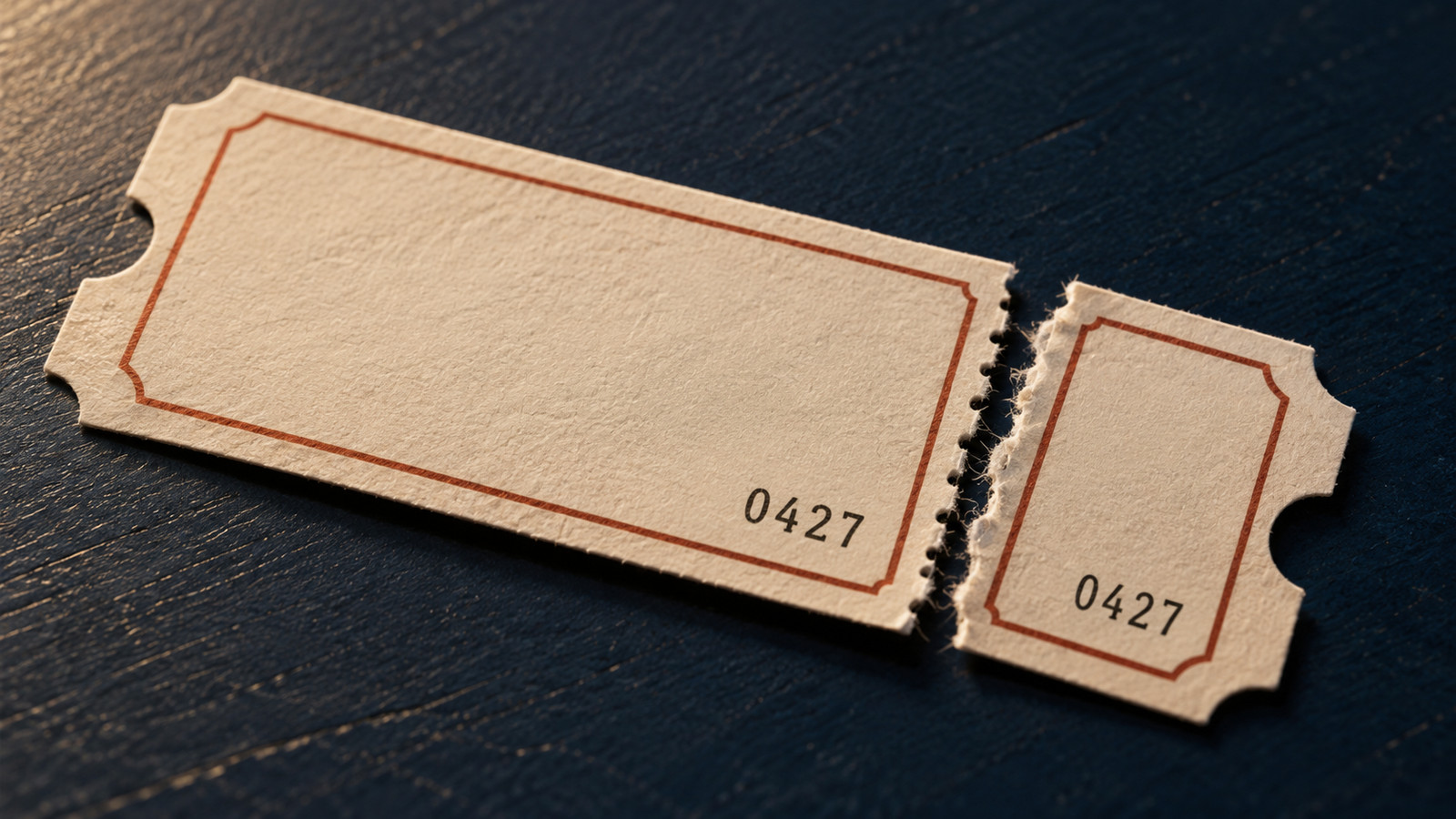
A perforation is a planned separation. The artwork needs to work before that separation and after it. Thinking about both pieces early can prevent a polished design from becoming two confusing scraps at the door.
Start with the handover, rather than the dashed line
Imagine a fictional event ticket with a short detachable stub. An attendant keeps the stub while the visitor takes the main ticket into the venue.
The designer needs to know that arrangement before deciding what belongs on each side. If the main ticket carries the event name but the retained stub has only an unexplained number, will the organiser know what that number refers to later?
There is no single answer for every event. The question is what each person will actually do with the piece they receive. A number may be enough within one clearly controlled batch; another job may need a category or event identifier too.
Draw the handover in plain words: person, piece, purpose. Then review the artwork against it.
A tear line and a number solve different problems
A perforation makes separation possible. Numbering identifies a ticket or part of a ticket. Specifying one does not explain the other.
Ticket manufacturer US-TICKET describes several constructions, including two-part tickets with matching numbers. Its coat-check example gives the relationship a clear purpose: one part accompanies the coat and another goes to the guest, so the pieces can be matched later.
Those are that producer's examples, not a universal ticket specification. The useful principle is the relationship between the records. Two pieces belonging to one transaction may need the same identifier, while different tickets within a batch may need different ones.
If matching numbers are required, say so explicitly. Also identify the starting value and how the supplied data should appear. “Numbered tickets” does not, by itself, settle the location, sequence or repetition of the number.
Keep necessary information on the right piece
Return to the fictional event. Put a finger over the detachable stub on the proof and read only what remains. Then cover the main ticket and inspect the stub alone.
Can each piece still do its agreed job? Look for a number stranded on the wrong side, an instruction divided by the tear line or a label that only makes sense when read alongside the other half.
This is a layout review you can do on a proof. It is not evidence that the physical tear or production process has been tested. The point is to find an information problem before treating a complete-looking rectangle as finished.
The same distinction helps with a ticket that has several detachable sections. More sections mean more resulting pieces to account for. Do not assume that each piece needs identical wording; identify what each one is for.
Use the actual producer's preparation rules
The finishing position needs to be communicated separately from decorative artwork. A dotted line in a design could mean a visible printed feature, a production instruction or both. Do not leave the printer to guess which was intended.
48HourPrint's ticket preparation guidance asks its customers for an additional mock-up showing numbering and perforation positions. It also gives particular clearances for its own numbering areas and perforations.
Those dimensions describe its process. They should not be copied into another producer's artwork as a universal rule. Ask for the template or instructions for the actual job, then make the production intention clear in the agreed way.
Likewise, PrintSafari's numbering-position instructions explain how selecting its perforation-and-numbering option affects where numbers appear. It is a useful example of why finishing and numbering choices need to be checked together rather than inferred from the preview.
A proof and a finished sample answer different questions
The proof can show whether the wording, identifier and separation position agree with the plan. A physical sample can reveal how the chosen construction behaves when handled and separated.
Agree what will actually be assessed before treating either as approval of everything. If easy separation, retained-stub size or a particular handling arrangement matters, describe that requirement to the producer. Avoid choosing an unverified stock or finishing setting to solve a problem by assumption.
For a printing enquiry involving detachable sections, bring the layout, quantity, required date and a short explanation of who keeps each piece. Ask which options are suitable for assessment; this guide does not establish a particular Time for Designs perforating or ticket-numbering capability.
A useful final check is simple: look at the two resulting pieces, not just the ticket before it is torn. The finish should preserve the purpose of the print.
Sources and scope
US-TICKET, 48HourPrint and PrintSafari provide the linked producer examples. The event and handover exercise are fictional editorial examples. Numbering and perforation are not presented as guarantees against copying, misuse or invalid admission; no raffle, gambling or ticketing-law advice is given.