
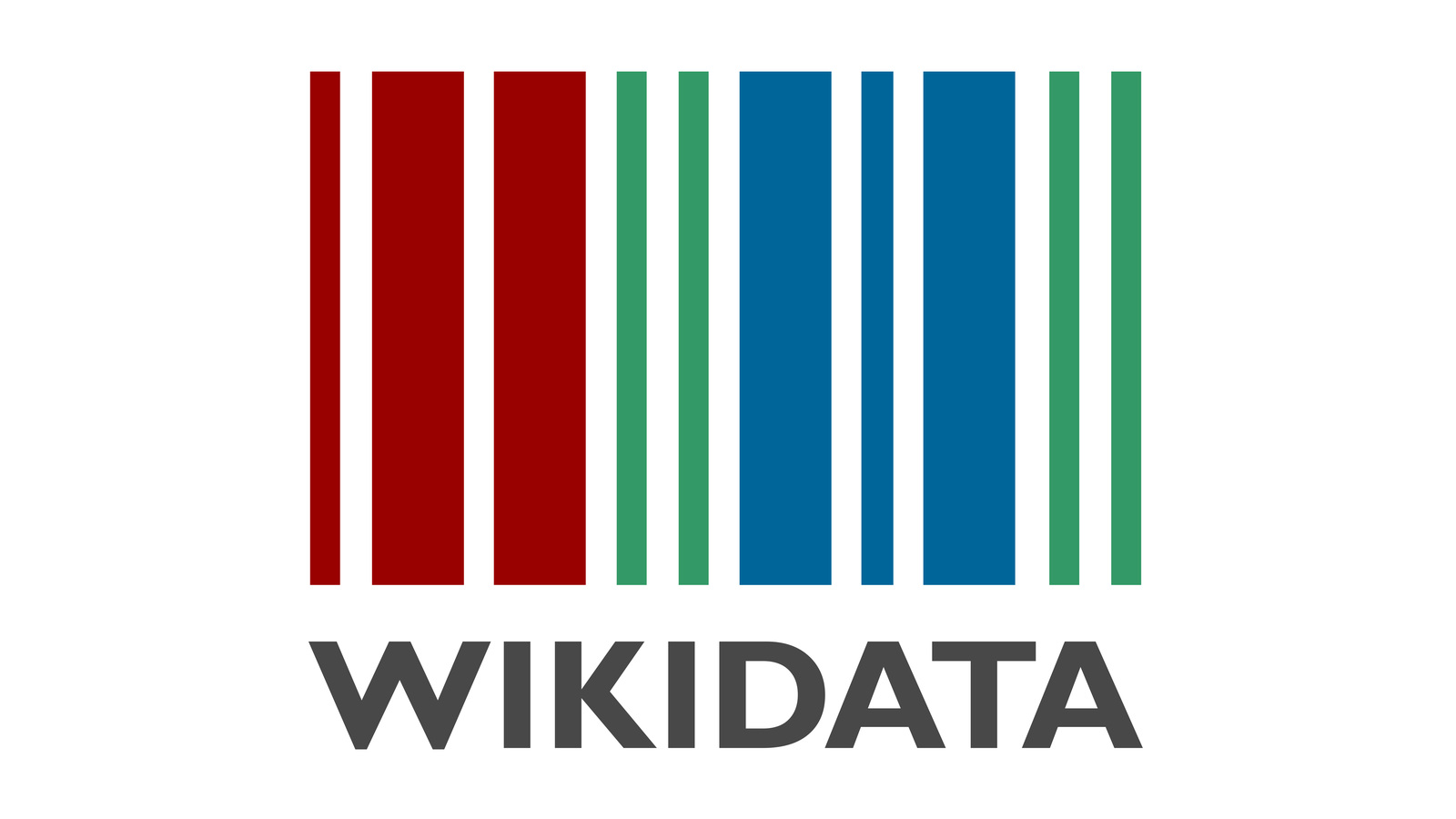

The bars look ready to pass under a scanner: red, green and blue strokes above the name WIKIDATA. But the useful way into this particular pattern is to read it as Morse code.
The word is WIKI. It appears twice in different forms: once within the name below the bars, and once in the widths of the bars themselves.
With Wikidata turning 14 on 29 October 2026, there is a timely reason to look again at an identity whose idea dates back to the project's beginnings. The mark carries a small explanation of what it represents.
Read the widths, not the heights
In the designer's original logo proposal, the contributor Planemad explains that the bars spell “wiki” in Morse. The proposal dates from June 2012.

Follow the strokes from left to right. A narrow bar stands for a dot; a wide one stands for a dash. The first three, in red, give dot–dash–dash: W. Two narrow green bars give I. The blue group gives dash–dot–dash: K. The final green pair gives another I.
The sequence can be written as four groups:
W: dot–dash–dash. I: dot–dot. K: dash–dot–dash. I: dot–dot.
Those letter patterns can be checked against the International Telecommunication Union's Morse code table, in Annex 1. The changing widths are doing the work that dots and dashes do in a written transcription. Colour helps you follow the four groups.
The distinction is worth keeping. The barcode resemblance invites a familiar association with encoded information. The documented message inside this mark is a word, expressed through Morse. It is not a miniature copy of Wikidata's contents or a product record waiting to be looked up.
Three ideas in one strip of bars
Planemad's original description sets out three things the proposal was meant to communicate: data, a wiki and a Wikimedia Foundation project. The barcode-like appearance suggests the first. The encoded word supplies the second. The colours come from the foundation's logo.
That makes the arrangement more specific than a collection of digital-looking stripes. Its form, message and colours each connect to a part of the project's identity.
The full English signature also spells out WIKIDATA in ordinary letters. The encoded part contains only WIKI; the name underneath completes the introduction. Those two pieces are doing different jobs within the same mark.
The database behind the name
Wikidata is a collaborative, multilingual collection of structured information. Its own introduction describes a knowledge base that supports Wikipedia and other projects, while also being available for others to reuse.
“Structured” can sound more mysterious than it needs to. Instead of putting everything into a paragraph, the system gives information named relationships. For a person, a statement might connect them with the school where they were educated. The person, the relationship and the school remain distinguishable pieces.
Items have identifiers beginning with Q followed by a number. They can have names and descriptions in different languages. Statements connect information, and references can show where claims came from.
That organisation helps explain the logo's choice of an encoded graphic. Information is being arranged so it can be read and reused, rather than simply displayed as a page of prose. It does not make every claim automatically true; the relationship between a statement and its supporting evidence still matters.
A birthday for the people maintaining it
The anniversary programme announces events across October and November. A separate Wikimedia New York City listing advertises a birthday gathering and mini-conference at Pratt Institute's School of Information on 30 October.
These are celebrations of an ongoing project. Behind the compact logo are editors maintaining items, connections and sources—the less immediately visible work described in the project's introduction.
The birthday offers an invitation to notice that relationship. The coloured bars contain a small, readable message. The project they identify is concerned with giving much larger collections of information a structure people and computers can use.
Look back at the first red group: narrow, wide, wide. It is the start of a word. Once the pattern is explained, the mark becomes something you can read as well as recognise.
Sources
The original designer's proposal documents the intended meaning; the ITU table supplies the Morse letter patterns. Wikidata's introduction explains the data model. The birthday programme and New York organiser's listing describe announced events for this week. The interpretation of how these elements work together is ours.