
You need two people to receive the same three-page handout. Six printed pages will supply enough content, but the order matters: do you want two ready-to-read sets, or piles of matching pages to assemble later?
That is the distinction behind collated and uncollated copies. Quantity describes how much is printed. Collation describes how the repeated pages are grouped.
Follow one complete document
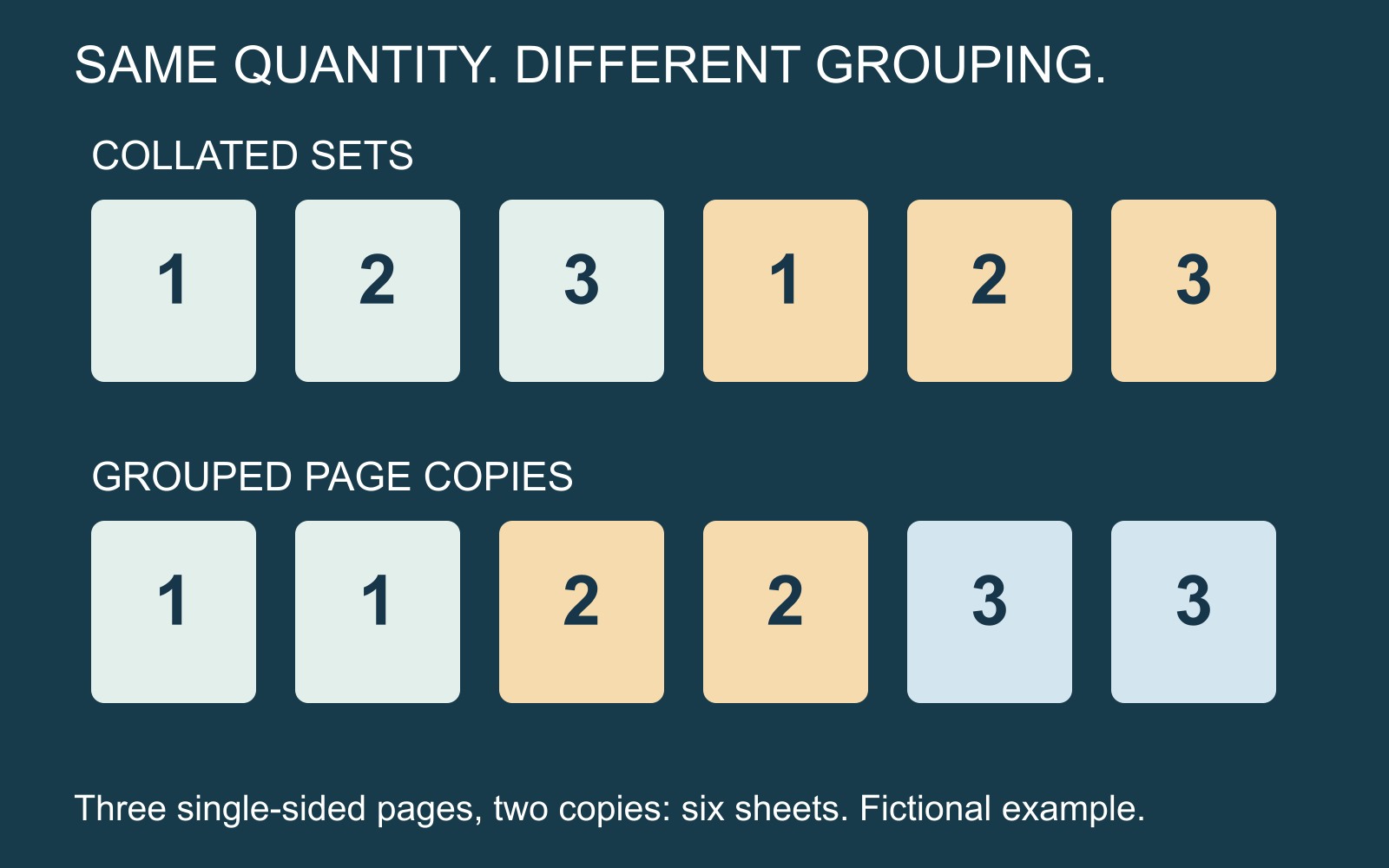
Brother's driver guidance explains that Collate repeats a complete document for each selected copy. Without collation, it repeats each page for the requested number of copies before moving to the next page.
Take a fictional three-page document, printed single-sided, with two copies required:
- Collated: 1, 2, 3 — then 1, 2, 3.
- Grouped by page: 1, 1 — then 2, 2 — then 3, 3.
Both arrangements contain six sheets in this limited example. Only the first already groups the pages into the two reading sets we described. This is an explanatory sequence, not the result of a printer test.
Describe what one recipient should receive
A clearer brief is “Two complete sets, each containing pages 1 to 3 in reading order” rather than simply “Two copies”. It makes the intended unit visible.
If the job contains several documents, identify whether each recipient needs all of them in one pack or whether each document should remain a separate set. A cover sheet, insert or different version needs a named position too.
Do not assume a filename explains that relationship. Label the files and provide a short list of the contents of one finished pack.
Collation does not specify every finishing choice
A set in reading order can still be loose. If it needs a staple, binding or another agreed finish, state that separately. Likewise, collated does not mean double-sided, and it does not specify which edge a two-sided document should turn around.
For folded booklets, explain the intended format and ask for the production requirements. Grouping repeated documents is a different decision from arranging pages on a sheet for folding.
Keep a reader-order master rather than rearranging the only original into guessed output piles.
Make the final arrangement part of the enquiry
For document printing and finishing, send the file, number of complete sets, pages per set, single- or double-sided requirement and intended finish.
If grouped page piles are actually useful for your assembly process, say so. The important point is to agree the arrangement someone should receive, rather than discover it after the total quantity has been printed.
Source: Brother's collation explanation. The three-page example is fictional and single-sided; no printer model or finishing method is promised.