
The awkward time to discover how a phone comes apart is after it has stopped working.
Until then, its sealed outline can make the question feel remote. The screen responds, the battery gets through the day and the charging port accepts a cable. Then one of those ordinary things changes. The phone may still be familiar and useful, but keeping it becomes a decision involving a diagnosis, a part, somebody's time and a bill.
An energy label now asks part of that question earlier. Among its battery figures and protection ratings, the EU label for smartphones includes a repairability class. It gives the future possibility of fixing a device a place beside the specifications used to sell it.
That is a useful change in the conversation. It also creates a new temptation: to let a reassuring letter answer more than it actually measures.
One A, six different scores
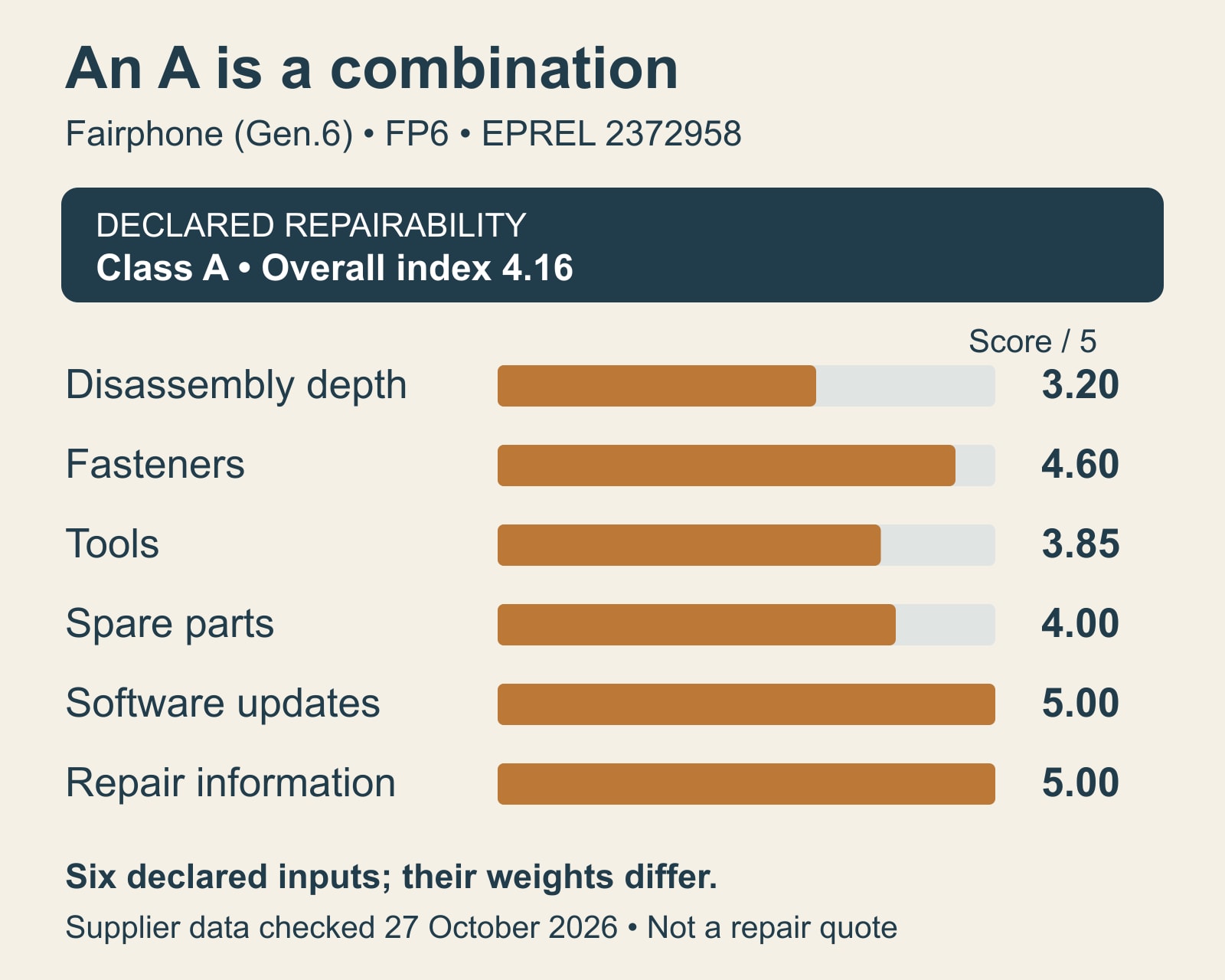
Take an exact registration rather than a brand's general reputation. The EPREL entry for the Fairphone (Gen.6), model FP6, records a repairability index of 4.16, in class A. This is the Android model under registration 2372958, not a different operating-system version or a later generation.
Open the detail beneath the letter and the result becomes more interesting. Its declared disassembly-depth score is 3.20; fasteners score 4.60; tools score 3.85; spare parts score 4; and software updates and repair information each score 5.
An A, in other words, does not require six perfect scores. It summarises a combination of different things.
These are supplier-declared values in the EU register, not a repair test performed for this article. They are useful precisely because they have a defined meaning. The disassembly score is not the percentage of owners who can fix the phone, and the overall index is not a promise that a future repair will cost a particular amount.
The scoring guidance published on the Commission's product-information site explains the combination: the six parameters carry weights, and class A begins at an index of 4.00. The guidance explains the method; it is not an individual legal assessment of a device.
The letter compresses information. The detail gives it back.
Repairability starts before the screwdriver
It is easy to imagine repairability as a purely physical property. Can the back come off? Are there screws? Will removing a battery damage the surrounding parts?
Those questions matter, but they describe only part of the route. A phone can be accessible yet difficult to restore if the relevant part cannot be obtained. A replacement part can exist while the person doing the work lacks the instructions needed to fit it. Hardware can remain usable while continuing software support becomes another consideration.
That broader route appears in the Joint Research Centre's explanation of the score. It identifies disassembly, fasteners, tools, parts availability, software updates and repair information. The method examines specified priority parts and combines the parameters into one result.
This changes what belongs in a design discussion. A screw is a design decision. So is the information that lets someone understand what is behind it. Support after the sale is part of the product's practical future, even though it does not appear in a photograph of the phone.
The useful question becomes less romantic than “Can I open it?” It is whether the route from a fault to a working phone remains understandable and usable.
The replacement part and the repair are different offers
Fairphone provides a concrete way to follow that route beyond the register. Its Gen.6 battery listing identifies the models the part fits and the tool used to access it. The offer concerns a particular component, not a fitted repair for any phone carrying the brand name.
That distinction is worth keeping even when the part looks affordable. Buying a battery is one transaction. Establishing that the battery is the problem is another task. Getting the phone back into use may involve time, tools, delivery or somebody else's work.
For a household facing an unexpected replacement, those are not obscure details. They determine whether repair is a realistic option this week. A low component price cannot, by itself, tell the person how long they will be without the device or what the complete job will cost.
Nor does repairability require everyone to become a technician. Someone may be perfectly capable of replacing a part and prefer to pay for the work. Another person may lack a suitable workspace, confidence, dexterity or time. A repairable design can still be useful when the person benefiting never touches a screwdriver.
The value is an available route, rather than a test of the owner's character.
Even a modular phone has boundaries
The manufacturer's current repair-support page makes that distinction unusually tangible. It offers guides for several components but says the Core Module is not sold individually. Suspected faults involving it are directed through diagnosis and professional repair. It also advises checking potential warranty coverage before ordering parts and obtaining an assessment after extensive damage.
This does not cancel the phone's repairability grade. It shows why the grade and the support terms need to be read together. A product can provide several accessible repair routes without making every possible failure a job for its owner at home.
It also exposes the limits of using a promotional photograph as evidence. Seeing a removed battery establishes something about access to that component. It does not establish that every damaged phone needs only a battery, or that every component can be ordered on the same basis.
The more useful picture is a network: device, diagnosis, parts, instructions, software and people able to do the work. A missing connection can matter as much as a difficult screw.
The label has more than one alphabet
There is another small trap on the label itself. A prominent energy-efficiency letter and a repairability letter may look as though they are two versions of the same judgement. They are separate measures.
The Commission's explanation of the smartphone label distinguishes the A–G energy scale from the A–E repairability classes. It also explains the separate information about battery endurance, repeated drops and protection against dust and water. The labelling requirements apply to in-scope smartphones and slate tablets placed on the EU market from 20 June 2025; they are not a retrospective grade for every older device.
Each field asks a different question. How a battery performs under a specified workload is different from how it holds capacity over repeated charging. Resistance under a drop test is different from the repair route after an actual accident. Ease of repair is different again from the probability of needing one.
For a reader, the point is not to memorise a new sheet of specifications. It is to avoid letting one strong result borrow the meaning of all the others.
An energy A is not automatically a repairability A. A repairability A is not an all-purpose guarantee of durability, low cost or suitability.
The time hidden behind “support”
Software's place in the repair score may initially seem surprising. It is not a component someone can hold beside a replacement screen. Yet physical repair and continued usefulness do not always end at the same place.
A working display cannot answer whether the device still receives the support its owner needs. Equally, a long support commitment does not repair a broken port. The two contribute to keeping a phone useful through different routes.
This is why a duration needs its starting point. The EPREL model page labels its update field by reference to the end of placing the model on the market. A launch-year promise, a calendar end date and a duration measured from a defined market event should not casually be turned into the same number of years remaining from the day somebody buys it.
No personal expiry date follows from the single letter on the label. For a present purchase, the applicable model and current support terms still matter. For a phone already owned, the practical question is what support actually remains—not whether a replacement advert has a more impressive number.
A comparison, not a command to replace
There is an awkward paradox in any label designed to help people choose longer-lasting products: the label sits on something new.
It can make a future purchase more informed without establishing a reason to replace a working phone today. Keeping a useful device, repairing a fault, buying refurbished and buying new begin from different circumstances. A class on a new model does not calculate the best choice among them for an unidentified household.
What the grade can do is bring a neglected comparison into view when a purchase is needed. Camera specifications describe what the phone might do while it works. Repair information helps describe what might happen when part of it does not.
That gives design a longer horizon. The moment of unboxing is no longer the only moment worth examining. There is also the later day when an owner wants the same familiar phone back, rather than another product to learn and pay for.
The repairability letter cannot promise that ending. It can make the route towards it less invisible—and give the reader a sensible place to begin asking what happens next.
Sources and scope
The model example uses supplier-declared data in EPREL registration 2372958, inspected on 27 October 2026, and Fairphone's public parts and support information. EU and Commission-hosted guidance explain the label's scope and scoring. No phone was opened, tested or priced for a complete repair for this story. This is an examination of what the label describes, not a product endorsement, individual repair instruction or savings forecast.