
A silver disc is an unusually quiet explanation of a technological change. Hold it in your hand and it does not tell you which machine will play it, what music is available or how to choose the next track.
The compact disc had to answer those ordinary questions as well as the difficult engineering ones. Even its transparent plastic case could require an explanation. A new sound carrier was also a new set of things for a listener to understand.
A disc needed a world around it
Sony’s history of digital audio describes the joint development with Philips and disagreements over the format, including the choice between 14-bit and 16-bit sound. These were decisions about what the system would carry, not just the styling of an object.
For a listener, the significance of an agreed format is easier to express: the disc and player must belong to the same system. An attractive disc with no suitable player is not yet a usable music collection. A player without music to put into it has a similar problem.
The two objects could be sold separately, but the experience depended on their relationship. That makes the CD’s introduction more interesting than a simple replacement of one round thing with a smaller round thing.
The technical agreement also sat behind a much simpler public gesture. Someone could pick an album, take it home and expect the machine to recognise it. The engineering did not disappear; it became part of an expectation.
The prototype was not the finished system
In J. B. H. Peek’s technical history, published by IEEE in January 2010, the Philips prototype shown in March 1979 is a stage in a longer process. The account describes Philips and Sony settling a common standard in June 1980, with work on error correction and the coding of the recorded signal.
Those two tasks are worth separating. A recording system needs a way to represent its information and a way to deal with errors when reading it. The presence of a laser does not make damage irrelevant or guarantee that every disc will play forever.
Peek’s account is a participant’s technical retrospective, with references to the development papers. It lets us see work that the finished object conceals. The shiny surface is not a diagram of the decisions needed to make it useful.
There is a distinction between showing that a principle works and producing a system that can leave the laboratory. A demonstration can have a prepared disc and a carefully assembled player. A household needs an ordinary route to another album.
A launch needed something worth playing
Sony’s account dates the Japanese launch of its CDP-101 player to 1 October 1982. Its account pairs the hardware with fifty initial CBS Sony CD titles, spanning several musical genres. This is the company’s retrospective account, rather than independent evidence that every listener welcomed the format.
What matters here is the pairing. The player’s arrival and the catalogue were parts of the same proposition. The promise was not merely that a new machine could make a sound. There would be music a person might choose to bring home.
An album also gave the unfamiliar object a familiar purpose. A listener could be curious about digital technology while still asking the older question: is there something here I want to hear?
The equipment and the repertoire were different kinds of work. Their usefulness met in one room, when someone put a selected disc into a compatible player.
The change reached the listening controls
The Philips Museum’s account, written from its company archives, describes the European advertising introduction on 1 March 1983. It also highlights selecting tracks and programming a listening order as features of the new experience.
These controls make the change tangible. A person does not have to understand the recorded signal to understand choosing a track. The interface turns an underlying capability into an action.
That does not mean every recording became an invitation to ignore its sequence. The ability to choose and the decision about what to hear remain different things. An album can still be heard from beginning to end.
The interesting shift is that the listener encounters the recording through a different set of controls. The new system changes the way someone reaches the music, as well as the object kept on the shelf.
Even the clear case was unfamiliar
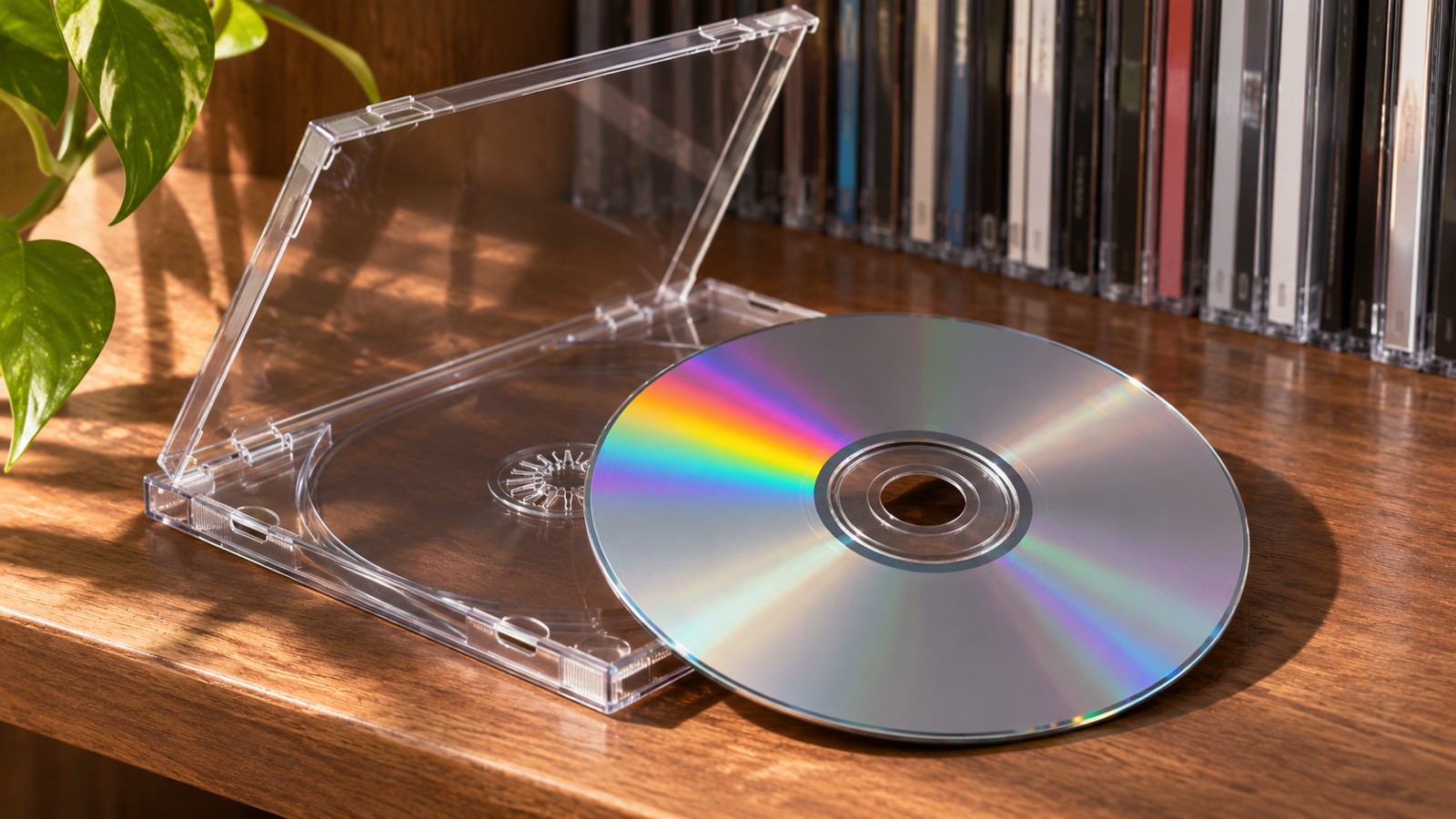
The same Philips archive account records a less grand difficulty. Consumer-panel testing found that not everyone immediately knew how to open the jewel case, so opening and closing instructions were included. The account describes a particular development finding; it is not a claim that all early buyers struggled.
This small detail changes the scale of the story. A team can solve difficult problems of sound and still need to explain a hinge. Transparency lets the owner see what is inside; it does not automatically explain the movement that releases it.
The case belongs to the listening experience too. Before the player can read the disc, a person has to get it out of its packaging. The advanced and the mundane occupy the same journey.
Seen that way, the CD was more than a digital recording in a small circle. It was an agreement between companies, a way to manufacture music, a machine, a set of controls and an object people handled. Its engineering became useful through all those connections.
Sources: Sony’s corporate history, Peek’s IEEE technical retrospective and the Philips Museum’s company-archive account, linked beside the relevant passages. This story does not resolve the differing accounts of the disc’s playing-time decision or claim that digital sound is universally superior.