
The barrel is sound. The clip is still attached. The pen has simply stopped putting ink on the page. Replacing the refill sounds straightforward until several similar tubes appear in the search results.
The useful question is not just whether a refill fits inside the barrel. It is which replacement the pen is designed to use, and what evidence will let its next owner find that replacement again.
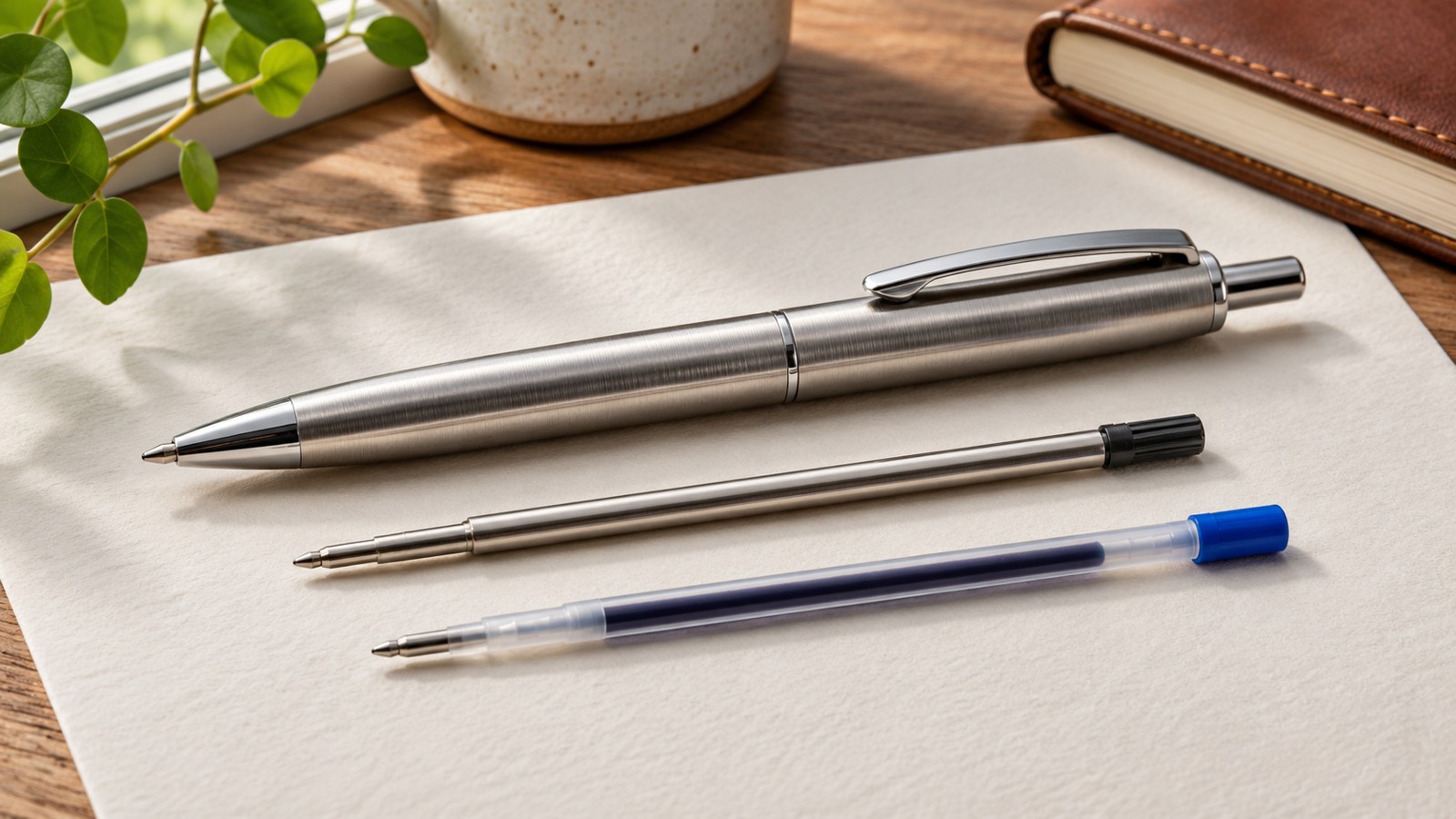
Start with the pen, not the colour of the ink
A request for a blue refill leaves the central identification problem unresolved. Blue describes an output. It does not identify the pen’s writing system or the part that belongs in it.
Look for a model name, a maker’s reference or information on the original packaging. Keep a photograph of the complete pen and any readable markings. If the maker provides replacement instructions, follow those rather than forcing an unfamiliar mechanism apart.
The name printed on a promotional pen may identify the organisation that gave it away, without identifying its manufacturer or model. That name can be meaningful to its owner and still be insufficient for a refill search.
For an unmarked pen, the honest starting point may therefore be “model not identified”. A clear unknown is more useful than a confident recommendation based on a similar photograph.
One manufacturer shows why the writing type matters
Parker’s ballpoint-refill page says its ballpoint replacements can be used with Parker ballpoint pens. Its gel-refill page says those replacements can be used with Parker ballpoint or gel pens.
These are the manufacturer’s compatibility statements for its own products. They are useful precisely because they have a defined scope. They do not establish that every refill labelled gel fits every promotional pen.
Parker also presents a separate rollerball-refill range. The familiar word refill does not collapse the different product categories into one interchangeable part.
This example is a way to read a compatibility claim, not a recommendation to buy a particular brand. Start with the writing instrument and then read what the replacement supplier actually names.
A loose refill is information, not permission to improvise
In its ballpoint and gel support guidance, Parker’s first instruction for a loose refill is to check that the refill is correct for the instrument. That is a narrower and more useful response than assuming that any part inside the barrel must be suitable.
If a replacement cannot be confirmed, do not describe improvised packing, cutting or forcing as ordinary compatibility. A tube staying inside a barrel is not evidence that the complete writing action is right.
A proposed sample check can answer practical questions: does the intended replacement install as instructed, does the mechanism move normally, and does the tip sit correctly for use and storage? Those are checks to perform on an identified pair, not tests carried out for this article.
A successful sample also has a boundary. It supports that particular pen and replacement. It does not prove that another visually similar pen uses the same part.
Keep a replacement record someone else can use
For a pen being retained or ordered as a branded item, record the exact pen model and the replacement’s part reference together. Add the writing type, chosen ink colour and the source of the compatibility statement.
Keep identification separate from availability. “The specified refill is this part” and “this seller currently has it” are different claims. A saved product photograph does not guarantee future stock.
Where a replacement has actually been checked, record what was checked and when. Where it has not, say so. That prevents an old suggestion from becoming an invented test result when the record is passed to another person.
The useful handover can be very small: pen model, refill reference, manufacturer link, chosen colour and check status. It is more durable than a shopping link on its own because it explains what the next person is trying to find.
Ask about replacement before choosing the branded pen
When discussing personalised or branded merchandise, ask for the exact pen model and whether a replacement refill can be identified. A general merchandise description does not confirm that every pen offered is refillable or that replacements will remain available.
If keeping the barrel is important to the intended recipient, make the refill question part of choosing the item. Ask what documentation can accompany it and what remains uncertain. Do not substitute a general “reusable” description for a named replacement route.
Refillability alone is not proof of lower lifetime cost, longer service or an environmental saving. Those conclusions need evidence beyond the existence of a removable ink tube.
The immediate benefit is simpler: when the ink runs out, the owner has something more useful than a familiar-looking pen. They have a way to identify the part that belongs inside it.
Sources: the linked Parker manufacturer pages support the bounded compatibility examples and support instruction. The record and sample-check questions are editorial guidance. No pen testing, writing-distance measurement, supplier availability or customer outcome is claimed.