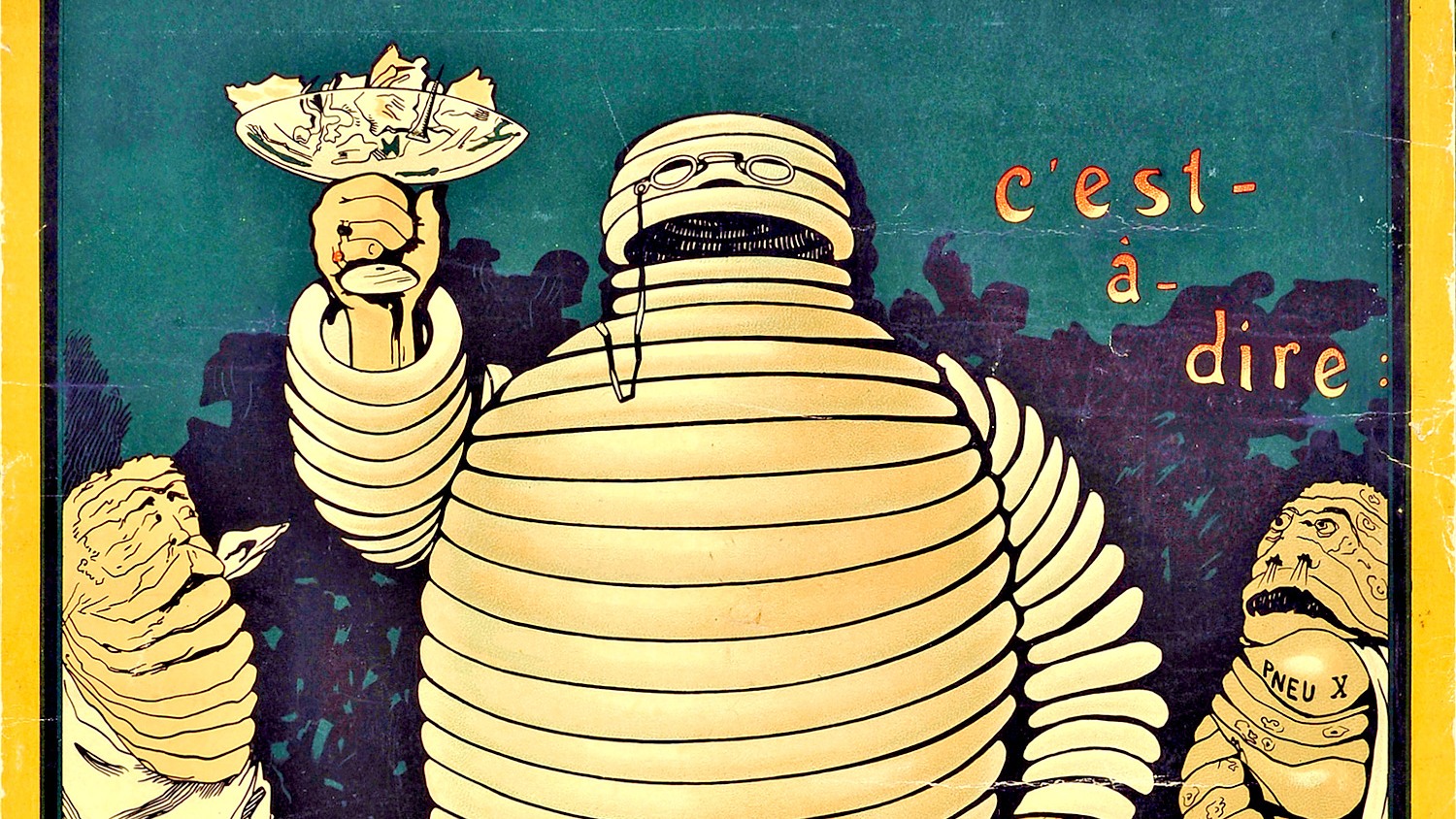
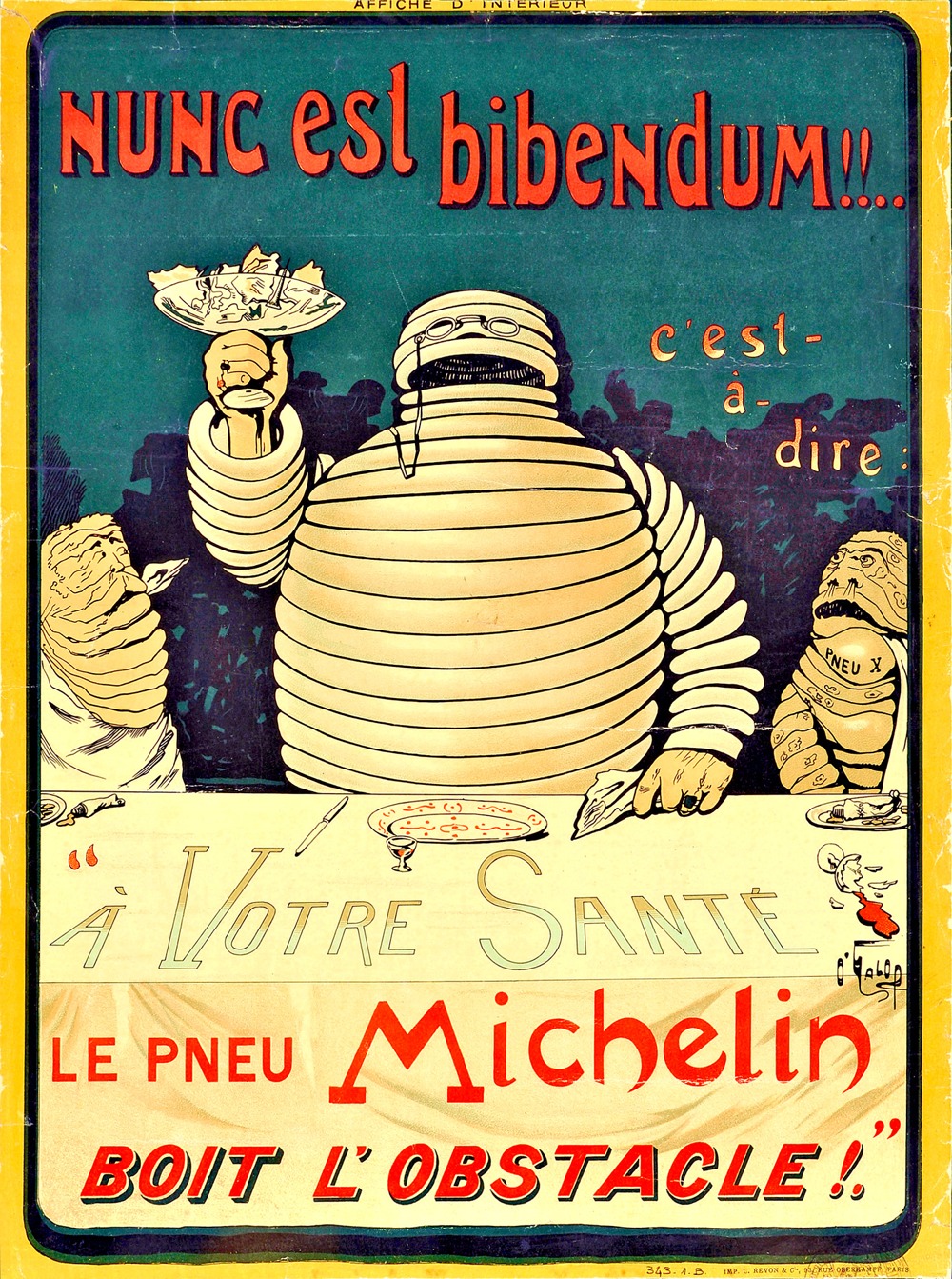
The familiar Michelin Man is raising a glass. But the glass contains nails and broken glass, and the smile is less welcoming than triumphant. In this 1898 advertisement, a figure made of tyres is doing something a tyre cannot literally do: drinking the road's obstacles.
That peculiar toast is the point of the picture. Before Bibendum became a friendly figure who could wave from a truck, he was the central actor in a printed argument about the product.

A product becomes a person
The artist was Marius Rossillon, known as O'Galop. The Italian national collection catalogue dates the poster to 1898 and identifies the figure, glass, nails and broken glass in its imagery. It records a colour lithograph: this was a physical advertisement, not a later interpretation of the mascot.
Look at the construction of the body. The rings do more than make an amusing outline. They keep the product visible inside the person. Remove the printed brand name and the figure still looks as though he belongs to the tyre business.
His raised arm then gives that product an action. A stack on its own could suggest stock in a warehouse. A stack that can raise a glass becomes a character capable of making a boast.
The difference matters when reading an old advertisement. Its imagery is not simply ornament wrapped around a written claim. The image performs the claim. The little competitors at either side help stage the comparison without requiring a modern chart of specifications.
The toast had another life
The Louwman Museum's account of the poster describes an earlier design for a German brewery: a king raising a beer mug. In that account, the brewery rejected the sketch and the Michelin brothers saw how its central figure could become a man made of tyres.
That is an account of the design's origins, rather than a surviving transcript of a meeting. It is still a revealing way to approach the finished work. The raised drink, the commanding central figure and the toast make sense as a composition before the viewer has decoded the tyre metaphor.
The change was therefore more substantial than putting a different name at the bottom. The beverage became hazards from the road. The figure's body became the product. A scene about drinking became an argument about travelling.
The composition gives an unfamiliar creature a familiar social role: someone making a toast at a table. That is our reading of the surviving poster, rather than a claim about what every viewer in 1898 understood.
A legend is not a measured result
Michelin's own history connects the character to a stack of tyres seen at the Lyon exhibition in 1894. The company explicitly introduces the observation as legend. It also describes the original bespectacled, cigar-smoking figure and the advertising idea of swallowing obstacles.
It is tempting to turn that into a neat moment when an inspired founder instantly invented an enduring icon. The evidence supports a more careful distinction: there is a documented 1898 poster, and there are retrospective accounts explaining how the character took shape.
Nor does the image prove the performance it dramatises. Glass and nails in a goblet are an advertising metaphor, not a test report demonstrating immunity to punctures. Appreciating the visual invention does not require accepting the boast as engineering evidence.
The body remained; the performance could change
Michelin's retrospective follows the character beyond printed posters into figurines and digital animation. Those forms allow different gestures and encounters. A figure placed on a cab roof has a different job from the imposing host at this table.
The useful continuity is visible in the body rather than in a single frozen pose. Tyre rings make a character recognisable while leaving him free to act. In the early poster, they support a combative product argument. In another setting, the same basic construction can support a greeting.
That does not mean a mascot succeeds merely by appearing everywhere. This particular artefact shows something more specific: how an industrial object became a performer, and how the performer's action made the advertisement's meaning easier to see.
The surprising thing in the old Michelin poster is not simply that today's familiar figure looks different. It is that he has a job to do. He is not standing beside the sales argument. He is making the toast that delivers it.
Sources and the image
The collection catalogue establishes the artefact's date, artist and imagery. The museum and Michelin histories provide attributed retrospective origin accounts. Visual interpretation is Time for Designs' analysis; no recognition percentage, isolated sales effect or tyre-performance finding is claimed. The complete historical poster is reproduced with its source credit below the image.