
A vivid yellow surface and a silver strip can both attract attention. They do not get their brightness in the same way.
That difference explains why a material that looks striking in daylight may look quite different under a nearby light at night. “Bright”, “fluorescent” and “reflective” are not interchangeable descriptions of one effect.
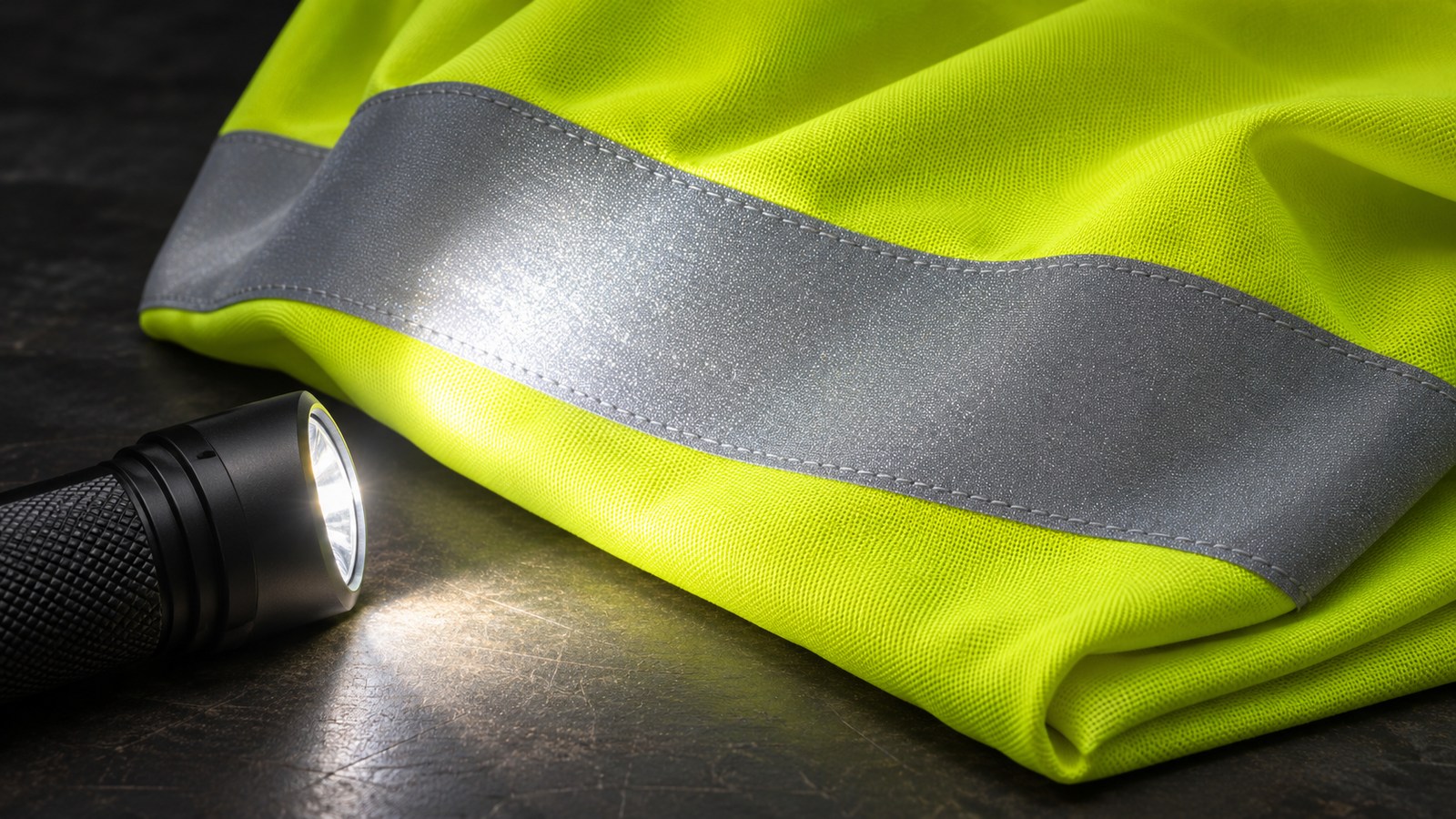
Fluorescence changes the light being seen
The Canadian Centre for Occupational Health and Safety’s material explanation describes fluorescent pigments converting some ultraviolet energy from sunlight into visible light. This gives the material a different effect from ordinary bright colour. It does not make it an independent lamp.
The distinction is easy to lose in a photograph. A highly saturated yellow on a screen can suggest fluorescent material, but a colour value in an image does not demonstrate the physical behaviour of a fabric or film. Colour appearance and material properties are separate information.
If a brief simply asks for “that really bright yellow”, it leaves the material question unresolved. Is the requirement a colour appearance, a particular fluorescent product, or a verified performance specification? A visual reference helps explain the intended look, but it cannot answer all three.
Retroreflection sends light back towards its source
3M’s explanation of retroreflection describes light returning towards the direction it came from. An observer near the light source can see a strong return. Ordinary scattered reflection sends light in many directions; mirror reflection sends it away at a corresponding angle.
That makes the position of the light and viewer part of the explanation. A material has not necessarily changed because it looks brighter from one position than another. The viewing arrangement has changed.
This is also why a flash photograph should not be treated as a universal prediction of appearance. The camera and its light can be close together. Another observer standing elsewhere has a different relationship to the returning light. A dramatic photograph records a particular arrangement, not every possible one.
Glow-in-the-dark is another category
3M’s comparison of visibility materials distinguishes fluorescent, retroreflective and phosphorescent materials. Its phosphorescent example needs prior light exposure; its retroreflective example needs an illuminating light source. These descriptions explain different mechanisms rather than ranking every available product.
A useful first question is therefore “What supplies the light?” The next is “Where does that light go?” Those questions are more precise than asking which swatch looks brightest in a product photograph.
The answer can involve more than one property. CCOHS notes that combined-performance material can be both fluorescent and retroreflective. One word should not be inferred from the other.
What an artwork proof can tell you
An artwork proof can help agree wording, shape, placement and the intended colour arrangement. It cannot, by itself, establish the light-return behaviour of a finished material. A screen illustration of a silver stripe is still a screen illustration.
Keep the design decision and the material specification connected, but record them separately. “Silver band here” explains a position and appearance. An exact product reference explains which material is proposed. A verified specification supplies a different kind of evidence again.
When discussing decoration on printed hi-vis garments, bring the actual garment details and proposed print position. That enables an assessment of the job; this explanation does not establish that a particular reflective or fluorescent decoration is offered or suitable.
For safety clothing, material science alone is not a selection or compliance assessment. Follow the applicable requirements and the garment manufacturer’s instructions before specifying or altering an item. This article gives no visibility distance, certification or assurance that an illustrated arrangement is safe.
The same photograph can hide different mechanisms
The practical distinction is between an appearance and its cause. Fluorescence, retroreflection and stored-light glow can all produce an eye-catching image, but the conditions behind that image matter.
Once the light source and viewing position are part of the question, the material stops being merely “a bright finish”. Its particular behaviour becomes something that can be named, specified and checked using the appropriate evidence.
Sources and scope
The linked CCOHS and 3M explanations support the material distinctions. The proof-reading questions are editorial guidance, not a test method or safety specification. The illustration supplies no measured evidence about a real product. No Time for Designs production test or customer result is claimed.