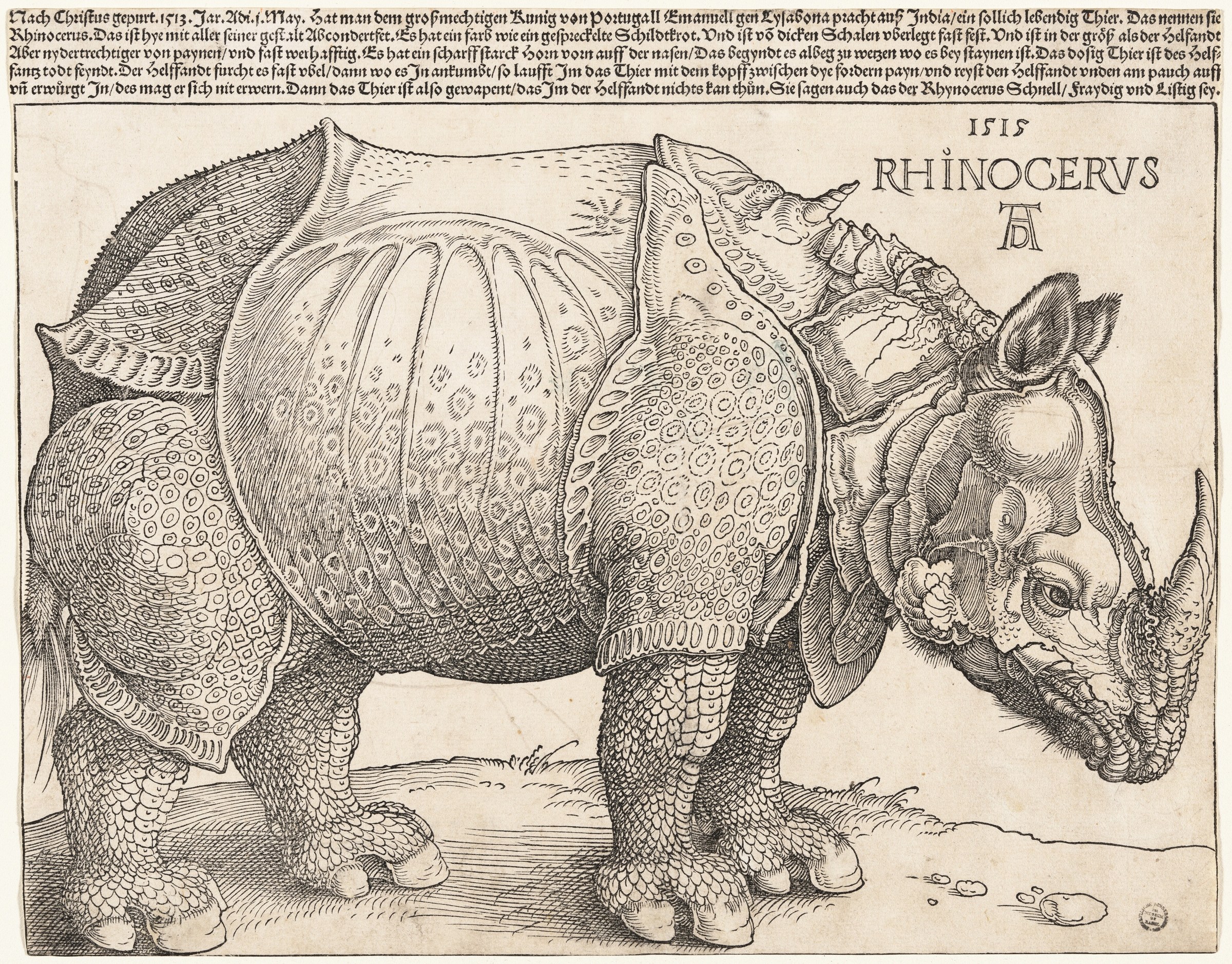
The nose horn is where you would expect it. The smaller, twisted horn above the shoulders is harder to explain. Between them sits an animal covered in patterned plates, with scales running down its legs.
This is the rhinoceros in Albrecht Dürer’s 1515 woodcut. It faces right, filling almost the whole picture. Above its back are the date, its Latin name and Dürer’s intertwined initials. Everything about the dense detail invites a close look.
Look next at Enea Vico’s engraving of 1548. The animal now faces left. A scroll carries its name, and different initials identify the artist. The armour and the little back horn have made the journey with it.
The two pictures are thirty-three years apart. One is not simply another sheet printed from the other’s wooden block. Vico made a new image after Dürer, in a different printmaking medium. Following the features between them reveals how this particular rhinoceros acquired a life in pictures.
News of an animal in Lisbon
Behind the image was a living Indian rhinoceros that reached Portugal in 1515 as a gift for King Manuel I. Dürer was working from information that had travelled farther than he had.
The Städel Museum’s account of its own impression explains that he relied on descriptions and a drawing rather than seeing the animal himself. The National Gallery of Art’s account likewise traces the image to other people’s reports and a sketch.
His sheet joined words to a picture. Lines of German text sit above the animal, giving readers an account alongside its visible form. This was news with something remarkable to show: a creature many readers would have had little chance to examine for themselves.
The animal’s next voyage had a different ending. Manuel sent it towards Rome as a gift for Pope Leo X, but the ship sank and the rhinoceros died. The National Gallery recounts that journey. The image could continue to circulate after its living subject was gone.
The surfaces that make it memorable
The print rewards looking in sections. A broad, curved panel covers the flank. Around the shoulder, another section carries rings and dots. The head has ridges and small folds; the legs have repeated, scale-like shapes. Light paper shows between black marks, giving each area a different texture.
Those are features of the picture, rather than a complete account of a rhinoceros’s skin. The National Gallery’s comparison with an Indian rhinoceros distinguishes real folds in thick hide from the print’s exaggerated armour and scales.
The effect is wonderfully specific. Dürer did not leave an unfamiliar animal as a vague outline. He gave the viewer one surface after another to inspect. The small circles, curved borders and overlapping forms make the creature seem assembled from parts that can each be understood.
The neck feature needs care. The National Gallery treats the back horn as an anatomical departure; the ALBERTINA’s catalogue discussion suggests that a horn-like neck growth could have informed it. That difference does not establish the exact appearance of the Lisbon animal. The prints do let us see something more certain: the same distinctive protrusion was carried into another image.
A picture could travel with its block
A woodcut offered one way to repeat all that detail. The raised parts of the carved block received ink; paper pressed against them took the image. The same block could be inked again for another impression, as the National Gallery explains in its account of the process.
The block could also outlast its maker. Dürer died in 1528. The ALBERTINA holds a much later impression associated with the Amsterdam publisher Willem Janssen, catalogued as printed after 1620 from the 1515 design.
Its record describes the worn original block being used with an added block to supply colour. That produced a later, two-block print. It is a different object from the black-on-paper National Gallery sheet pictured here.
The distinction matters when looking at dates. A design could belong to Dürer’s lifetime while a surviving impression was made long afterwards. The ALBERTINA’s later sheet carries that history in its catalogue entry: the old design, the reused block and the added tone.
Another artist could remake the animal
Vico’s 1548 print shows a second route. The National Gallery catalogues it as an engraving by Vico after Dürer, rather than another impression of Dürer’s woodcut.
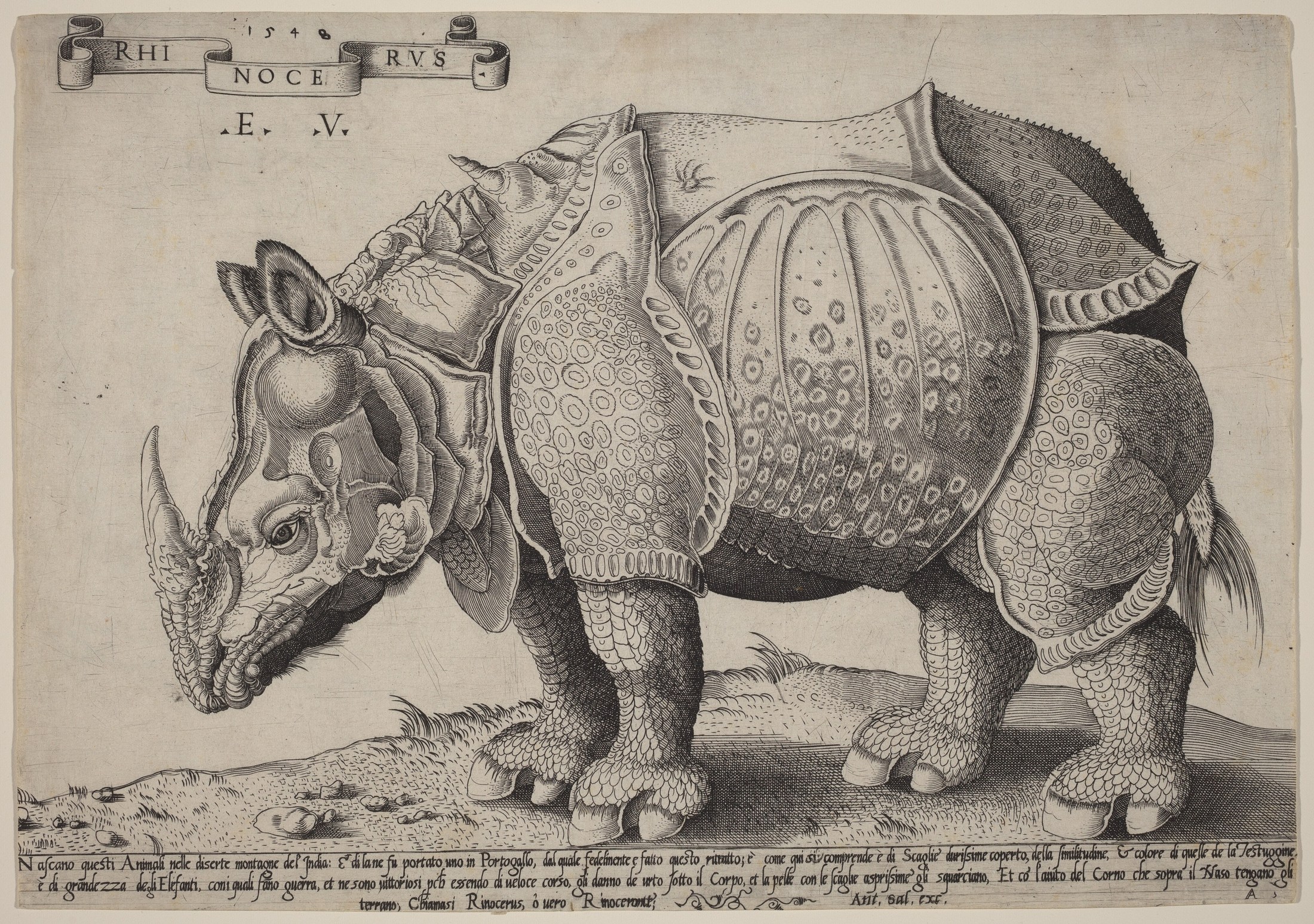
The changed direction is the first thing to notice. Then look at the shoulder. Its circular marks and shaped border remain familiar. The scaly legs, large side panel and small horn above the neck all connect the animal to the earlier image.
Around that body, the page has changed. Vico’s name for the creature sits on a curling ribbon. The date 1548 and the letters E.V. occupy the space above it. Text runs beneath the ground on which the animal stands. Dürer’s AD monogram has gone.
This is more than a flipped view. Another maker has rebuilt the recognisable creature within a new arrangement of marks and lettering. The National Gallery identifies the relationship between the works; the two photographs make it possible to follow the inherited features directly.
The rhinoceros entered books as well
The route continued beyond individual prints. The Natural History Museum’s account of its library display follows Dürer’s image into natural-history books. It identifies a rhinoceros based on the print in Conrad Gessner’s History of Animals, published in 1551.
The museum also points to later examples retaining the armour and extra horn. It notes that other contemporary artists had produced likenesses too. Dürer’s version became influential among competing pictures, rather than being the only attempt available.
That book history gives the repeated features a wider setting. A reader could meet the animal as news on a sheet, as another artist’s engraving or within an account of nature. Its surrounding words and purpose could change while the familiar body remained.
Return to the two prints and the little horn is easy to find. So are the heavy plates and patterned legs. The real rhinoceros had a short, interrupted journey through Europe. This drawn and printed creature travelled through other people’s hands, turning around, acquiring new initials and entering new pages while keeping its extraordinary skin.
Sources and images
The National Gallery of Art’s records identify the 1515 Dürer woodcut and 1548 Vico engraving; its illustrated account explains their connection. The Städel record and ALBERTINA’s later impression supply separate collection evidence. The Natural History Museum documents the book examples in its display. The German text on the pictured Dürer sheet begins with the year 1513; the design and object are catalogued as 1515. The inscription has been retained as photographed. Both selected photographs are National Gallery open-access images, released under its CC0 policy.