
A dashed line on a flat design can stand for several different things. It might mark a fold that should stay intact, a strip that should detach, or merely a guide that should never appear in the finished print.
Before asking for a crease or a perforation, describe what somebody should be able to do with the finished piece. The line’s purpose matters more than how its dashes look on screen.
Start with what remains attached
Imagine a folded invitation with a reply panel. There are two separate questions. Where should the invitation bend? Should the reply panel remain part of it or come away?
These are fictional examples, not a description of an actual customer job. Their value is in separating two instructions that can occupy the same flat artwork.
If a section must remain attached, say that. If it must detach, identify which section is kept and which is removed. A short explanation such as “this reply panel tears away; the rest stays as one folded piece” communicates a behaviour that a dashed mark alone does not.
A crease and a perforation are not identical
National Steel Rule’s technical note on crease and perforating rules describes creasing as indenting or compressing material at a specified position. It describes perforating as a sequence of cuts and uncut spaces.
There is an important qualification in that same source: perforations can be designed for folding as well as tearing. The note also discusses combined crease/perforation rules and tear strips.
So “crease means fold, perforation means tear” is a useful-looking shortcut that does not cover every production arrangement. The safer brief names the intended result, then lets the production specification identify how to achieve it.
Nor does one visible dashed pattern define the strength of a tear line. The technical note identifies material condition, humidity and die-cutting variables among the factors affecting a folding or tearing result. This guide does not supply universal cut lengths, bridge lengths or a guaranteed force for separation.
The same piece can need different operations
A sheet can have more than one job to do. A retained panel might fold while a different section comes away. That does not make the two lines interchangeable.
As an equipment example, Duplo’s DC-618 page lists creasing and perforating as distinct capabilities and identifies perforated reply cards among its applications. This establishes the distinction in that manufacturer’s description. It does not establish which equipment or finishing options Time for Designs uses or can offer for a particular job.
The buyer’s useful contribution is therefore to make the intended action unmistakable. The printer still needs to assess the stock, layout and finishing route.
Mark the line with a sentence
A simple paper dummy can show what a flat preview leaves uncertain. Label the front, back and removable part. Indicate the intended opening order, and write a sentence beside each marked line.
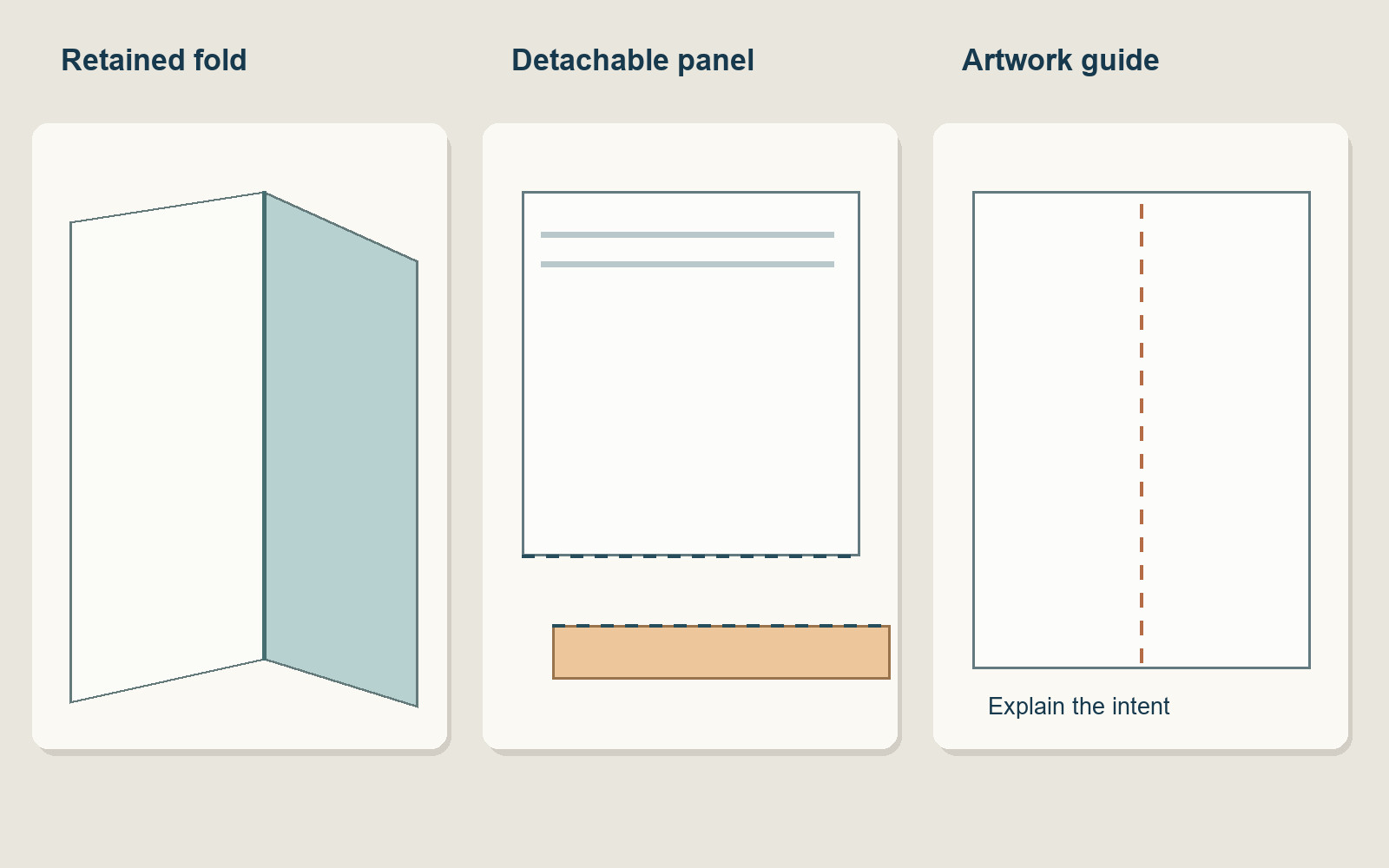
- Retained fold: “Bend here; both panels remain attached.”
- Detachable panel: “The reply section comes away along this line.”
- Artwork guide: “This mark explains the layout; confirm how to supply it without printing it.”
A dummy made from ordinary paper is a communication aid. It does not prove how the chosen stock will tear, whether a fold will crack or which tooling is suitable. If that behaviour is important, ask what sample or proof can establish it for the actual specification.
Keep essential words and images clear of the proposed line until its position and purpose have been agreed. Explain any element that is intended to cross it, rather than assuming the finishing operation will land perfectly through a letter or face.
Hand over the object you mean
For a business printing enquiry, send the flat and finished sizes, quantity, artwork and required date. Add the marked dummy or a clear view of the retained and detachable sections. Name the proposed stock if it is already known; otherwise explain the use.
Ask which finished dimensions refer to the whole piece and which refer to the part that comes away. Also agree how nonprinting production marks should be supplied. Do not draw a dashed rule into the final design and assume it has become a finishing instruction.
The aim is not to choose a machine from a catalogue. It is to make the intended object clear enough that material, artwork and finishing can be discussed together.
A fold that stays and a section that tears off can begin as similar marks. They should not arrive at production as an unanswered question.
Sources and scope
The linked technical note supplies the process distinction and its qualifications. Duplo supplies a named manufacturer’s application example. The briefing examples and diagrams are original editorial explanations. No physical trial, stocked paper, available machine, price, turnaround or universal finishing tolerance is claimed.