

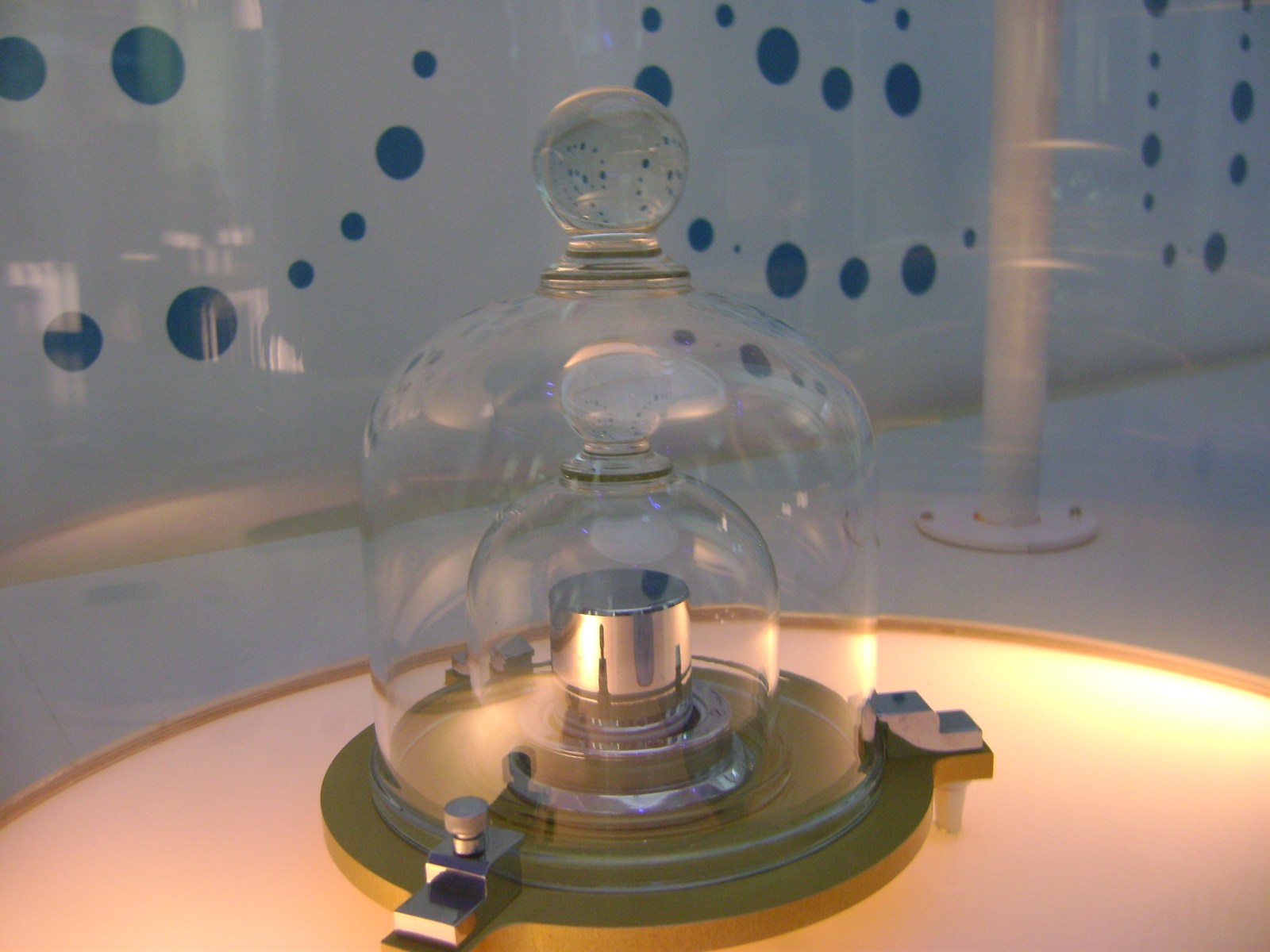
A polished cylinder sits beneath glass. The museum replica pictured here makes an old idea easy to grasp: give the world one carefully protected object, and use its mass to define a kilogram.
For a long time, the international system did something very close to that. Since 2019, it has worked differently. The change removed the defining object's special status, while leaving plenty of important work for metal weights to do.
That distinction offers a concrete way into World Science Day for Peace and Development on 10 November. UNESCO's 2026 theme is “Common ground through science diplomacy”. The International Science Council's separate 2026 invitation also centres cooperation across borders. A shared unit is a useful case to consider: agreeing on its meaning is one task; making reliable measurements from that agreement is another.
When one object supplied the answer
The International Prototype of the Kilogram, or IPK, was a cylinder made from 90 per cent platinum and 10 per cent iridium. Its height and diameter were each about 39 millimetres. The International Bureau of Weights and Measures, known as the BIPM, has kept it since 1889.
Its importance came from its role. Until 20 May 2019, the mass of that particular object defined the unit. The prototype was the reference against which other masses could be compared.
That did not mean every scale or weight travelled to France. NIST's account of the former system describes a chain: national laboratories held prototype masses, working standards were calibrated against those, and further comparisons carried the unit outward.
The United States' K20 was one such national prototype. It was a different object from the international cylinder. The photograph here shows a museum replica in Paris, rather than either original standard.
The system connected a small protected artefact to a great many measurements. It also gave a physical object an unusual responsibility. The same NIST account explains that comparisons between artefacts revealed small changes over time. A definition resting on one material object left metrologists dependent on that object's long-term stability.
What replaced the cylinder's authority
The current BIPM definition fixes the numerical value of the Planck constant, written as h, in units that include the kilogram, metre and second. Together with the definitions of the metre and second, that sets the unit of mass.
The Planck constant is not another object weighing one kilogram. It provides a fixed relationship on which the definition can rest. A laboratory then needs a physical method for putting that definition into practice. Measurement scientists call this a realisation of the unit.
This is the essential change in direction. A chosen cylinder used to define how much mass counted as a kilogram. Now the definition supplies the basis for measuring a cylinder's mass. The cylinder can remain useful without being the final authority on what the unit means.
The BIPM dates the revised definition's implementation to 20 May 2019. World Science Day provides the occasion for this explanation; it is not a new kilogram decision announced today.
A balance that needs two kinds of measurement
One route from the definition to a measured mass is a Kibble balance. NIST's explanation of its operation starts with a familiar action: balancing a downward force with an upward one.
In the weighing stage, a test mass rests on a pan linked to a coil in a magnetic field. Current through the coil produces a force. The current is adjusted until that force balances the mass's weight.
A second stage supplies information the first cannot easily provide by itself. The test mass is removed, the applied current is switched off, and the coil moves through the field at a controlled speed. Its motion induces a voltage, which is measured.
Combining the two stages removes a difficult magnetic-field-and-coil factor from the calculation. Electrical measurements linked to quantum effects provide the connection to h. Motion and local gravity must also be measured. These are separate stages, rather than a machine continuously producing power from a hanging weight.
The apparatus therefore joins the abstract definition to observable quantities. The constant is fixed; carrying out the experiment still takes precision.
The weights still have somewhere to go
A factory or calibration laboratory needs usable physical references. The change in definition did not require everyone to install a Kibble balance.
NIST's account of disseminating the kilogram explains the continuing role of physical transfer standards. They carry the realised unit to users in industry, academia and government. A metal mass can travel, be compared and help calibrate another mass without defining the unit itself.
That practical journey has its own complications. NIST describes the problem of connecting measurements made in vacuum with weights used in air. Buoyancy and material on a surface, including adsorbed water, affect the comparison. Careful corrections and an account of uncertainty remain part of the work.
This is where an exact definition and an exact measurement separate. Fixing a constant's numerical value does not give every balance unlimited resolution or remove uncertainty from each comparison. The definition supplies a common basis. Instruments and procedures determine how closely a particular measurement can put it into practice.
The distinction also explains why the old-looking objects have not become pointless. A transfer weight serves as a practical link in a measurement chain. Its usefulness no longer depends on it being the one object from which the entire unit takes its meaning.
Common ground needs practical links
World Science Day's theme invites attention to cooperation. The kilogram shows one specific form it can take: a common definition, laboratory methods for realising it, and comparisons that make the result available beyond the originating experiment.
Those three parts do different work. The definition establishes the unit. The experiment produces a measurement tied to it. Physical standards help carry that result to the next user, together with the limits of the comparison.
The cylinder under glass remains a compelling image because it makes a shared reference visible. What changed in 2019 was its place in the system. A particular object ceased to define the kilogram; the careful work of weighing objects continued.
Sources and image
The UNESCO 2026 observance and International Science Council's 10 November event establish the timely context. The BIPM records the former prototype and implementation date and current definition. NIST explains the former comparison chain, Kibble balance's two stages and physical transfer standards. Some NIST pages retain wording written before implementation; their descriptions of the process are used here alongside the BIPM's implemented definition, without treating old performance estimates as current results. The selected Japs 88 photograph shows a museum replica, not the protected IPK. No apparatus or mass was tested for this article.