
Pull the slider and two rows become one fastening. Reverse the movement and they separate. The action is familiar enough that the word zipper can seem as old and obvious as the mechanism.
It is not the name printed on Gideon Sundback’s 1917 patent. The document calls the invention a Separable Fastener. Its title describes a job. The later name makes that job sound like an action.
Between the two lie different kinds of work: arranging the parts so they can engage, making those parts repeatedly, and giving people an object and a name they can recognise.
Start with the document
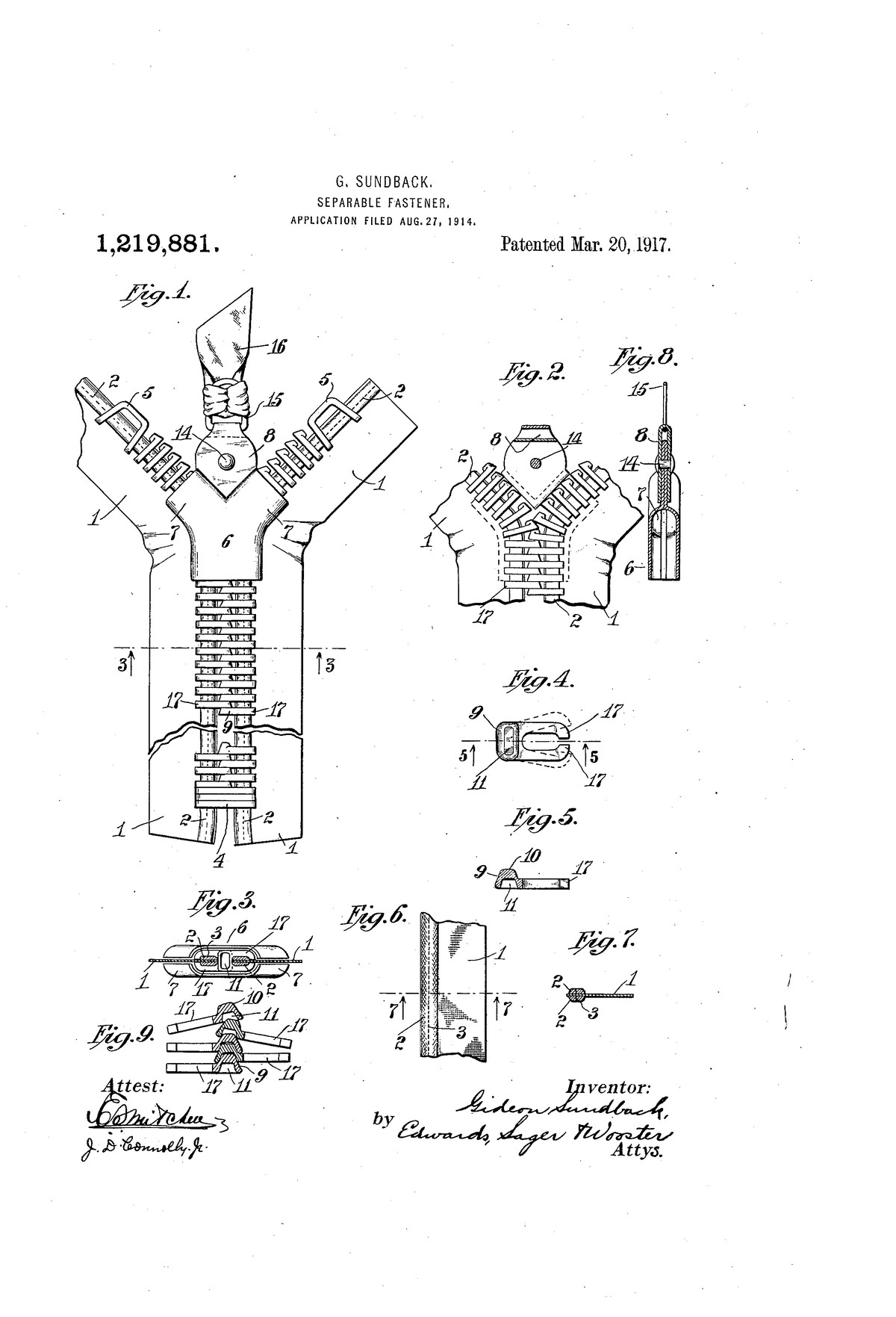
The first page of US patent 1,219,881 supplies two clear dates. The application was filed on 27 August 1914; the patent was granted on 20 March 1917. The drawing shown here belongs to that document.
A filing date and a grant date do not record the same event. Neither establishes the day on which every earlier fastening experiment began or every later product reached a buyer.
The National Inventors Hall of Fame’s Sundback profile places his work after earlier closure designs associated with Elias Howe and Whitcomb Judson. Sundback was improving a developing class of object, rather than introducing the entire idea of joining clothing from nothing.
That wider history need not blur the specific document. The patent lets a reader examine what this particular proposed improvement was trying to do.
The repeat is part of the invention
One detail in the patent is especially useful to notice: the locking members on the two sides are alike. They alternate along the opposing strips, and the outside of one nests into the recess of its neighbour.
That is more specific than a row of ordinary hooks meeting a different row of eyes. The document describes repeated complementary shapes, carried along flexible strips and brought together by a sliding device.
The pattern gives the fastening its continuity. An individual member is small; the closure comes from the relationship between many members. In the drawing, the slider sits where separated rows become an engaged chain.
This is an explanation of the arrangement shown in the patent, not a physical test of an original model or a claim that all present-day zippers have identical construction.
Closed does not mean rigid
Sundback’s specification sets out several intended improvements, including less bulk and more flexible, secure engagement. Those are the inventor’s stated aims. A patent describing an aim is not an independent performance comparison.
The combination is nevertheless revealing. A garment fastener has to keep two flexible edges together without turning the whole joined area into a stiff bar. Opening and closing are only part of the problem; the joined article must still be able to move.
The drawing’s enlarged views make a small ordinary object look less simple. Its useful action depends on shapes meeting in a repeatable relationship, rather than on a slider somehow sticking two edges together.
The slider organises the meeting. The rows provide the fastening.
For a present-day description of those roles, YKK’s explanation of zipper structure distinguishes the tape, the interlocking elements and the slider. It describes the slider’s Y-shaped passage guiding the elements together or apart. That helps explain the visible action without treating Sundback’s one drawing as a specification for every modern zip.
A working pattern needs a way to be made
The Hall of Fame profile also describes Sundback’s work on manufacturing equipment. A machine could form the small metal elements and help create a continuing fastener chain.
This is a separate step from drawing one successful engagement. A repeated closure needs many parts with the intended relationship. A persuasive illustration or a handmade sample does not establish that those parts can be supplied consistently.
The patent itself treats the use of alike components as a manufacturing advantage. Again, that is its author’s argument, rather than a cost comparison conducted for this article. It makes clear that the object was being considered as something to produce, as well as something to operate.
There are consequently two kinds of repetition in the story. The fastener repeats small elements along a strip. Manufacturing has to repeat the parts and the assembly across more than one strip.
The name arrived through an object
The Hall of Fame’s separate account of the zipper’s development connects the familiar name with B.F. Goodrich’s rubber boots. It says the company used the fastener on the boots and called the product Zipper, taking inspiration from the sound of the movement. The inductee profile dates the naming to 1923.
This is a useful difference from the patent title. Separable Fastener explains what a device allows. Zipper gives a short, active name to the encounter with it.
The name did not create the interlocking mechanism. Nor did the mechanism arrive with every later association already attached. An invention document, a manufactured component and a named consumer product occupy different points in the history.
That is why the boot connection deserves its place without having to become a claim that one company invented every aspect of the zipper. A product can introduce a memorable name for a device whose development has a longer trail.
Look again at the slider
The old drawing is compelling because the action remains recognisable. Two edges approach the slider separately and leave as a joined line. At a larger scale, the document reveals the small repeated forms that make that action possible.
It also slows down an invention story that is often told in one sentence. There were earlier closures. There were improvements to the engagement. There was work on making the parts. There was a later name associated with boots.
None of those stages needs to erase the others. The patent’s descriptive title and the familiar word zipper simply catch the object at different moments: one explaining the fastening, the other carrying the action into everyday speech.
Sources and scope
The original patent and its drawing establish the described proposal, stated aims and filing/grant dates. The two linked National Inventors Hall of Fame records supply the wider development and naming accounts; YKK explains present-day component roles. The illustration is the original 1917 drawing, not a modern reconstruction. A patent specification records a proposed invention, rather than an independent performance test.