
The large number is €59.99. The smaller question is what happens when the ink runs out.
That price appeared on DID Electrical’s Irish listing for the HP DeskJet 2820E, which also marked the printer sold out when checked on 3 November 2026. It is a concrete displayed price, not a promise that you can buy one for that amount today.
Still, the listing captures the attraction of an inexpensive household machine. A relatively small payment seems to settle a practical problem: now there will be a printer at home.
The payment does settle something. It does not settle everything. To understand the purchase, follow not just the machine but the supplies it will accept, the way those supplies are paid for and the conditions attached to using them.
The surprising part is that two cartridges containing ink can represent quite different things. One can be a replacement bought from a shop. Another can be equipment supplied for use within an ongoing service. Their physical contents do not tell you the whole story.
The box is a beginning, not a running-cost forecast
Start with the named machine rather than a general warning about cheap printers.
HP’s Irish specifications for the DeskJet 2820e list two setup cartridges: black, with an approximate yield of 120 pages, and tri-colour, with an approximate yield of 100 pages. Those are manufacturer figures, not pages printed in a Time for Designs test.
They should not be added together into a promise of 220 household pages. A pair of cartridges is not two separate stacks of finished documents waiting inside the box. The contents of the pages matter.
HP’s replacement list also distinguishes standard and XL supplies. It gives approximate black yields of 120 and 240 pages respectively, and tri-colour yields of 100 and 200. Beside these figures, it warns that actual yield varies considerably with printed content and other factors. The published standard replacement yields match the corresponding setup figures here; this is not evidence that every printer starts with a deliberately smaller cartridge.
That detail matters because an ownership story can become misleading in either direction. A box does not contain unlimited printing. Nor should an article invent a shortfall that this model’s specifications do not establish.
The useful discovery is more ordinary: the first purchase includes a finite supply, and the replacement route is part of the product decision. The headline price answers the first question, not the second.
The same printer offers a counterexample
There is no need to jump immediately to a more expensive rival machine to find another arrangement.
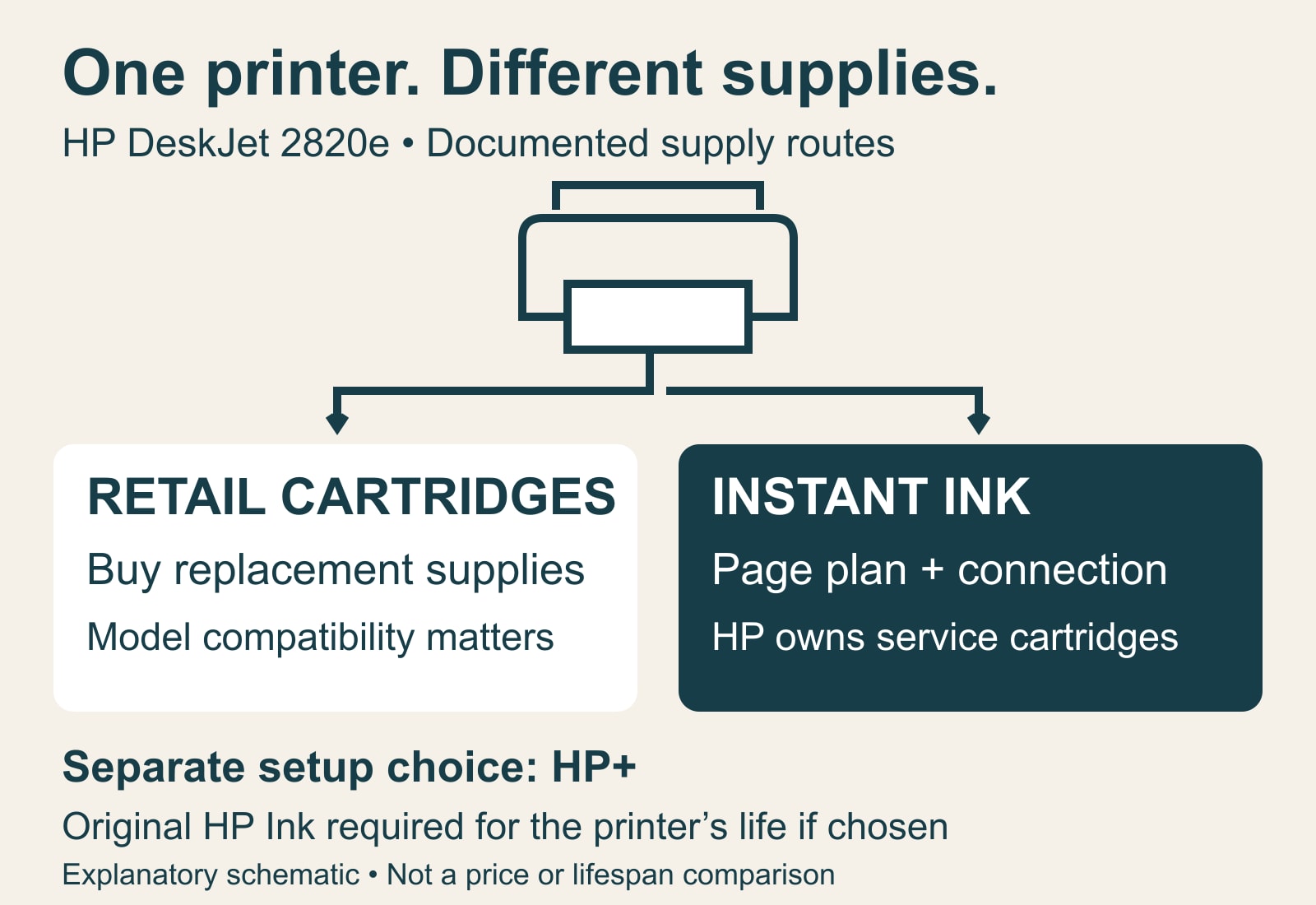
HP sells a conventional replacement cartridge, the HP 305 Black Original Ink Cartridge, which lists the 2820e among its compatible printers. The printer’s own specifications list the other standard and XL replacements. Buying cartridges is therefore a documented supply route for this machine, not a workaround invented by frustrated owners.
This is an important counterweight to the idea that a cheap printer necessarily means a compulsory ink subscription. The machine and a particular replenishment service are not the same purchase.
It also changes the comparison. If someone is deciding whether an ink service suits them, the alternative may be the printer they already have with ordinary replacement cartridges—not buying another printer, abandoning home printing or assuming that every third-party product will work.
There is no winner hidden in that distinction. It simply puts the right alternatives on the table before anyone starts multiplying monthly payments.
What is the subscription actually supplying?
HP describes Instant Ink in its US explanatory glossary as a page-based service with automatic supply delivery: the connected printer reports when supplies are running low. This explains the service’s proposition, not Irish prices or eligibility.
The attraction is understandable. Someone may value not having to identify, order and keep track of replacement cartridges. That is a practical benefit, even before the question of cost is answered. Choosing convenience does not make a household careless with money.
But the unit being bought has changed. A cartridge purchase concerns a physical supply. A page plan concerns an allowance under a service arrangement. Comparing them requires more than putting their two prices beside each other.
The Irish Instant Ink terms, last updated November 2025, say subscribers pay for a page allowance rather than purchasing cartridges. HP retains ownership of subscription cartridges. Any amount of printing counts as a page; printing both sides counts as two. Additional pages are charged in blocks under the chosen plan.
The same terms require internet connectivity for uninterrupted service. If disconnected, subscription cartridges are disabled while service charges continue. Delivered subscription cartridges are also disabled when the service is cancelled; ordinary replacements provide a route to continued printing. There is a qualification for in-box cartridges converted on activation: if not depleted, they may still be able to revert to their in-box status after cancellation.
An ink-filled cartridge can therefore be physically present without being an independently purchased reserve of usable ink. That is the distinction worth understanding before relying on it as a spare.
It is not the same as saying that the whole printer becomes useless. The documented replacement route matters just as much as the restriction.
A second choice has a different timescale
There is another label to separate from Instant Ink: HP+.
On the Irish 2820e product page, HP says the printer is HP+ enabled and that customers choose HP+ at setup. Its stated requirements include an HP account, an ongoing internet connection and exclusive use of Original HP Ink cartridges for the life of the printer.
That is not simply another name for a monthly ink allowance. The household is looking at a setup choice with a supply condition expressed over the printer’s life, alongside a service with its own charging and cancellation terms.
This is where treating all the branding as one bundle can obscure the decision. Ending one arrangement does not mean that every other condition disappears. Conversely, seeing a compatible model advertised with a service does not prove that the service is compulsory.
Compatibility needs its own care, too. HP’s page identifies the 2820e as dynamically secured: it describes blocking cartridges with modified or non-HP circuitry, while allowing reused HP circuitry in reused, remanufactured and refilled cartridges. It also warns that firmware updates can block cartridges that previously worked. That is a model-specific restriction, not a basis for saying that all third-party ink is banned on every HP printer.
The physical shape of a cartridge is only one part of whether it is a usable replacement. The identified model and the arrangements selected for it matter as well.
A low entry price can still be the right choice
None of this proves that the inexpensive machine is the wrong purchase.
A household with an immediate document to print and a tight upfront budget faces a different decision from one replacing a heavily used printer. Having less cash available today is not the same as failing to understand future costs. Nor does a higher purchase price automatically establish better long-term value.
What matters is whether the future supply arrangement fits the job the machine is being bought to do. For someone buying ordinary cartridges, that means identifying actual compatible replacements and their prices. For someone considering a service, it means matching the plan’s units and conditions to the printing they genuinely expect—not treating ink delivered to the house as an owned stockpile.
Even a neat cost-per-page sum needs the right label. A calculation using declared cartridge yield is an estimate built on that yield, not a household test. A plan allowance is not a guarantee that the household will use every included page. Neither becomes a lifetime ownership cost merely because it has been multiplied by several years.
There are other costs and uncertainties a personal comparison might need: paper, the purchase price, replacement supplies, any chosen service and how long the machine remains useful. This article does not assign them invented values or assume a lifespan. A precise-looking total would not become more honest by filling those gaps with guesses.
The point is not to make an everyday purchase impossibly complicated. It is to discover which questions the first number cannot answer.
The €59.99 on the listing describes a machine at the start of the relationship. The more revealing story follows the things it needs afterwards: what they are, how they are obtained and what must remain true for them to work.
Sources and scope
This is an explanation of public product information and supply terms, not a printer review, a finding of misleading advertising or an estimate of a household’s savings. The price and sold-out status were observed on DID’s listing on 3 November 2026. Model details come from HP’s Irish product and specification pages; service conditions come from its Irish Instant Ink agreement. The US glossary is used only to explain the delivery proposition. Offers, prices and terms can change; an individual purchase needs its own current documents.