A book can be too interesting for an ordinary box.
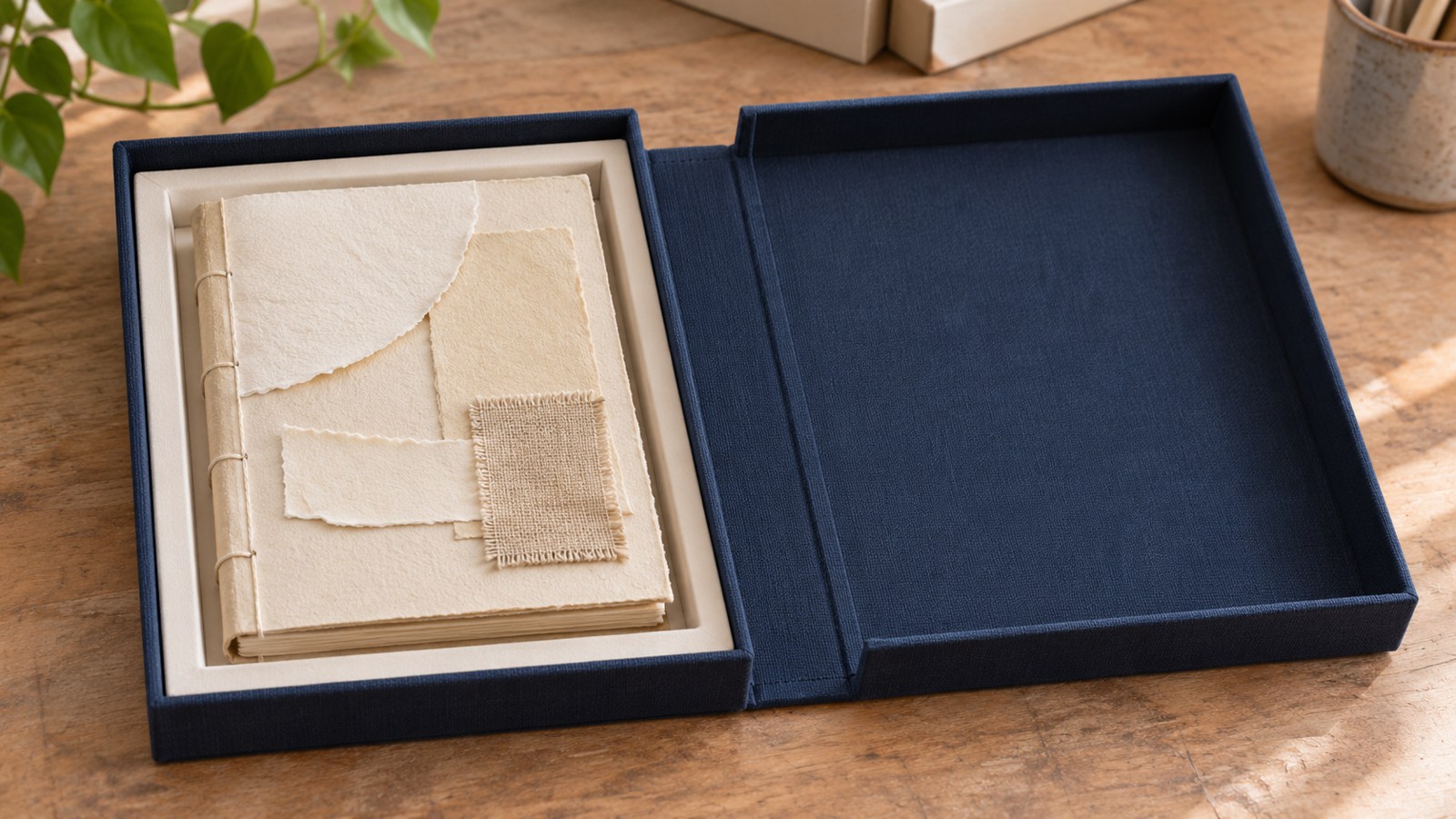
A raised piece of fabric, a wooden element or an uneven cover can make the familiar act of putting a book on a shelf unexpectedly complicated. Making the book flatter would defeat the point. Leaving it loose inside a large empty box would not solve the whole problem either.
The feature worth keeping created the storage problem
In a December 2024 Library of Congress account, conservation intern Ron Martin-Dent describes work on artist books, including those published by Ediciones Vigía in Cuba. Found materials were part of what made the books distinctive—and difficult to house.
The project involved removable supports inside clamshell boxes. Martin-Dent describes trying layered cardboard inserts, then folded structures, before adapting a foam-core approach after a colleague’s example. The early versions could function while still being heavy, time-consuming or awkward to adjust. The problem was not simply to close a lid: it was to keep unusually shaped objects supported when the boxes moved.
That is a useful change in perspective. The book’s irregularity was not a fault to erase. The surrounding structure had to accommodate the thing the collection was trying to preserve.
A container and a support have different jobs
Think of a book in a roomy carton. The outside may fit comfortably on a shelf, yet the contents can still move within it. Now imagine the opposite: a tight space that holds the book firmly but bears against a raised part of its cover. A tidy exterior is not enough to tell us that either arrangement suits the object.
These are illustrative comparisons, not instructions to construct an enclosure. They separate two questions. What surrounds the object? And what touches, supports or restrains it inside?
The Northeast Document Conservation Center’s enclosure guidance discusses both traditional drop-spine or clamshell boxes and corrugated clamshell boxes. It treats fit, construction and appropriate materials as part of the protection, rather than recommending any box that happens to close.
The hinge matters because it changes access. A clamshell-style enclosure can open out around an object. That is a different encounter from pulling a book through the narrow end of a sleeve. Neither shape proves that a particular enclosure is appropriate; it gives the designer a different way to approach the object.
A slipcase is not the same answer
The Canadian Conservation Institute distinguishes slipcases from boxes. It notes that a slipcase can suit a book in good condition, while fragile or badly damaged books are more appropriately housed in a box. A slipcase leaves the spine visible, so it does not provide the same protection from light as a fully enclosing box.
NEDCC takes a stricter position on slipcases: it warns that sliding books in and out can abrade bindings, as well as leaving spines exposed to light. The difference between these published recommendations is a reason to consider the actual book and seek suitable advice, rather than treating an attractive enclosure as a universal answer.
That visible spine can be desirable in one setting. In another, the exposure is precisely what the enclosure should reduce. The choice is a trade-off about the object and its use, not a ranking in which one handsome form is always best.
The institute also describes enclosures as a way to keep detached pieces with an object. That is easy to overlook if a box is judged only as packaging. Association is part of preservation: a loose fragment separated from its book can lose the connection that explains it.
Protection is not the same as repair
A new enclosure does not automatically repair a binding, identify every unstable material or reverse earlier damage. It changes the conditions around the object. Those are valuable changes, but they should not be described as a cure for everything inside.
The Library of Congress project is particularly interesting because its author discusses working solutions that were still imperfect to make. A support could do its immediate job and still call for a better construction method. The final design problem included the people making the enclosures as well as the books using them.
There is no universal recipe hidden in that account. An unusual artist book and a family volume with a damaged binding may need different assessments. A photograph cannot establish whether a board, adhesive, foam or lining is suitable for a particular object. This article explains a design problem; it does not replace a conservator’s examination.
The box has to allow the book to be used
A collection is not only a group of things kept out of reach. Its objects may need to be retrieved, examined and returned. An enclosure that protects an object while shut must also make sense when somebody opens it.
That is why the removable support is such an important detail in the documented project. It sits between storage and access. The support is not the art, but it affects how safely the art can be approached.
We usually expect packaging to make different objects behave like standard units. Here the more interesting design does the reverse: it makes room for an object to remain unusual. The box succeeds by refusing to demand that every book become the same shape.
Sources: the Library of Congress’s first-person project account, NEDCC’s protective-enclosure guidance and the Canadian Conservation Institute’s enclosure note are linked above. Generic comparisons and the illustration explain the design relationship; no conservation treatment or materials test was performed by Time for Designs.