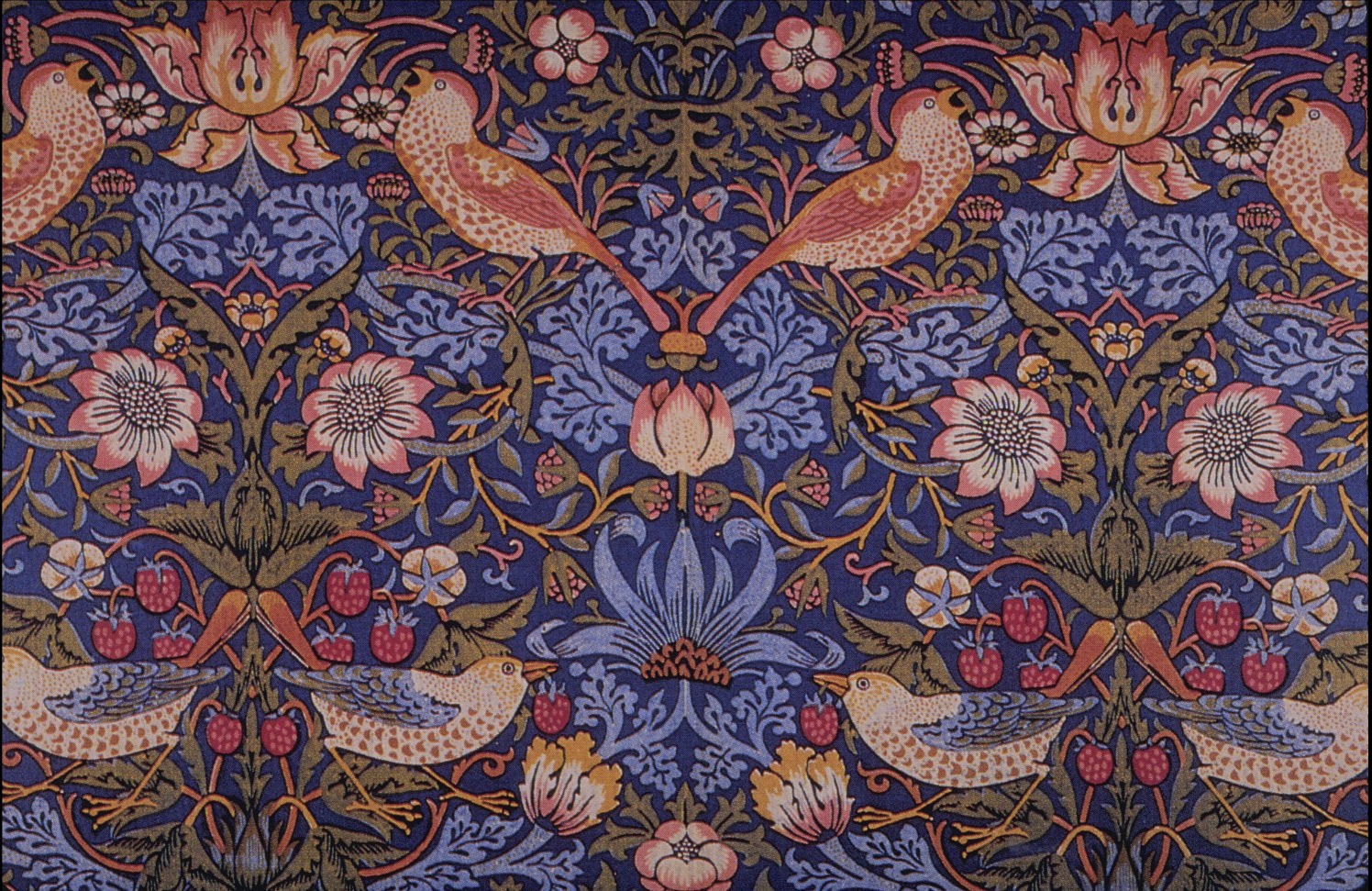
Two birds face one another among strawberries, flowers and curling leaves. The pattern is recognisable before the small print is read. But the small print can change what we think we recognise.
In a museum shop, an old pattern can become a notebook, a mug, a card or a bag. That is a new object with a new use. The familiar name attached to it may refer to a designer, a family, a company or a wider collection. Those meanings can overlap without being identical.

A collection heading is a doorway
The V&A’s William Morris shop collection is a useful place to notice the distinction. When checked for this article, its listings included William Morris notecards, a May Morris Arcadia T-shirt and a John Henry Dearle Oak Tree mug. Different names were visible within the same wider range.
That does not mean a collection heading is a mistake. A shop needs a recognisable way into a large selection. A visitor who knows one famous name can use it as a starting point. The trouble begins only if we stop there and assume that everything behind the heading was designed by the same hand.
Read the individual product name, then follow the named design or maker into the collection record. The shop and the museum catalogue answer related but different questions: what can I take home, and what exactly am I looking at?
The company style could outlive one person’s drawings
A particularly revealing example sits in the Metropolitan Museum of Art’s record for Compton. The 1896 wallpaper was once believed to be William Morris’s last design. The museum now identifies John Henry Dearle as its designer.
The record preserves more than one role. It names Dearle as designer, William Morris as approving the design, Morris & Company as manufacturer and Jeffrey & Co. as printer. Its account describes the pattern as a clear example of the company style. This is a record about the wallpaper; it is not a claim about who manufactured a modern shop product.
That is a richer story than replacing one famous signature with another. An object could belong to a recognisable design language while carrying the work of several people and organisations. Approval, design, manufacturing and printing are not interchangeable credits.
The distinction also changes how we look. Similarity can help us recognise a style, but it cannot settle authorship by itself. A flowing arrangement of flowers may feel unmistakably “Morris” and still require a more precise account of who drew, approved and produced that particular design.
May Morris belongs in the story in her own right
May Morris should not appear merely as a family footnote. The Ashmolean’s account of her work presents her as a designer and maker and draws attention to its collection of her drawings and patterns. It identifies her as the younger daughter of William and Jane Morris, while giving her creative work its own space.
That combination matters: a family connection is context, not a substitute for a maker’s identity. Looking for May’s name leads to a different body of work than treating every occurrence of “Morris” as shorthand for William.
The V&A’s own Morris collection overview makes room for collaborators and for work beyond wallpaper and textiles, including furniture, tiles and publishing design. A famous pattern is an invitation into that wider network, rather than a complete summary of it.
A pattern changes when it becomes an object
There is another translation after attribution. A textile pattern can continue across a broad surface. A postcard has an edge. A mug has a curve, a handle and a side that turns away. A notebook has a fold and a spine.
Those are observations about the forms, not reports of a product test. They explain why applying a design is more than dropping an image onto a rectangle. Scale decides whether we notice one bird or the repeating structure. A crop can preserve a motif while hiding its relationship to its neighbours. A seam can interrupt a line that looked continuous on the original surface.
A thoughtful product can therefore be both recognisable and different. Its success as an adaptation is a question to examine in the actual object, not something established merely by the age or fame of its source.
The object can send us back to the collection
The V&A describes its shops as offering collection-inspired objects and says purchases support the museum. That is the institution’s account of the relationship; a product listing alone does not tell us sales, profit or a buyer’s later engagement with the collection.
What we can see is the opportunity for a two-way journey. A museum object can inspire something used every day. That new object can also prompt a question about the older design, its makers and its original purpose.
The most interesting souvenir may be the one that makes its owner look again. The birds bring us in. The names, materials and records give us a reason to stay.
Sources: the V&A’s current collection and shop pages, the Met’s Compton record and the Ashmolean’s May Morris account are linked beside the claims they support. Product listings were checked on 6 November 2026 and can change. Interpretation of scale and object form is Time for Designs’ editorial analysis.