
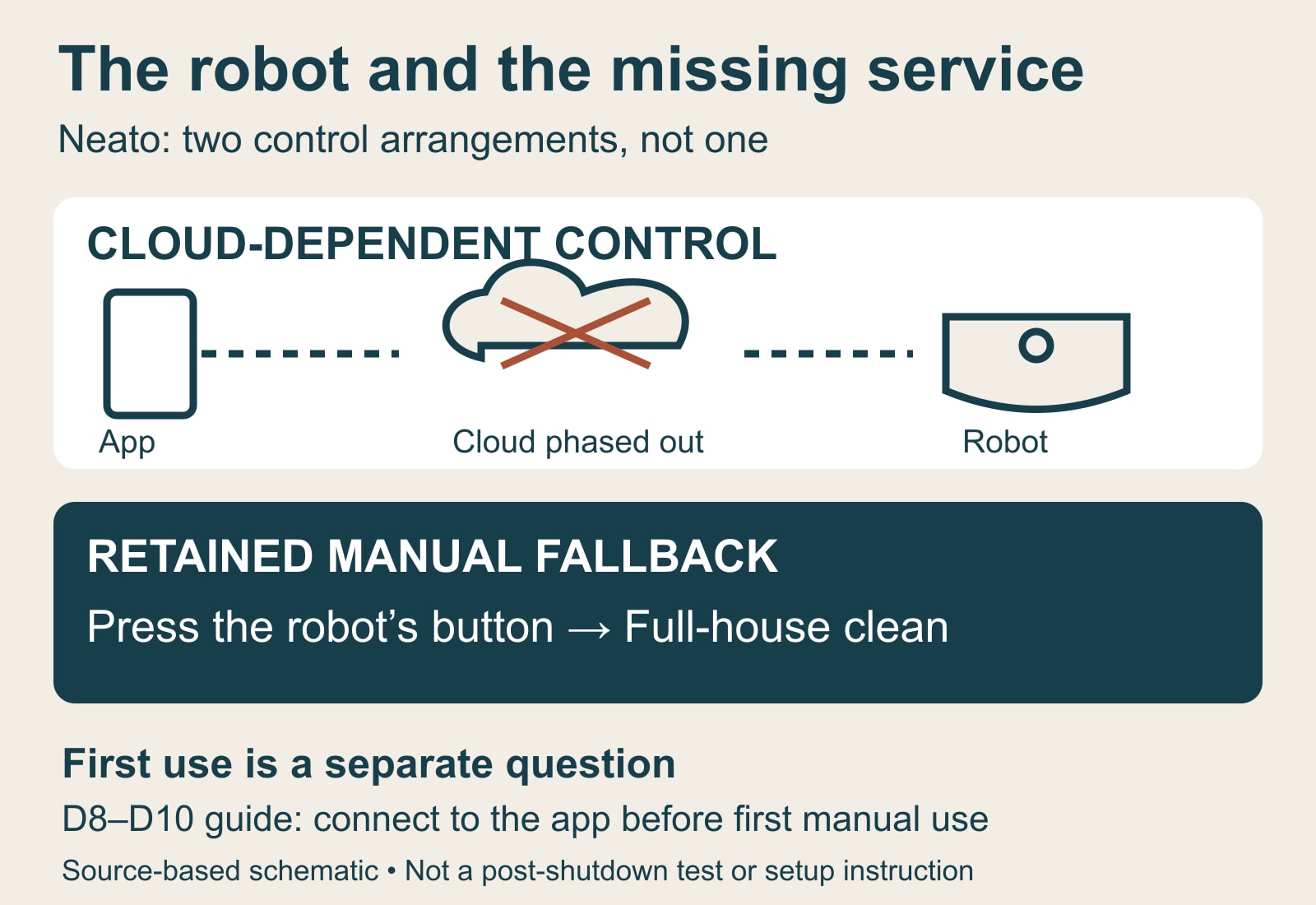
Press the button once and the robot starts a full-house clean.
That is the fallback described in Neato’s announcement of 6 October 2025, which said its cloud services were being phased out. The machine was not described as scrap. The company said manual operation would remain and manufacturer warranty commitments were intact.
It is a reassuring statement, but it answers a narrower question than it first appears to. Can the robot still clean? According to the notice, yes. Does that mean the household still has the same arrangement for getting the cleaning done? That is a different question.
A button on an appliance is easy to locate. A service dependency is less tangible. You cannot see it wearing out beside a brush or a wheel. Yet it can help determine whether the machine carries out a routine in the background or needs someone to organise its next run.
The Neato story is not a simple choice between a working product and a useless one. Its interest lies in the space between them.
Cleaning the floor and arranging the cleaning
The distinction is visible in the manufacturer’s own instructions.
The D8, D9 and D10 user guide describes maps and No-Go Zones in the MyNeato app, along with routines for cleaning on chosen days and times. It also describes a manual room clean: place the robot in the room, start it and close the door; afterwards, return it to the charging base.
These are different ways of arranging work, not merely different pictures of the same start button. A routine concerns when cleaning happens. A map and a boundary concern how an area is represented and selected. Carrying the machine into a room and closing a door uses the person and the building to define the immediate job.
The manual method can be useful. It should not be belittled because it involves a person. But usefulness is not the same as equivalence. Someone who bought automation to reduce the number of small tasks they must remember may reasonably distinguish a cleaner they start from a cleaning routine they set up once.
That does not establish the outcome for every owner or every model. It explains why continuing mechanical operation cannot, by itself, prove that the original convenience has survived unchanged.
The first run is a separate question
There is a qualification in the D8–D10 guide that deserves particular attention. In its manual-operation section, it says the robot must be connected to the MyNeato app before manual cleaning is used for the first time.
That changes what an old instruction book can establish today. It describes the intended operating sequence when written. It is not a promise that an unused, reset or second-hand unit can now complete every setup step without the discontinued service. Nor does it establish that all such units fail: model, existing setup and software state would need their own evidence.
An already configured robot continuing a button-started clean and an unconfigured robot being brought into use are different situations. They should not be collapsed into the same assurance.
This is particularly important when a household is trying to keep a machine rather than replace it. “It still works manually” is valuable information, but the next question is whether that statement applies to the particular machine in front of them. A general shutdown notice cannot substitute for checking its state.
The manual also prevents another overstatement. Losing an app connection is not evidence that a robot has lost every form of navigation inside its own hardware. Cloud functions, local navigation and basic movement are not interchangeable descriptions of one capability.
A different dashboard does not necessarily remove the dependency
It is tempting to assume that another smart-home interface can preserve the missing arrangement. The software might run at home, so surely the control stays at home too?
Home Assistant’s Neato integration documentation shows why the location of the dashboard is not enough. It says the Neato Developer Network is no longer available, new credentials cannot be created and the integration cannot be set up as a new installation. Its warning says existing setups may continue until the cloud is fully shut down. The integration is classified as cloud polling.
The project’s alert dated 20 October 2025 is more direct about that dependency: after the cloud shutdown, its integration would no longer be able to control Neato devices.
Those are the maintainers’ statements about this integration, not proof that every imaginable alternative is impossible. They do not establish that a particular modification is safe, supported or suitable for someone’s appliance either.
The narrower lesson is substantial enough. A local-looking control panel can still depend on a remote service. Adding another interface does not necessarily move the underlying capability into the household’s possession.
That is why the service boundary matters more than the word “smart”. Where does a command have to travel? Which part still answers when the original provider stops answering? These questions describe the arrangement more clearly than an app icon does.
The company’s explanation is part of the story
Neato’s shutdown announcement said the business had ceased operations in 2023 and acknowledged an earlier five-year cloud-service commitment. It attributed the phaseout to changes in cybersecurity standards, compliance obligations and regulatory frameworks, saying the existing infrastructure could no longer be maintained reliably and in a future-proof way.
That is the company’s explanation, not an independent finding that shutdown was technically unavoidable or legally required. Its notice also said other Vorwerk products and services were unaffected. The case should not be turned into an allegation about every connected appliance the group sells.
The distinction between an explanation and a verified necessity matters. Readers can understand the stated reason without being asked to accept a conclusion that the evidence here does not establish.
There was also regulatory scrutiny. Italy’s competition authority announced an investigation on 23 April 2026 into Vorwerk Management and Vorwerk Italia concerning the shutdown. That announcement opened an investigation; it was not a final finding of wrongdoing. This article does not treat it as one or make a claim about the proceeding’s current outcome.
The later exchange offer changes the ending
Stopping at the shutdown would leave out a material development.
In its European exchange-programme notice, Vorwerk says customers in Europe who bought a Neato robot since May 2023 and actively used its cloud features can receive a current Kobold VR7 without charge in exchange for their Neato. The notice directs customers to Neato support to check eligibility.
Those conditions matter. This is not an offer to every person who has ever owned a Neato, and it is not a cash refund or a restoration of the old cloud platform. An individual customer’s eligibility has not been checked here. Vorwerk describes the programme as voluntary; that description does not decide anyone’s statutory rights.
For a household that qualifies, an exchange could answer a practical replacement question. For someone outside the stated group, the existence of the programme does not itself resolve what their old machine can still do.
Both facts belong in the story: there is a manufacturer response beyond the manual fallback, and that response has a defined scope.
The household owns more than one kind of useful life
An appliance can have a mechanical life, a supported-service life and a useful life in a particular home. They may overlap without ending together.
This is not a reason to dismiss connected products or the people who buy them. Automation may be precisely the feature someone needs. A service can provide real convenience while it operates. The question is what remains when that arrangement changes—and whether what remains still fits the job.
For household costs, that distinction is more useful than inventing a replacement bill. A working manual fallback might let one owner keep using a machine. Another may need the functions around which their routine was built. Without knowing the appliance’s condition, the household’s needs or any exchange eligibility, a confident savings total would be fiction.
The Neato case leaves a more concrete question to carry into the next purchase. Not just “Does it work without the app?” but “Which jobs remain, can it still be set up, and who has to do the arranging afterwards?”
The button tells us that some cleaning can remain. It does not tell us that nothing important has changed.
Sources and scope
This story follows the manufacturer’s shutdown and exchange notices, the D8–D10 operating guide and Home Assistant’s documentation for its own integration. The guide describes the original operating arrangements, not a post-shutdown test. No individual robot, account, firmware version or exchange application was tested. There is no recommendation to reset, modify or discard a machine, and no finding about a company’s intent or legal liability. Public sources were checked on 6 November 2026; individual support and eligibility information should be checked against the relevant current documents.