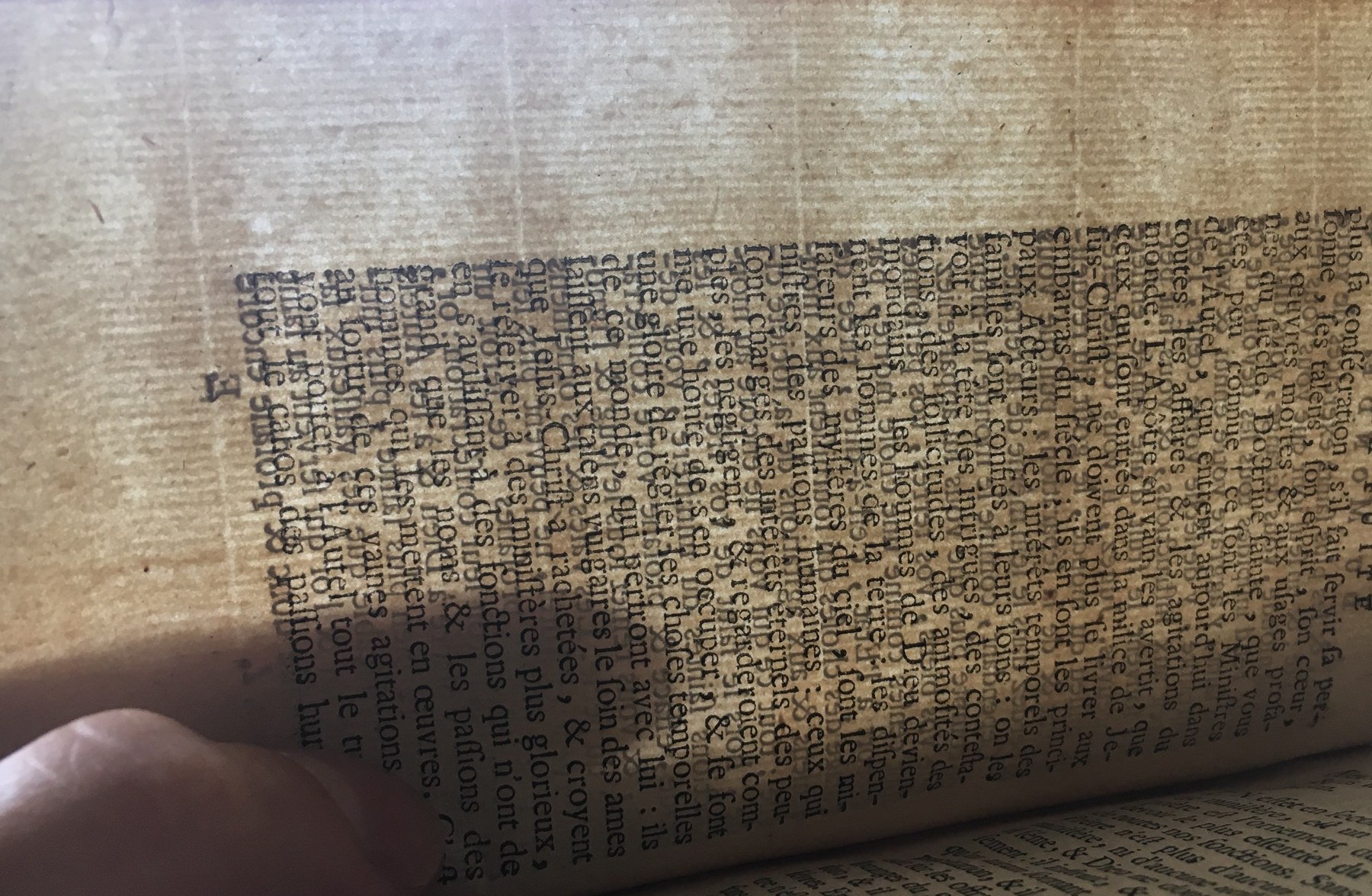

Hold a suitable old sheet towards the light and another pattern can appear behind the writing. Fine lines run close together. Wider lines cross them. They belong to the paper, not to the words printed on it.
These are clues to the surface on which a wet sheet formed. In laid paper, the papermaker’s equipment left a pattern that can remain visible long after the sheet became a page.
Reading that pattern means looking past the printed message to the material carrying it. It also means keeping three different things apart: lines left by a mould, fibre direction and evidence of age.
The screen came before the sheet
Princeton University Library’s account of laid and wove paper explains the hand process through moulds in its Graphic Arts Collection. Fibres dispersed in water settled onto a wire screen as water drained away; the resulting sheet was then worked and dried.
A traditional laid mould has closely spaced wires crossed by more widely spaced chain wires. Their arrangement can become visible in the sheet when it is held against light. The close lines are laid lines; the crossing pattern supplies the chain lines.
The essential sequence is easy to miss when looking at a finished book. The patterned surface was there first. The wet fibres formed against it. Printing came later.
It is therefore possible to have two sets of lines in the same place for entirely different reasons: the printed letterforms carrying the text, and the sheet’s formation pattern behind them.
Why the broad lines can have shadows
In her Folger account of examining old paper, curator Erin Blake explains that paper is thinner where the pulp meets the wires. Light makes that difference visible.
She also describes a feature of antique laid paper: darker regions alongside the chain lines. The wooden ribs beneath the screen affected drainage, leaving a thicker accumulation nearby. A later mould arrangement introduced a gap that removed that effect.
The distinction is more specific than simply calling an old page rough. Surface texture, local thickness and transmitted light can disclose different parts of its manufacture.
In the photograph above, the broad shadows and close parallel pattern are part of the reason the sheet is worth looking at. The printed words do not have to describe papermaking for the page to preserve evidence of it.
A smooth-looking alternative has its own history
Wove paper is associated with a finer woven forming surface rather than the conspicuous laid-and-chain arrangement. But the historical transition should not be turned into an absolute rule that every sheet fits a perfect diagram.
An American Printing History Association report of Cathleen A. Baker’s research describes her examination of paper in Baskerville’s 1757 Virgil. It records both laid and wove sheets in the edition, and woven patterns accompanied by underlying chain lines and rib shadows.
The report explains experiments that reproduced those features by placing woven fabric over laid moulds. That is a reported material investigation into particular historical sheets, not a claim that every wove paper was made that way.
It is a useful complication. A concise definition helps someone recognise a pattern. An actual object can preserve a less tidy stage of development, when makers combined surfaces and methods.
The lines are not an arrow showing grain
A sheet’s visible formation pattern and its grain direction answer different questions. Paper grain describes fibre alignment and its relationship to the sheet and fold. Laid lines describe marks associated with the forming surface.
Seeing regular lines in a sheet should therefore not become a shortcut for deciding a modern print job’s fold direction. Nor does the pattern provide its weight or thickness. Those properties need their own specifications.
The useful comparison is between kinds of information. A mould pattern can tell something about how a sheet was formed. Grain concerns how fibres are predominantly oriented. Grammage describes mass per area. One observation cannot simply stand in for the others.
Old paper is not necessarily an old impression
Paper can also survive unused before something is printed on it. Blake’s Folger account discusses later impressions on older sheets and explains why a year in a watermark need not be the exact year of printing.
That is a reason to treat material clues as part of an investigation, rather than as an automatic certificate of authenticity. A page contains a sequence of events: making paper, storing or moving it, printing it, binding it and perhaps reusing it.
The photograph’s source filename includes a historical place and date, but those details have not been independently established here. The image is used to show the visible structure, not to date the text or authenticate a particular edition.
The satisfying discovery is smaller and more tangible. Before the page carried a sentence, it had already taken an impression from the papermaker’s screen. Light can make that earlier pattern readable again.
Sources and scope
The linked Princeton and Folger collection accounts explain the mould and sheet features. The Printing History report adds a specific material-research example. This is an introduction to looking at paper, not an authentication service or evidence that Time for Designs supplies a particular historic or modern laid stock.