
A personalised print list contains the fictional name “Oak, Fern”. After import, Oak and Fern appear in separate columns. Before removing punctuation from the approved name, check whether the comma was interpreted as part of the text or as a field separator.
A separator belongs to the file's structure. The comma in a name belongs to its content.
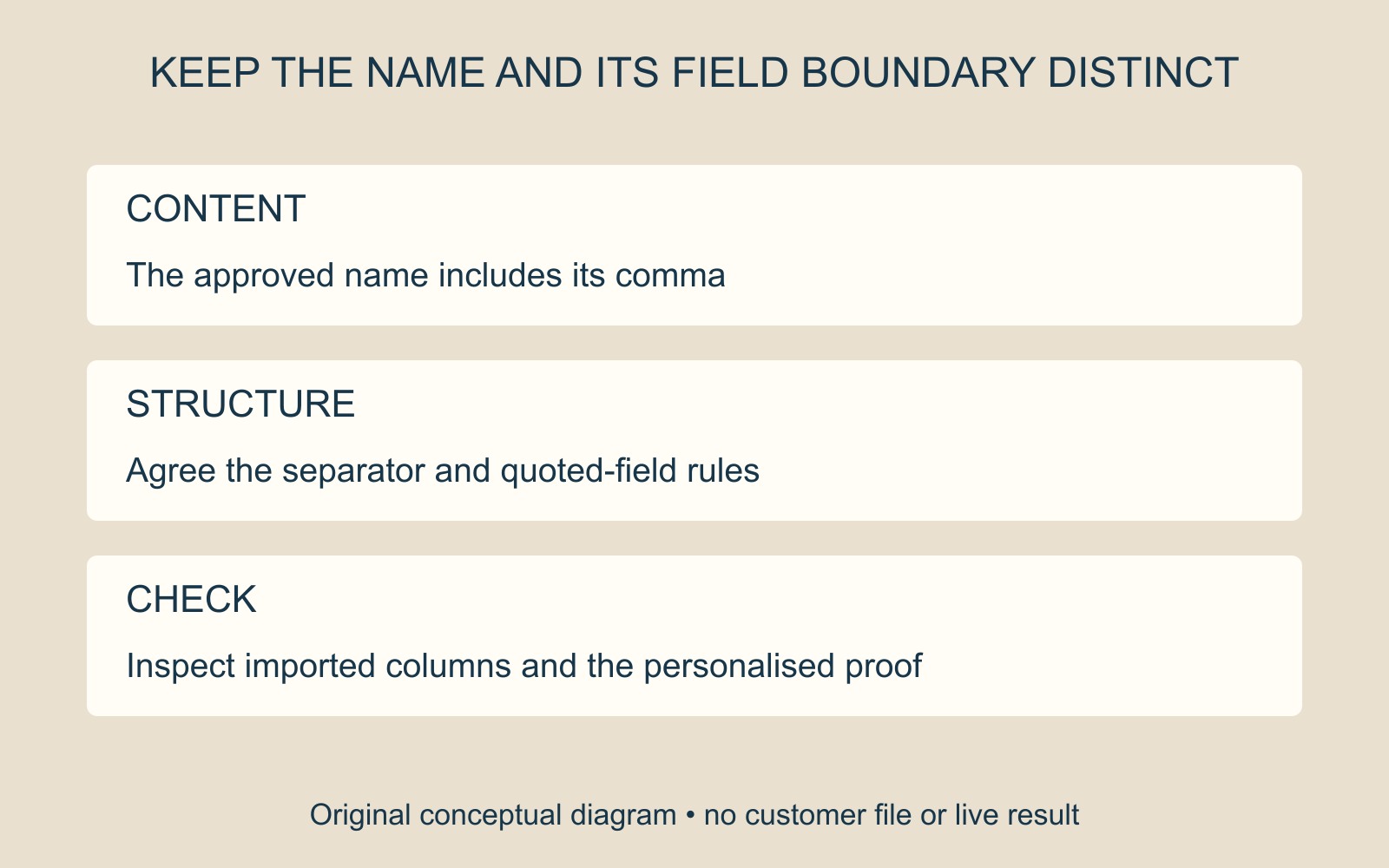
A quoted field can contain a comma
RFC 4180 documents a common CSV format in which commas separate fields and fields containing commas are enclosed in double quotes. It is an informational description, and it acknowledges differences between implementations.
For our fictional two-field record, "Oak, Fern",A7 represents the name as one quoted field followed by reference A7 under those rules. Without that enclosing boundary, the internal comma can be interpreted as another separator.
This is an explanatory text example, not an export template guaranteed to suit every recipient's software.
Agree the export and import rules
Ask which file format the person preparing the artwork can accept and which columns are required. Keep the original list and use the source application's appropriate export route rather than manually inserting or deleting punctuation across records.
If the imported columns disagree with the source, identify a specific affected record and compare both views with the person handling the import. The relevant question is where each field begins and ends, rather than whether the filename contains “CSV”.
Do not remove the approved comma from the name simply to hide a parsing problem. Likewise, an apparent extra column should not be silently discarded before its contents are understood.
Approve the resulting fields and proof
Inspect the imported name, reference and neighbouring columns before the data is used in artwork. Then inspect the actual personalised proof: a tidy source file does not establish that the right words reached the intended positions.
For a printing enquiry involving variable names, describe the intended wording and available source file. Agree the handover format before treating an imported list as production-ready.
Source: RFC 4180 linked above. All names and references are fictional; no customer list, import or print run was tested.